The Charity of Pope Pius XII by Eugenio Zolli |
From
Before the Dawn: Autobiographical Reflections by Eugenio Zolli, Former
Chief Rabbi of Rome
"Did you become a convert out of gratitude
toward the Pope, who did so much for the Jews of Italy during the Nazi
persecution?" This question was addressed to me, and still is, by
reporters. In many interviews (inaccurate or invented), they describe
me as answering in the affirmative. Why? I suppose to please readers by
providing them with a precise and pleasing explanation. In reality, my
reply has always been in the negative, but this ought not to be
interpreted as a lack of gratitude, and in fact in another book of mine
[1] I have emphasized the great charity of the Holy Father and my
admiration for him and his work.
As from the Cross of Christ, so from the Chair
of Peter, proceed spiritual rays that aim at reaching and illuminating
and doing good to all without distinction. One might say of the reign
of Plus XII that he is inspired by Isaiah's words: Peace is harmony,
peace is salvation, to those near, to those afar off. I want to heal
them all.
The Catholic Church loves all souls. She suffers
with all and for all; she awaits her children on the sacred threshold
of Peter with love, and her children are all men. Wisdom, in the
Proverbs of Solomon, invites all to her table. The Church, through her
visible Head, offers her love and truth and freedom to all. "You shall
know the truth and the truth shall make you free" (Jn 8:32).
Jesus Christ spoke of Himself as the "door";
and, again, He said: "Behold, I stand at the door and knock" (Rev
2:20). The Vicar of Christ wants all men to be within the sphere of
human and divine charity. Only charity makes men free. At the very hour
in which the terrible sacrificial rite of blood was initiated, the
destruction en masse in the name of race, of nation, of the state,
concentrating the three into one factor: "blood"--precisely then, in
the midst of so many fanatics, the great Pontiff, unique, serene and
wise, exclaims: "But the legitimate and just love toward one's own
country must not close the eyes to the universality of Christian
charity, which also considers others and their prosperity in the
pacifying light of love!"
There is no place of sorrow where the spirit of
love of Plus XII has not reached. Volumes could be written on the
multiform works of succour of Plus XII. The Catholic priesthood
throughout the whole world, religious men and women and the Catholic
laity, stand behind the great Pontiff Who could ever tell what has been
done? The rule of severe enclosure falls, every thing and all things
are at the service of charity. As the sufferings grow, so grows the
light from the heart of Christ, and from His Vicar; more vigilant and
ready for sacrifice and martyrdom are his sons and daughters in Christ.
Young Levites and white-haired priests, religious of all orders, in all
lands, dedicated Sisters, all in quest of good works and ready for
sacrifice. There are no barriers, no distinctions. All sufferers are
children of God in the eyes of the Church, children in Christ, for them
and with them all suffer and die. No hero in history has commanded such
an army; none is more militant, more fought against, none more heroic
than that conducted by Plus XII in the name of Christian charity.
An old priest who could do nothing further
gathered around him in the church the women and children of the village
(the men had been slaughtered outside the village) so that they might
die together in the presence of the crucifix. His dead body is thrown
upon the altar, where once he celebrated the Holy Sacrifice, and there
he lies, himself sacrificed. An army of priests works in cities and
small towns to provide bread for the persecuted and passports for the
fugitives. Sisters go into unheated canteens to give hospitality to
women refugees. Orphans of all nations and religions are gathered
together and cared for. No economic sacrifice is considered too great
to help the innocent to flee to foreign lands from those who seek their
death. A religious, a most learned man, works incessantly to save Jews,
and himself dies a martyr. Sisters endure hunger to feed the refugees.
Superiors go out in the night to meet strange soldiers who demand
victims. They manage, at the risk of their lives, to convey the
impression that they have none--they, who have several in their care.
The attic of one of the great churches in the
center of Rome is divided into many sections, each bearing the name of
the saint in whose honor the altar below is dedicated. The refugees are
divided for the distribution of food into groups according to the names
of these saints. Must not the soul of the saint rejoice in such a
tribute? Schools, administrative offices, churches, convents all have
their guests.
Pope Plus XII is followed by all with the fervor
of that charity that fears not death. No one asks for anything except
to follow in the footsteps of the Master under the guidance of Plus
XII.
--------------------------------------------------------------
The Truth of Pope Pacelli
A Look
at the Man Who Became Pius XII
By Elizabeth Lev
ROME, NOV. 27, 2008 - November in Rome offers
time for reflection, as the usual local exuberance is tempered by the
encroaching darkness of winter.
A new exhibit on the life of Pope Pius XII in
the Charlemagne wing of St. Peter's Basilica offers the possibility to
pilgrims, students and the simply curious to examine the multiple
facets of this Pope's remarkable life.
"Pius XII: The Man and the Pontificate" opened
on Nov. 6 and will remain until Dec. 5. It has no admission fee; all
are invited to come and learn more about this much maligned and
misunderstood Pontiff.
An impressive array of sponsors put the show
together, drawing on archives from Argentina, Hungary, Uruguay, Brazil,
France and Germany, as well as Vatican archival material. The Italian
state television RAI and Vatican Radio offered footage and recordings,
while scholars from all over the globe produced the astonishing
quantity of didactic material.
The first few displays introduce the visitors to
the young Roman boy, Eugenio Pacelli, born into a devout family of
successful professionals. Even as a youngster living near Piazza
Navona, he distinguished himself through his love of music and reading.
At eight years old, Eugenio began spiritual
direction with Father Giuseppe Laus of the Oratory of St. Philip Neri.
This connection with the Oratorians would fuel his spirit of
galvanizing the laypeople into preaching and living the Gospel in their
lives and actions.
Eugenio Pacelli soon entered the seminary and on
April 2, 1899, Easter Sunday, he was ordained a priest. A photograph
from that happy era shows light radiating on a high intelligent brow
and his direct gaze warmly engaging the viewer. Comparing this serene
and hopeful portrait with later pictures, underscores how much his
times and trials marked him.
Maturing
The exhibit is biographical, and traces the
various steps of Pacelli's life from his ordination as bishop in the
Sistine Chapel in 1917, his years as nuncio in Germany, his rise to
cardinal and election to the papacy. Scattered amid the chronological
narrative are some shimmering moments that bring out various facets of
the nuanced personality of Pope Pius XII.
A jeweled ring sitting in a glass case carries
an unusual history. It was Pacelli's bishop ring from his ordination to
the episcopate, which in 1958, he slipped off his own finger to give to
the neo-archbishop of Montreal. The ring was then given to Pope Paul VI
who returned it to the Pacelli family.
Also from the Pacelli family archives is a
letter written from Bishop Pacelli to his brother on Oct. 2, 1928,
imploring him to intercede to prevent him from being made cardinal and
"condemned to purely bureaucratic work in the congregations."
Bishop Pacelli begs to remain in Germany where
he can be of much greater assistance to the relationship between the
Church and Germany.
The German Catholics loved Eugenio Pacelli for
his galvanization of the faith among the laity. He strongly promoted
Katholiktag every year, when thousands of Catholics gathered together
to affirm their identity and pray.
Undoubtedly many of the connections forged in
those days became crucial to the network of Christians helping refugees
during the era of Hitler.
Photographs record Bishop Pacelli's visits to
prison camps to ensure better treatment for prisoners and the release
of the ill or infirm. Eugenio Pacelli also set up the Ufficio
Informativo Vaticano to let families know the whereabouts of prisoners
of war.
Another picture shows the bishop in miner's
gear, visiting the mining camps to learn about the conditions of
workers.
Reaching out
Bishop Pacelli's ceaseless desire to learn about
all branches of human activity brought him to converse with Einstein,
while another photo has him standing with Gugliermo Marconi, inventor
of the radio.
Marconi would oversee the design of Vatican
Radio and Pope Pius XII would embrace the invention, delighting in the
ability to reach more and more people throughout the world.
As his mission became increasingly universal,
Pacelli studied constantly to keep up with the developments of the
modern age. Health workers, scientists and philosophers were all amazed
by the versatility and depth of his knowledge.
Eugenio Pacelli was elected Pope in 1939 just as
the situation in Germany was rapidly deteriorating. The exhibition, in
its attempt to move beyond the malicious slander of Pius' alleged
collaboration with Hitler's regime, offers just a few telling photos,
such as Jewish refugees hidden in his summer home of Castel Gandolfo.
Sadly, it does not pause to present the
worldwide thanks and tributes offered to Pope Pius after the war by
Golda Meir and many others, long before the campaign of lies initiated
by the 1963 play "The Deputy."
"We are either with Christ or against Christ,"
announced Pope Pius XII in his Christmas message of 1947, prophetic
words which defined his own life.
His message and his example are sorely needed in
our times, but his words have been drowned out by the torrent of
falsehoods poured out from Eastern Europe and channeled through the
West.
Emerging from the Charlemagne wing after
pondering the extraordinary life of Eugenio Pacelli, I hoped for a day
when Pope Pius XII would join the saints peopling the colonnade of St.
Peter's Square.
* * *
Elizabeth Lev teaches Christian art and
architecture at Duquense University's Italian campus. She can be
reached at lizlev@zenit.org.
-------------------------------------------------------
Pius XII Display Includes Rabbi Thank You
'44
Letter Recalls Jews Saved in Rome
ROME, NOV. 5, 2008 - A Pius XII display at the
Vatican exhibits a letter from a French rabbi thanking Pius XII and
Catholic priests for their aid to Jews during the Holocaust.
The letter from Rabbi André Zaoui, a
chaplain and captain of a French expeditionary force, was dated June
22, 1944. It is among the pieces in the "Pius XII: The Man and the
Pontificate" display, which opened to the public Tuesday and runs
through Jan. 6.
The rabbi notes how he attended a public
audience of the Pope on June 6, 1944, at 12:20 with "numerous allied
soldiers and officials."
He also mentions his visit to the Pius XI
Institute, "which protected for more than six months some 60 Jewish
children, among them some little refugees from France."
Zaoui wrote that he was impressed with the
"paternal solicitude of all the teachers," and recalled that the
prefect of studies affirmed, "We have done nothing more than our duty."
The rabbi recounts another event, of June 8,
1944: the reopening of the synagogue of Rome, which had been closed by
the Nazis in October, 1943.
He spoke of the presence of a priest, Father
Benoit, a "French fugitive" who dedicated himself "to the service of
the Jewish families of Rome." He recalled the impression made on him by
the words of the priest: "I love the Jews with all my heart."
Zaoui affirmed his gratitude, saying, "Israel
will never forget."
This letter is also reproduced in the catalogue
of the display, published by the Vatican Publishing House. In the
catalogue, Benedict XVI's secretary of state, Cardinal Tarcisio
Bertone, highlights the importance of the exhibit, saying that "it
makes better known a Pontiff who is justly recognized as one of the
greatest personalities of the 20th century."
The cardinal thanks those who made the exhibit
possible, and expresses his hope that it "brings people, especially
young generations, to appreciate the extraordinary figure of this Pope,
who knew how to prepare, with prophetic intuition into the signs of the
times, the path of the Church during his time."
The display aims to present Pius XII's
personality, ranging from his love for animals -- with photographs of
him with a canary and some lambs; his fascination for modern inventions
-- with his electric razor and his typewriter; his concern for the
needy -- with photos of mattresses set up even on the steps of the
Apostolic Palace for World War II refugees; his love for art -- noting
the concert from the Philharmonic Orchestra of Israel on May 25, 1955,
as a sign of gratitude for his work in favor of the Jews; to his
repeated interventions during the war.
--------------------------------------------------------------------------------------------
Pius XII Saw "Miracle of the Sun"
Handwritten
Note Reveals Pope's Experience
By Antonio Gaspari
ROME, NOV. 4, 2008- According to his own
testimony, the Pope who declared the dogma of the Assumption saw the
"miracle of the sun" four times.
This information is confirmed by a handwritten,
unpublished note from Pope Pius XII, which is part of the "Pius XII:
The Man and the Pontificate" display. The display opened in the Vatican
to the public today and will run through Jan. 6.
A commissioner of the display and a Vatican
reporter for the Italian daily Il Giornale, Andrea Tornielli, explained
to ZENIT that the note was found in the Pacelli family archives. It
describes the "miracle of the sun," an episode that until today had
only been affirmed by the indirect testimony of Cardinal Federico
Tedeschini (1873-1959), who recounted in a homily that the Holy Father
had seen the miracle.
Pius XII wrote, "I have seen the 'miracle of the
sun,' this is the pure truth."
The miracle of the sun is most known as the
episode that occurred in Fatima, Portugal, on Oct. 13, 1917. According
to the Fatima visionaries, Mary had said there would be a miracle that
day so that people would come to believe. Thousands had gathered at the
site of the visions, and the sun "danced," reportedly drying
instantaneously the rain-soaked land and spectators.
Confirming the dogma
Pius XII's note says that he saw the miracle in
the year he was to proclaim the dogma of the Assumption, 1950, while he
walked in the Vatican Gardens.
He said he saw the phenomenon various times,
considering it a confirmation of his plan to declare the dogma.
The papal note says that at 4 p.m. on Oct. 30,
1950, during his "habitual walk in the Vatican Gardens, reading and
studying," having arrived to the statue of Our Lady of Lourdes, "toward
the top of the hill […] I was awestruck by a phenomenon that before now
I had never seen."
"The sun, which was still quite high, looked
like a pale, opaque sphere, entirely surrounded by a luminous circle,"
he recounted. And one could look at the sun, "without the slightest
bother. There was a very light little cloud in front of it."
The Holy Father's note goes on to describe "the
opaque sphere" that "moved outward slightly, either spinning, or moving
from left to right and vice versa. But within the sphere, you could see
marked movements with total clarity and without interruption."
Pius XII said he saw the same phenomenon "the
31st of October and Nov. 1, the day of the definition of the dogma of
the Assumption, and then again Nov. 8, and after that, no more."
The Pope acknowledged that on other days at
about the same hour, he tried to see if the phenomenon would be
repeated, "but in vain -- I couldn't fix my gaze [on the sun] for even
an instant; my eyes would be dazzled."
Pius XII spoke about the incident with a few
cardinals and close collaborators, such that Sister Pascalina Lehnert,
the nun in charge of the papal apartments, declared that "Pius XII was
very convinced of the reality of the extraordinary phenomenon, which he
had seen on four occasions."
Son of Our Lady
Tornielli told ZENIT that there was always a
close link between the life of Eugenio Pacelli and the mystery of the
Virgin Mary.
"Since childhood," he said, "Eugenio Pacelli was
devoted [to Our Lady] and was registered in the Congregation of the
Assumption, which had a chapel close to the Church of Jesus. A devotion
that seemed prophetic, since he would be precisely the one to declare
the dogma of the Assumption in 1950."
The future Pope celebrated his first Mass on
April 3, 1899, at the altar of the icon of Mary "Salus Populi Romani"
in the Basilica of St. Mary Major. "And then," Tornielli continued,
"Eugenio Pacelli received episcopal ordination from Pope Benedict XV in
the Sistine Chapel on May 13, 1917, the day of the first apparition of
the Virgin of Fatima."
As Pope, in 1940, he approved the Fatima
apparitions, and in 1942, consecrated the entire world to the
Immaculate Heart of Mary.
As well, Pius XII often spoke with Sister Lucia,
the visionary of Fatima, and he asked her to transcribe the messages
she received from the Virgin. He thus became the first Pope to know the
"third secret of Fatima," which Pope John Paul II would later make
public.
---------------------------------------------------------------------------------
Myth and Lies
Last Oct. 9, the Church offered a magisterial example of the virtue of
gratitude while remembering the 50th anniversary of the death of Pope
Pius XII, one of the unsung heroes of the 20th century.
The life of Pius XII seems to have certain parallels with this summer's
blockbuster film "The Dark Knight." The hero, Batman, out of love for
his fellow citizens, must sacrifice recognition for his relentless
battle against evil and ultimately endure persecution by the very
people he is protecting.
Pius XII, who reigned from 1939 to 1958, spanning the years of the
Second World War, was universally lauded for his wartime efforts after
the defeat of the Nazis. But revisionists of many stripes in the late
20th century have competed with one another to besmirch his name,
culminating in the scandalous label -- or libel -- of John Cornwall's
"Hitler's Pope."
Obscured by the flood of false accusations, from criminal silence
regarding the fate of the Jews in Germany to active participation in
their persecution, the brilliantly innovative aspects of this
pontificate have been completely neglected.
But the tables recently turned for Pius XII as, in the words of Vatican
reporter John Allen, Benedict XVI initiated a "full court press" to
redeem the name of this great Pope and push forward the cause for his
beatification.
An international symposium was held in Rome last September under the
auspices of the Pave the Way foundation in order to shed light on the
activities of Pius XII in favor of the Jews during World War II.
This organization was founded by an American Jew, Gary Krupp, who
believes that in order to create a fruitful dialogue among religions,
the accusations regarding Pius XII, a source "of friction between
people," must be laid to rest through the discovery of the truth.
Among the findings of the conference was that those who "lived through
the brutality of the Nazis and were saved by the church's actions" had
a high opinion of the Pope. The Israeli Philharmonic orchestra asked to
play for Pope Pius in 1955, and at his death Israeli Foreign Minister
Golda Meir mourned "a great servant of peace."
Krupp noted that it has been the "subsequent generations born into the
safety of the defeat of the Nazi regime" who have bought into the myth
of the Pius XII as a Nazi collaborator.
During the three-day conference, the meticulous research of Sister
Margherita Marchione, Rabbi David Dalin, Andrea Tornielli, Ronald
Rychlak and many others was presented, refuting the spurious
accusations against the Pope and demonstrating his tremendous role in
saving Jewish lives.
Paolo Mieli, director of Italy's leading newspaper, "Corriere della
Sera," who happens to be a secular Jew, added another interesting point
in an interview published in L'Osservatore Romano when he noted that
the hostility toward Pius XII did not originate among the Jews.
It was an Eastern European playwright, Rolf Hochhuth, apparently backed
by the KGB, who started the ripple that turned into an earthquake with
his six-hour play "The Deputy," in which the playwright accused the
Pius XII of culpable silence regarding the persecution of the Jews.
The theatrical piece was quickly picked up by leftist promoters in
Paris and London and soon enough, Anglo-Saxon "scholars" hopped on the
bandwagon with bestselling books like "Hitler's Pope," "Papal Sin" and
"Under His Very Windows."
But when Pope Paul VI announced the opening of the beatification
process of both John XXIII and Pius XII in 1965, there were no
objections. The Pope's decision to jointly open the two processes was a
message of continuity within the Church.
The lies regarding Pius XII were welcomed and even abetted, however, by
those who wanted to create a division in the 20th-century Church by
drawing a line between the "good" John XXIII and the "bad" Pius XII,
and between the "old" Church and the "new" Church of the Second Vatican
Council.
But in this wonderful week, as Benedict XVI celebrated a Mass in honor
of his esteemed predecessor in a packed St. Peter's Basilica, a giant
step was taken toward putting to rest the fictitious legend and
honoring the great contributions of Pius XII.
Earlier in the day, the Pope's secretary of state Cardinal Tarcisio
Bertone wrote in L'Osservatore Romano of Pius XII's material assistance
to the Jews. He said that if Pius XII "had intervened publicly, he
would have endangered the lives of thousands of Jews who, at his
request, were hidden in the 155 convents and monasteries in the city of
Rome alone."
During his homily, Benedict XVI offered a refreshing new view of Pius
XII indicating "a great multitude of speeches, addresses and messages
delivered to scientists, doctors, and representatives of the most
varied categories of workers, some of which even today still possess an
extraordinary relevance and continue to be a concrete point of
reference."
The current Pontiff concluded with the thought: "As we pray the process
of beatification of servant of God Pius XII proceeds happily, it is
well to recall that holiness was his ideal, an ideal that he constantly
urged for all."
At last, a hero's welcome for Pope Pius XII.
--------------------------------------------------------------------------
Blessed Pius XII?
The rabbi of Haifa protests, and "La
Civiltà Cattolica" bridles. But the beatification of Pope
Eugenio Pacelli continues to draw near. And history will also have to
do him justice, according to Paolo Mieli, a secular Jew, in
"L'Osservatore Romano"
by Sandro Magister
ROMA, October 10, 2008 – Celebrating the Mass
for the fiftieth anniversary of the death of Pius XII yesterday at St.
Peter's, Pope Joseph Ratzinger invited all to pray "that his
beatification cause may proceed smoothly."
It was Paul VI himself, in the hall of Vatican
Council II, who proposed the beatification of Pius XII, together with
that of John XXIIII. It was November 8, 1965, and Pope Eugenio Pacelli
was already the target of mounting accusations that he had
collaborated, through his silence, in the Nazi extermination of the
Jews: these accusations achieved worldwide prominence through the play
"The Vicar" by Rolf Hochhuth, performed for the first time two years
earlier in Berlin.
Since then, the beatification cause of Pius XII
has crossed paths with the controversy over his silence. On May 8,
2007, the Vatican congregation for the causes of saints voted
unanimously in approval of "the heroic virtue" of Pope Pacelli, the
last step before the beatification process properly speaking. But so
far, Benedict XVI has not signed the decree. A study commission has
been charged with making further investigations, also on the basis of
documents held in the Vatican archives but not yet accessible to the
public.
Opposition to the beatification of Pius XII has
been expressed repeatedly in recent years by some representatives of
Judaism. These include the current chief rabbi of Rome, Riccardo Di
Segni.
In a surprise move, they were joined last
October 6 by the chief rabbi of Haifa, Shear Yashuv Cohen.
This was surprising because Rabbi Cohen spoke
out against the beatification of Pius XII immediately after speaking
before the assembly of the synod of bishops, to which he had been
invited as a special guest, entering the hall with full honors, at the
side of Benedict XVI, for the first time in the history of the synods.
And there, as well at the end of his speech, he
issued a veiled accusation against Pope Pacelli, saying:
"We cannot forget the sad and painful fact of
how many, including great religious leaders, didn’t raise a voice in
the effort to save our brethren, but chose to keep silent and help
secretly."
At the secretariat of state, Cardinal Tarcisio
Bertone and foreign minister Dominique Mamberti were rather irritated
with the snap from the rabbi, and even more so with the decision to
invite him, when there are many prominent Jewish leaders who have great
respect for Pius XII.
The Vatican authorities, naturally, do not
accept outside interference in their decisions, like the proclamation
of saints and blesseds, which belongs exclusively to the Church. But
the most insidious opposition to the beatification of Pius XII comes
from inside the Catholic camp, not from outside of it.
Some of this opposition was to be taken for
granted, like the frontal opposition from the scholars of the "school
of Bologna," whose exaltation of John XXIII goes hand-in-hand with
their rejection of Pius XII.
But other forms of opposition are more subtle,
and invested with authority. This is the case of "La Civiltà
Cattolica," the magazine of the Rome Jesuits that is printed after
review by the secretariat of state.
Last September 18, the same day on which
Benedict XVI was defending the heroic virtues of Pius XII in speaking
to a group of Jews from the Pave the Way Foundation, "La Civiltà
Cattolica" published an article by its historian, Fr. Giovanni Sale,
highly critical of the diplomatic caution with which Pacelli, as
secretary of state, reacted to the anti-Jewish racial laws promulgated
in Italy in 1938.
The article – republished in several languages
on www.chiesa – prompted an uproar at the Vatican. Some accuse the
Jesuits of "La Civiltà Cattolica" of working for a boycott,
while others accuse the secretariat of state of failing to exercise
proper supervision.
Cardinal Bertone has tried to settle things down
by giving great emphasis, in the October 8 edition of "L'Osservatore
Romano," to his preface to a book in staunch defense of Pius XII, "The
Truth Will Set You Free," written by an American sister, Margherita
Marchione, and released that day by Libreria Editrice Vaticana.
But another backlash in the quarrel provoked by
"La Civiltà Cattolica" could be found in "L'Osservatore Romano"
on the following day, in a question from an interview about Pope
Pacelli.
"La Civiltà Cattolica has written that
Pius XII failed to speak with a prophetic voice. Isn't that a somewhat
anachronistic judgment?"
The interview is with Paolo Mieli, a student of
the great historian of fascism Renzo De Felice, and the director of the
leading Italian newspaper, "Corriere della Sera." Mieli is of Jewish
family, with relatives who died in the Nazi concentration camps.
And on an entire page of "the pope's newspaper,"
Mieli absolutely dismantles the "black legend" weighing against Pius
XII, whom he calls "the most important pope of the twentieth century."
The interview was conducted by Maurizio Fontana,
who signed the article, and by the director of "L'Osservatore Romano",
Giovanni Maria Vian. It was published on October 9, the same day on
which, at the Mass for the fiftieth anniversary of the death of Pius
XII, Benedict XVI said this of him in the homily:
"He often worked in a secret and silent way
precisely because, in the light of the concrete situations of that
complex historical moment, he intuited that this was the only way to
prevent the worst from happening, and to save the largest possible
number of Jews."
Here is the interview, in its entirety:
History will do justice to Pius XII
An interview with Paolo Mieli
Q: There is often talk about the play by Rolf
Hochhuth "The Vicar," performed for the first time on February 20,
1963, at the Freie Volksbühne in Berlin. But the criticism of Pope
Pacelli's attitudes dates back to long before this. When did the "Pius
XII problem" truly emerge?
A: The watershed was without question the
performance of "The Vicar," but some of the accusations, even if they
were not of the same kind as those of Hochhuth, go back even before the
beginning of the second world war. The first to speak of the reticence
of Pius XII was, in fact, Emmanuel Mounier, who in May of 1939
courteously objected to a silence that brought embarrassment to many:
that of Pius XII concerning Italian aggression against Albania.
The same kind of accusation was then lodged
against him by another French Catholic intellectual, François
Mauriac, who in 1951 lamented, in the preface to a book by Léon
Poliakov, that the persecuted Jews had not had the comfort of hearing
the pope condemn in clear and distinct terms "the crucifixion of
countless brothers in the Lord." But it should also be recalled that
this same book – one of the first important texts on anti-Semitism –
presented justifications for this silence. In essence, Poliakov,
himself a Jew, wrote that the pope had been silent in order to avoid
compromising the safety of the Jews to a much greater extent than had
already been done.
Q: So, the first statement on this topic by a
Jewish scholar was very cautious?
A: I would go even further. Except for Poliakov,
the first assessments of the Jewish community all over the world were
not only cautious, they were very favorable toward Pius XII.
Q: Could one reason for this caution be the fact
that the real accusations against the pope began to come, already
during the war, from the Soviets?
A: Pius XII was certainly a pope who was also –
and I emphasize "also" – anti-communist. And during these decades of
controversy, he has often been criticized for being swayed by this
view. We recall, for example, two famous speeches he delivered before
becoming pope, during his trip to France (1937) and to Hungary (1938),
in which he emphasized the persecutions of the communist regime rather
than those of the Nazi regime.
But a premise must be noted in this regard: the
thematization of the Holocaust as we know it today came many decades
after the end of the second world war. I remember that during the
1950's and '60's, one still spoke roughly of deportees in the
concentration camps. It was known that the Jews had suffered the worst
fate, but full awareness of the Holocaust came later. During the
1930's, very few had any idea about what could happen to the Jews. Of
course, in Germany, there had been the "night of broken glass." But it
is obviously much easier to interpret and understand the facts today,
in hindsight. And the Jews who escaped from Germany were not welcomed
with open arms in any part of the world, not even in the United States.
In short, it was a complex problem. The Western world, the civil world,
apart from a few exceptions, did not understand, did not realize what
was happening. For this reason, when we talk about a pope at the end of
the 1930's, we can understand why he would be more sensitive to
anti-Christian persecution in the Soviet Union then to what was
emerging in the Nazi world. This does not mean that he was secretly a
Nazi.
Q: The 1930's: controversy is often directed at
Pius XI as well . . .
A: One of the criticisms of Cardinal Pacelli,
who was secretary of state for Pius XI, is that he softened the
condemnations of National Socialism. Among the many accusations – which
I do not believe are entirely justified – against Pacelli was that he
moderated the tone of the encyclical "Mit Brennender Sorge." In
reality, examining Pope Pacelli's activities from an historical
standpoint, I would recall a few details. When the war began, he
criticized the apathy of the French Church under Nazi domination in
Vichy France; he then criticized the flagrant anti-Semitism of
Slovakian Monsignor Josef Tiso; he extended – as documented in a book
by Renato Moro, "La Chiesa e lo sterminio degli ebrei [The Church and
the extermination of the Jews]," published by Il Mulino – his own
willingness, and even assistance, with highly risky decisiveness, to
some of those who plotted against Hitler between 1939 and 1940. I
continue: when in June of 1941, the Soviet Union was invaded by
Germany, there was a certain resistance in the Western world to making
pacts with those who until that moment had fought on the side of Nazi
Germany. Pius XII instead exerted himself greatly to facilitate an
alliance between Great Britain, the United States, and the Soviet Union.
And finally, there is the most important
chapter: during the Nazi occupation of Rome – as recounted, for
example, in two books, the famous volume by Enzo Forcella ("La
resistenza in convento [The resistance in the convent]," published by
Einaudi) and one just recently released by Andrea Riccardi ("L'inverno
più lungo [The longest winter]," Laterza) – the Church made all
of its resources available: almost every basilica, every church, every
seminary, every convent accommodated and helped the Jews. So much so
that in Rome, in comparison with two thousand deported Jews, ten
thousand were able to save themselves. Now, I don't mean to say that
all of those ten thousand were saved by the Church of Pius XII, but
without a doubt the Church contributed to saving most of them. And it
would have been impossible for the pope to be unaware of what his
priests and sisters were doing. The result was that for years, for
years and years – dozens of examples could be given – extremely
important figures in the Jewish world acknowledged this contribution,
attributing it explicitly to Pius XII.
Now, almost any trace of these witnesses has
been lost. This was the subject, for example, of a wonderful book by
Andrea Tornielli ("Pio XII il papa degli ebrei [Pius XII, the pope of
the Jews]," Piemme). It is an extremely vast literature, of which I
would like to provide just a sample. In 1944, the grand rabbi of
Jerusalem, Isaac Herzog, said: "The people of Israel will never forget
what Pius XII and his illustrious delegates, inspired by the eternal
principles of religion that are at the basis of authentic civilization,
are doing for our unfortunate brothers and sisters in the most tragic
hour of our history. This is living proof of divine providence in this
world."
That same year, Sergeant Major Joseph Vancover
wrote: "I would like to tell you about Jewish Rome, about the great
miracle of finding thousands of Jews here. The churches, the convents,
the monks and nuns, and above all the pontiff, ran to the aid and
rescue of the Jews, snatching them from the clutches of the Nazis and
of their fascist Italian collaborators. These great efforts, not
without their dangers, were undertaken to conceal and feed the Jews
during the months of the German occupation. Some religious paid with
their lives for this rescue operation. The entire Church was mobilized
for this purpose, working with great dedication. The Vatican was at the
center of every activity of assistance and rescue, under the given
circumstances an under Nazi domination."
I also cite a letter from the Italian front, by
the soldier Eliyahu Lubisky, a member of the socialist kibbutz Bet
Alfa. It was published in the weekly "Hashavua" on August 4, 1944: "All
of the refugees are talking about how helpful the Vatican was. Priests
put their lives in danger to conceal and save Jews. The pontiff himself
participated in the work to rescue the Jews."
Again, October 15, 1944. We note the address
given by the extraordinary commissioner of the Jewish community in
Rome, Silvio Ottolenghi: "Thousands of our brothers were saved in the
convents, in the churches, in the extraterritorial buildings. On July
23. I was summoned to meet with His Holiness, to whom I communicated
the thanks of the community of Rome for the heroic and affectionate
assistance extended to us by the clergy through the convents and
colleges . . . I told His Holiness about the desire of my fellow Jews
in Rome to go en masse to thank him. But this kind of demonstration was
not possible, except at the end of the war, in order to avoid
compromising all of those in the north who still needed to be
protected."
Q: This was while the war was still going on.
Let's come to today . . .
A: Today, unfortunately, attention to Pius XII
is so strong that even a normal historiographic discussion becomes
heated.
Q: The issue is so incendiary that there is
still the problem of the photograph of Pius XII at Yad Vashem, and its
caption. This in spite of the mass of testimonies to which you have
just referred. What happened?
A: What happened is that over the years, the
black legend of Pius XII has been spread. We recall the books by John
Cornwell ("Hitler's Pope") and by Daniel Goldhagen ("Hitlers willige
Vollstrecker [Hitler's willing executioners]"), in which these
accusations are made more explicit. A common judgment was formed,
according to which Pius XII was seen as a pontiff who was nothing less
than an accomplice of the Nazi Führer. This is crazy! And just
think that at Eichmann's trial in 1961, a judgment about the pope was
expressed that is worth rereading. The person speaking is Gideon
Hausner, the state prosecutor in Jerusalem: "In Rome, on October 16,
1943, a vast round-up was organized in the old Jewish neighborhood. The
Italian clergy participated in the rescue operation, the monasteries
opened their doors to the Jews. The pontiff intervened personally in
favor of the Jews arrested in Rome."
Q: This was just two years before the
performance of "The Vicar" . . .
A: And it was in 1963 that a twofold revision of
Pius XII's role began taking hold. One of these was malicious – inside
the Church itself – and contrasted Pius XII with the figure of John
XXIII. It was a devastating operation: John XXIII was treated as a pope
who had demonstrated a sensitivity during the second world war that
Pius XII had not. This is a very bizarre idea. And between the lines of
the invective against Pacelli, it seems to emerge that the pontiff has
been made to pay for his anti-communism. In reality, Pius XII was a
pope in line with the history of the Catholic Church in the 20th
century. If one reads what he wrote or listens to the recordings of his
speeches, one realizes how he also expressed, for example, criticism of
liberalism. I mean that he was not at all a pawn of anti-communist
Atlantism.
Q: This means that he wasn't the chaplain of the
West . . .
A: Absolutely not. The image of Pius XII as the
chaplain of the great anti-communist offensive during the cold war is
off track. Although, naturally, he was anti-communist. And for this
anti-communism, he has been made to pay a very high price, which has
distorted his image through theatrical performances, publications, and
films. But anyone who has not taken a prejudicial attitude and has
tried to understand Pacelli through the documents cannot help but be
stunned by this black legend, which makes no sense. Pius XII was a
great pope, able to meet the situation. It is as if today we were to
blast Roosevelt for not speaking more clearly about the Jews. But how
can one scrutinize a war, especially regarding an unarmed figure like
the Pope? This speciousness of this offensive against Pius XII seems
truly suspect to any person of good faith, and it is a speciousness
that should be opposed. Sooner or later, someone will reinterpret the
facts in the light of the testimonies to which I referred earlier.
Q: Are there differences between European, and
in particular Italian, historiography on Pius XII, versus American?
A: I think so. We should not forget that this
aversion toward Pius XII emerged in the Anglo-Saxon, Protestant world.
It did not emerge from the Jewish world, which instead adapted itself
over time in order to avoid being caught off guard by an international
campaign. To put it in another way: if the pope is accused of letting
anti-Semitism run free, obviously the Jewish world feels itself
responsible for seeing things clearly. This brings us to the episode of
the seventh hall of Yad Vashem in Jerusalem, where a photograph of the
pope appears with a caption that describes his behavior as "ambiguous."
Or to the request, in 1998, by of the ambassador of Israel to the Holy
See at the time, Aaron Lopez, to put a moratorium on the beatification
of Pius XII. Now, I have nothing to do with this matter of the
moratorium, because it is not an historiographical issue. But there is
something excessively obstinate about attitudes toward this pope, and
it stinks from a mile away.
It was in 1963 that the spotlight was focused on
Pius XII, in an effort to find evidence of his guilt, and nothing
emerged. On the contrary, the studies brought to light copious
documentation attesting to how his Church gave crucial help to the
Jews. I recall, in this regard, one beautiful gesture: in June of 1955,
the Israel Philharmonic Orchestra asked to be allowed to give a concert
at the Vatican in honor of Pius XII, to express gratitude to this pope,
and it played in the presence of the pope a movement from Beethoven's
seventh symphony. This was the atmosphere. And when the pope died,
Golda Meir – Israel's foreign minister, and future prime minister –
said: "When the most appalling martyrdom ever struck our people during
the ten years of the Nazi terror, the voice of the pontiff was raised
in favor of the victims. We weep for the loss of this great servant of
peace." For some, the pontiff's voice had not been raised, but they had
heard it. Understand? Golda Meir had heard his voice. And William
Zuckerman, director of the magazine "Jewish Newsletter," wrote: "All
the Jews of America pay homage and express their sorrow, because it is
likely that no leader of this generation gave more substantial help to
the Jews in the hour of tragedy. More than anyone else, we were able to
benefit from the great and charitable goodness and magnanimity of the
lamented pontiff during the years of persecution and terror." This is
how Pius XII was considered for years, for decades. Were they all
crazy? No, they were the ones who had suffered the persecutions for
which Pius XII is blamed as an accomplice. If we take this as a case of
historiography, the black legend is crazy. But I think that, apart from
some polemicists, any historian worthy of the name – even in the case
of people like me who are not Catholic – will fight to reestablish the
truth.
Q: What has emerged so far from Israeli
historiography? Has there been an evolution in the judgment of
historians? Is there still a debate about Pius XII?
A: I would say that Israeli historiography is
very restrained. In reality, the case is still open because of the
obstinance of another world, which is not the Jewish world. I think
that three aspects must be considered. First of all, Pius XII has been
made to pay for his anti-communism. Second: this pope knew Germany
well, and had a pro-German attitude that, make no mistake, does not
mean pro-Nazi. Finally, it must be said that the criticisms of Pius XII
always come from circles that could be criticized ten times as much
themselves. During the Holocaust, these circles were unable to
demonstrate a presence anywhere near what they criticize Pius XII for
not doing.
Q: Do you want to give us some examples?
A: I think about what happened in France, in
Poland, but even in the United States. Let's think about it: the idea
of those who accuse Pius XII is that everyone knew, or that in any case
it was possible to know. So I ask: whom do we remember, during the
second world war, among the personalities of these circles who raised
their voices in a way that the pope is criticized for not doing? I
don't know any.
Q: Are you also referring to the Italian
anti-fascists?
A: Absolutely. But essentially: who can be
pointed to as someone who did for the Jews something that the pope did
not do? I don't know anyone. There are individual cases, just as there
were individual cases among Church authorities. At least this pope did
everything he was able to do. He made it possible for ten thousand Jews
in Rome – but this also happened in other parts of Italy – to save
themselves, compared to the two thousand who were killed. I don't
understand what the terms of comparison should be. So I believe that it
is possible to conjecture that these criticisms, these invectives, come
from circles whose consciences are not at ease in regard to this
problem.
Q: So the black legend is a case of a guilty
conscience?
A: I would say so. it doesn't make sense
otherwise. The truth is that hatred for Pius XII emerged in a specific
context, at the start of the cold war. We should remember that it was
the pope who made possible the victory of Democrazia Cristiana in 1948.
I am convinced that the accusations against him are the purging of a
hatred that emerged in the second half of the 1940's and during the
1950's. The literature hostile to Pius XII came after the war. In
Italy, it began after the collapse of the national unity government in
1947, and became more heated during the 1950's. This entire depository
of hatred and strong aversion emerged in later years. If it had come to
light immediately, the Jews whose lives have been saved thanks to this
Church would not have permitted the speaking and writing of what has
been said and written. Because it came out twenty or thirty years
later, all of the witnesses, all of those who were saved – we are
talking about thousands of people – were gone, and the new generation
of their children took in these accusations. And in fact, who was it
who resisted the accusations? The historians.
Q: In addition to this, there were Catholic
voices that have contrasted Pius XII and his successor, John XXIII.
A: In fact, I believe that the opening of the
beatification causes of these two popes was not announced at the same
time by accident. When Paul VI went to the Holy Land in 1964, and spoke
in very warm terms about Pius XII, there were no great protests. No one
protested. And operation "Vicar" had already begun. The accusations
seemed incredible. After this, the landslide gradually gained force, as
the generation of eyewitnesses disappeared. In any case, I think that
historians will do justice to Pius XII.
Q: We have mentioned the Catholics. "La
Civiltà Cattolica" has written that Pius XII failed to speak
with a prophetic voice. Isn't that a somewhat anachronistic judgment?
Should the pontiff have gone to the ghetto on October 16, 1944, as he
had gone to the bombed neighborhood of San Lorenzo a few weeks earlier?
A: Sincerely, the Jewish blood that runs through
my veins makes me prefer a pope who helps my fellow Jews to survive,
rather than one who performs a showy gesture. A pope who goes to a
bombed neighborhood is a pope who weeps for the victims, he performs a
gesture of warmth and affection for the city, while his presence in the
ghetto might be controversial. Of course, in hindsight anything can be
said, even – as has been written – that it would have been right for
him to throw himself on the tracks to keep the trains from leaving. But
I think that these are frivolous judgments. And also, in sincerity,
criticizing another for not doing what none of your own people did is a
bit risky. In fact, I don't recall that any representatives of the
anti-Nazi Roman resistance went to the ghetto, or threw themselves on
the tracks. These discussions are truly lacking in moderation.
Q: About the controversy within Catholicism,
Rabbi David Dalin has gone so far as to write that Pius XII is the
biggest club that the progressives can use to attack the
traditionalists . . .
A: The most inconvenient aspect, but to me it is
evident (even if I am looking at it from the outside) is that this
battle in the Catholic world that opposes the figures of John XXIII and
Pius XII is not very courageous, because no one does it openly. There
is no book or article from an authoritative representative of the
Catholic world that says clearly, John XXIII yes and Pius XII no. It is
a battle carried out between the lines, made up of subtleties. For me,
the issue is clear: either one is truly convinced that Pius XII was a
Nazi accomplice, or if instead things are the way they have been
discussed in this interview, then certain people should realize that
these arguments contributed only to perpetuating the black legend about
this pope. It should be noted: I believe that this black legend is
running out of time. Pius XII will not be a pope marked by a "damnatio
memoriae."
Q: Why do you say this?
A: Precisely from the historical point of view,
the evidence in favor is so strong and extensive, and the lack of
contrary evidence is so glaring, that this offensive against Pius XII
is destined to exhaust itself.
Q: A final question about the attitude of Pius
XII. How is it possible to reconstruct the nature of his silent work
regarding the Holocaust?
A: I have often thought about Pius XII, trying
to imagine what kind of personality he had. He has been compared to
Benedict XV, the pope of the first world war. But the second world war
was very different. Certainly Pacelli was a tormented man, one who had
his doubts. He himself dwelt upon his own "silence" in 1941. He found
himself at a horrible crossroads that brought some of his convictions
into question. Then there was a long period after the war, until 1958,
in which he continued to be a strong pope, present, important, decisive
for the reconstruction of Italy in the period following the war. He may
have been the most important pope the 20th century. He was certainly
tormented by doubts. On the matter of his silence, as I have said, he
questioned himself. But it is precisely this that gives me a sense of
his greatness.
One thing has struck me above all. Once the war
was over, if Pius XII had had a guilty conscience, he would have
bragged about his work to save the Jews. But he never did this. He
never said a word. He could have. He could have had it written about,
had it said. He didn't do it. For me, this is the proof of how
substantial his character was. He was not a pope who felt the need to
defend himself. Regarding judgment about Pius XII, I must say that
there remains in my heart what Robert Kempner, a Jewish lawyer of
German origin and the second prosecutor at the Nuremberg trial, wrote
in 1964: "Any propagandistic statement of position by the Church
against the government of Hitler would not only have been premeditated
suicide, but would have accelerated the killing of a much greater
number of Jews and priests."
I conclude: for twenty years, the judgments
about Pius XII were unanimous. In my opinion, therefore, there is
something that doesn't add up about the offensive against them. And
anyone who ventures to study him with intellectual honesty must start
from precisely this point. From these figures that don't add up.
----------------------------------------------------------------
A Son of the Church of
Pius XII Breaks the Silence on His Sanctity
The beatification of pope Pacelli brings
division again. Some Jews and Catholics reject it. Pietro De Marco
defends it. And he explains what is the real miracle accomplished by
this pope
by Sandro Magister
ROMA, January 27, 2005 – In relations between
the Jews and the papacy, lights alternate with shadows.
One great moment of light was the January 18
meeting in the Vatican between John Paul II and 130 Jewish rabbis from
various countries.
The purpose of the meeting – initiated by the
rabbis and organized by the Pave the Way Foundation, headed by Gary
Krupp – was to thank the pope for his extraordinary commitment to
reconciling Jews and Christians and to defending the Jewish people,
ever since he was a young priest in Poland. After saying "thank you"
and "shalom" with great emotion in their voices, three rabbis blessed
John Paul II with formulaic prayers in Hebrew and English.
The previous evening, in a conference in Rome at
the Pro Unione center, rabbi Jack Bemporad of the Center for
Interreligious Understanding had faced the question of Pius XII and his
much-discussed "silence" on the exterminations carried out by the nazis.
"By his judgement Pius XII did what he had to
do," he said. "Look at what happened in Greece and Thessalonika, where
over 96 percent of the Jews were rounded up and sent to the camps.
There both the Catholic and the Orthodox bishops did speak out, and
they were rounded up and shipped off too."
In Poland, too, the bishops repeatedly asked the
pope to raise a public protest against the killing of priests and
religious sisters. But he didn't do it. "Are we supposed to think that
Pius XII was anti-Catholic because he didn’t condemn the killing of
Catholics in Poland?"
Bemporad concluded that it is extremely
difficult to express judgments on Pius XII, given the extreme threats
he had to face. "It was not clear who was going to win the war, and if
the Church would even be able to survive."
He was echoed by another rabbi of the
delegation, Moses A. Birnbaum of the Plainview Jewish Center in Long
Island, New York: "Let’s not forget that Jewish groups praised Pius XII
after the war." The Jews, he added, should stay out of the discussion
about the possibility of his beatification.
* * *
But the chief rabbi of Rome, Riccardo Di Segni,
had indeed spoken out against the beatification of Pius XII a few days
earlier.
Using as his launching point the new Vatican
documents that had appeared in the newspapers, dealing with the Jewish
children sheltered during the war by Catholic families and institutes –
documents he defined as "horrible" – Di Segni told the news agency
Apcom on January 11:
"The Church has every right to elevate to the
altars whoever suits it. If anything, the problem is ours, because if
the Church beatifies someone it is doing nothing other than indicating
a model of spiritual perfection to Christians. Faced with a Church that
identifies as a spiritual ideal a subject who has behaved in a certain
way, we [Jews] can, as a consequence, also decide whether and how to
engage in dialogue."
During those same days, Catholic historian
Alberto Melloni, of the Institute for Religious Studies in Bologna
founded by Fr. Giuseppe Dossetti and headed by Giuseppe Alberigo, also
spoke out against the beatification of Pius XII, started by Paul VI in
1965. Melloni wrote in "Corriere della Sera" on January 9:
"A process [of beatification] is not a dogma
before which historians and Catholics, and above all Jews, must bow
down in order not to block its development."
Pius XII, in the judgment of Melloni and
Alberigo, was "a solitary and calculating pope, whose person was
dominated by the internal logic of political factors."
But curiously, in the most recent edition of the
magazine directed by Alberigo and Melloni, "Christianity in History,"
there appears an essay by Kenneth L. Woodward which records the
unanimously positive opinions about Pius XII that appeared in the
English-language press after his death in 1958.
"For example," Woodward writes, "an editorial in
‘The New York Times,’ now one of the most sympathetic forums for
Pacelli criticism, praised the pope for standing up to the Nazis [...]
noting [his] intense spirituality." The only criticism that the most
critical newspaper at the time, the liberal 'The Reporter', directed
against the deceased pope was his "failure to replenish the
much-depleted College of Cardinals."
Woodward adds that judgments on Pius XII would
change in "another five years [with] the publication of Rolf Hochhuth’s
play, ‘The Deputy,’ generally regarded as the event that precipitated
the revised and largely negative assessment of Pacelli in our own time,
at least in some circles."
* * *
In short, Pius XII continues to be a sign of
contradiction, both within and outside of the Church. And he would be
so even more as soon as he was proclaimed blessed.
But behind the curtain of the polemics, the
authentic Pius XII is in danger of disappearing. And any understanding
of his sanctity remains elusive.
In the note below, Pietro De Marco – who was a
son of the Church of Pius XII – penetrates this wall of incomprehension
and traces a profile of this pope free from the usual categories. Free,
and liberating.
Pietro De Marco, a specialist in religious
geopolitics, is a professor at the University of Florence and the
Theological Faculty of Central Italy. He wrote this note for www.chiesa:
Towards an Evaluation of Pius XII
by Pietro De Marco
My Christian formation took place in the Church
of Pius XII. My parish priests, my religion teachers were men of the
Church of Pius XII. No anti-Semitic attitudes were transmitted to me,
unless one maintains that the Creed, the Catechism, the Mass, and the
Gospels were or are anti-Semitic. For years, I prayed on every Good
Friday for the "perfidi Judaei," knowing since my youth that "perfidus"
in Church Latin means "unbelieving" with respect to Christ.
My high school religion teacher and spiritual
director – mine, and of many others in Florence – until the time of his
death, Fr. Raffaele Bensi, was a priest of the Church of Pius XII, even
though he had been trained for the priesthood during the two preceding
pontificates. He was a priest of the Church of Pius XII also in his
intense activity to help the Jews and the men of the Italian
anti-fascist Resistance conducted during the war.
But I learned from Fr. Bensi that the Church,
with the same courage and freedom with which it sought to help the
Resistance and the Jews, also meant to save the lives of the men on the
other side, when the defeated were made beasts to be hunted.
The Church of Pius XII was then still the
sovereign Church in its judgment of history, in the decisions its men
faced, in the horizons of ultimate choice to which these were called.
It might err, in men just as in this or that act or judgment, but it
drew its capacity for judgment and for jurisdiction from its own
supernatural foundation: and in that, no circumstance founded otherwise
could replace or compel it. This is the meaning of its "perfectio,"
which is strictly connected with martyrdom, because collision with
other powers – even the most legitimate – is certain.
I add that the tested and enlightened humanity
that emerged from the second world war and from its chains of
retaliations and massacres understood the meaning of this limitless and
sovereign exercise of charity (and forgiveness) by the Church,
according to which it had one day saved an Italian resistance fighter
and the next day had wished to withdraw from summary execution a German
or a fascist. It was the right to give sanctuary, the right to bind and
loose, as a manifestation of the lofty and meek justice of God.
Fr. Bensi spoke to us with admiration and, at
the same time, detachment of the book "Pastoral Experiences" by the
"rebel" Fr. Lorenzo Milani. But Milani himself, perhaps his most
beloved pupil, had been born for the priesthood and always held to the
austere, difficult, virile dialectic of the Church of Pius XII; he was
never "conciliar." Bensi himself had no tolerance for the fashions and
the choruses of the conciliar period; he taught us to keep our minds
and hearts vigilant against catchwords, against "turning points" and
"conquests," which are always equivocal in a religious tradition.
Thus, even during my time as a young Catholic
connected with projects of "reformatio Ecclesiae" and very close to the
political left – the 1960's and '70's, to give an idea – the Church's
more than spiritualistic transcendence and its ultimate primacy over
the city of man remained for me undeniable facts. This meant a primacy
that was also "social," in the meaning proposed by Henri De Lubac in
"Catholicisme." It meant the Church-as-institution as an irrevocable
form of the manifestation of the Holy.
Together with the Church-as-institution and
Rome, which represents it, not even the "white Father" of my
adolescence was ever eliminated from within me by upheavals or revolts.
My Catholic ties to pope Pius XII weathered the test of the 1960's. The
aggression carried out against him by the "Vicar" of Hochhuth seemed to
me – and still seems – despicable; but in reality it seemed that way to
everyone, even in progressivist Catholic circles. It must be said,
however: persons born, like me, at the time of the war, if they were
not subsequently "remade" ideologically, retain an unparalleled sense
of the complexity of daily life and of history, and an aversion to
rhetoric. To the contrary; they retain a sense of and a need for truth
that has little to do with an abstract raging, whether twenty or sixty
years later, over events that have become incomprehensible in the
meantime, even when their details are better known.
Anyone who had told him that Pius XII should
have "spoken," "born witness," "incarnated the Word," would not have
been spared Fr. Bensi's reproof. The "white Father" did what his
conscience told him: and it was the conscience of a pope; that is, of
someone really, and not just rhetorically, responsible for the
universal Church and for the spiritual and, at that moment, even
physical health of many. Pius XII both wanted and knew how to avoid
being impeded from action. And from the safety of his position between
spiritual guide and head of state, he worked in practical ways for the
good of many, and to an enormous extent, I believe.
The unfavourable comparison with Gandhi – newly
proposed in recent days – is unsustainable. The Church, the Christian
people, is not a nation, does not mobilize itself as a great ethnic
group; the German army of occupation cannot be compared to the English
troops; the British leaders were not the SS. Pope Eugenio Pacelli did
not have decades before him, but a meager ration of days, each of which
might have been the last of his rule. Nor did Gandhi – I hazard to say
– have the complexity of a Christian saint; he was imbued from the
start with Tolstoy's simplified Gospel. It is foolish to imagine the
pope at the head of a non-violent demonstration in St. Peter's Square,
on any day whatsoever of 1943. Such an exhibition, supposing it would
have been thinkable for the rigorous mind of Pius XII, would not have
disconcerted the German high command.
It was, instead, pope Pacelli's impenetrable
brilliance and his capacity as a leader that stopped Hitler at the
gates of Vatican City. Words could not have had any effect on Hitler,
but he probably was affected both by the manifestation of the bond
between the Vicar of Christ – yes, the Vicar! – and his universal
people, i.e. an extraordinary degree of political-religious charisma,
and by the fear that laying hands on the pontiff would have had a
delegitimizing, profaning effect upon him, Hitler, and not only among
Catholic peoples.
In short, the only foundation and the only arena
of political action that remained for Pius XII in the face of Hitler
was his person, as the "Pope's body," and his charisma of authority. He
wanted these to remain free and operative, and he kept them so for as
long as he could. Pacelli's freedom was the residual "libertas
Ecclesiae," and this represented, and saved, the lives of many.
It is too simple to insist today – perhaps
recalling as a counterexample the sacrifice of Fr. Kolbe – that
Pacelli, in the midst of that turbulence, should have gone to meet a
personal "martyrium." Martyrdom would have been only a liberation from
the burdens of office, from the daily exercise of charisma. I have
reread "Murder in the Cathedral" by T.S. Eliot. It was published and
performed in 1935, but I don't know if Pacelli was familiar with it at
the time. Shortly before his death the protagonist, Thomas Becket,
faces temptations old ("real goods, worthless but real," as he says)
and new, presented to the archbishop by the ultimate Tempter, himself.
In the face of the supreme temptation, that of certain sanctity through
martyrdom, Thomas examines and chooses the option of sufferance, of
non-action: neither going towards nor drawing back from martyrdom.
Pacelli chose action. But there's a difference
between him and Becket. Thomas could rely on the pope to make up for
the blood spilled and the void left in Canterbury by his own
defenseless self-offering to his assassins. But Pacelli was the pope,
and there was no principle of order greater than him on the earth.
In Pius XII, therefore, there is manifested the
heroism of the one who works under extreme responsibility, in the
exceptional situation: it is the sanctity of the rock, the marvelous
Catholic sanctity that flows from decisive action, and not from
homilies. It is a sanctity that, perhaps after torment, knows it cannot
stop because of torment and indecision.
The miracle of Pius XII is that of the house
built upon the rock (Mt. 7:24), which he kept intact in silence – and
by virtue of silence – and which was thereby capable of providing
shelter and protection in a place that words would have destroyed.
Of course, Pacelli has nothing to do, in part
because of his aristocratic birth, with the famous "clasa discutidora"
of Donoso Cortés. Pacelli had already experienced the dangerous
vacuity of revolutionary wordmongering as a nuncio in Munich, Germany,
in 1919.
Rationality, incarnating the role of the guide –
"pasce oves meas" – and work: in part because of all these the "gentle
Christ on earth" looked upon the horror with eyes that, in my mind,
fortunately do not resemble those of the Dostoyevskian reprises of
Christ so attractive for us. He was a model of sanctity neither
smiling, nor utopian, nor sacrificial.
For this reason, too, it is a source of riches
for us – and a gift of the Catholic "complexio oppositorum" – that the
sanctity of Pius XII should be so, and that the Church should intend to
propose it to us. Raised to the altars, he will be a lofty model of
charismatic responsibility and rational rigor, of which we have a
tremendous need.
-----------------------------------------------------------------------------------------------
Pope's Homily on Pius XII
"Sanctity Was His Ideal"
VATICAN CITY, OCT. 9, 2008 - Here is a translation of the homily
given
by Benedict XVI at a Mass said in St. Peter's today in memory of the
death of Pius XII on the 50th anniversary of his death.
* * *
Cardinals,
Venerable Brothers in the Episcopate and Priesthood,
Dear Brothers and Sisters!
The passage from the Book of Syracide and the prologue from the
First
Letter of Saint Peter, proclaimed as the first and second reading,
offer significant points for reflection in this Eucharistic
celebration, during which we remember my venerable predecessor, the
Servant of God Pius XII. Exactly fifty years have passed since the time
of his death, which occurred in the first hours of October 9 1958. The
Syracide, as we heard, reminded those who wish to follow the Lord that
they must prepare themselves to face new trials, difficulties and
suffering. To not be overcome by these -- he admonishes -- one needs a
righteous and constant heart, faithfulness to God and patience united
to an inflexible determination in continuing on the path of good.
Suffering sharpens the heart of the Lord's disciple, just as gold is
purified in the furnace. The sacred author writes: "Whatever happens to
you, accept it, and in the uncertainties of your humble state, be
patient, since gold is tested in the fire, and the chosen in the
furnace of humiliation" (2:4).
On his part, Saint Peter in the pericope that was proposed to us,
turning to the Christians of the communities of Asia Minor who "bear
all sorts of trials", goes beyond this: he asks them to feel, despite
all this, "great joy" (1 Pet 1:6). Proof is in fact necessary, he
observes, "so that the worth of your faith, more valuable than gold,
which is perishable even if it has been tested by fire, may be proved
-- to your praise and honour when Jesus Christ is revealed" (1 Pet
1:7). And then, for the second time, he exhorts them to be joyous,
rather exult "with a joy so glorious that it cannot be described" (see
1:8). The profound reason of this spiritual joy is the love for Jesus
and the certainty of His invisible presence. He makes the believers'
faith and hope unshakeable, even when faced with the most complicated
and harsh events of existence.
In the light of these Biblical texts we can read about the earthly
life
of Pope Pacelli and his lengthy service to the Church, which began in
1901 under Leo XIII and continued with Saint Pius X, Benedict XV and
Pius XI. These Biblical texts help us, above all, to understand which
was the source he drew from for his courage and patience in his
pontifical ministry, during the troubled years of World War II and the
following ones, no less complex, of reconstruction and difficult
international relationship of history called "the Cold War."
"Miserere mei Deus, secundum magnam misericordiam tuam": with this
invocation from Psalm 50(51), Pius XII began his testament. And he
continued: "These words, conscious of being unworthy and unequal, which
I pronounced the moment I gave, trembling, my acceptance of the
election as Supreme Pontiff, with greater conviction I repeat now."
This was two years before his death. To abandon oneself in the hands of
the merciful God: This was the attitude my venerable Predecessor
constantly cultivated, the last of the Popes born in Rome and belonging
to a family tied to the Holy See for many years.
In Germany, where he was the Apostolic Nuncio, first in Munich of
Bavaria and then in Berlin until 1929, he left behind grateful
memories, especially for having collaborated with Benedict XV in the
attempt to stop the "useless slaughter" of the Great War, and for
having realized from the beginning the danger of the monstrous
Nazi-Socialist ideology with its pernicious anti-Semitic and
anti-Catholic root. He was created a Cardinal in December 1929, and
shortly after became the Secretary of State. For nine years he was a
faithful collaborator of Pius XI, in a time marked by totalitarianism:
Fascist, Nazi and Soviet Communism, all condemned by the encyclicals
"Non Abbiamo Bisogno," "Mit Brennenbder Sorge" and "Divini Redemptoris."
"Whoever listens to my words, and believes in the one who sent me,
has
eternal life" (Jn 5:24). This assurance made by Jesus, which we have
heard in the Gospel, makes us think back to the hardest moments of the
Pontificate of Pius XII when, realizing the loss of any human security,
he felt the need, even through constant ascetic effort, to belong to
Christ, the only certainty that never sets. The Word of God thus
becomes the light of his path, a path in which Pope Pacelli had to
comfort the homeless and persecuted persons, dry the tears of suffering
and the crying of so many victims of the war. Only Christ is the true
hope of man; only entrusting the human heart to Him can it open up to
love that overcomes hate. This knowledge followed Pius XII in his
ministry as the Successor of Peter, a ministry that began when the
menacing clouds of a new world conflict grew over Europe and the rest
of the world, which he tried to avoid in all ways: He called out in his
message on the radio on August 24 1939: The danger is imminent, but
there is still time. Nothing is lost with peace. Everything can be lost
with war" (AAS, XXXI, 1939, p. 334).
The war highlighted the love he felt for his "beloved Rome," a
love
demonstrated by the intense charitable work he undertook in defense of
the persecuted, without any distinction of religion, ethnicity,
nationality or political leanings. When, once the city was occupied, he
was repeatedly advised to leave the Vatican to safeguard himself, his
answer was always the same and decisive: "I will not leave Rome and my
place, even at the cost of my life" (cf Summarium, p. 186). His
relatives and other witnesses refer furthermore to privations regarding
food, heating, clothes and comfort, to which he subjected himself
voluntarily in order to share in the extremely trying conditions
suffered by the people due to the bombardments and consequences of war
(cf A. Tornielli, "Pio XII, Un uomo sul trono di Pietro"). And how can
we forget his Christmas radio message of December 1942? In a voice
breaking with emotion he deplored the situation of "the hundreds of
thousands of persons who, without any fault on their part, sometimes
only because of their nationality or race, have been consigned to death
or to a slow decline" (AAS, XXXV, 1943, p. 23), a clear reference to
the deportation and extermination of the Jews. He often acted secretly
and silently because, in the light of the concrete realities of that
complex historical moment, he saw that this was the only way to avoid
the worst and save the largest possible number of Jews. His
interventions, at the end of the war and at the time of his death,
received numerous and unanimous expressions of gratitude from the
highest authorities of the Jewish world, such as, for example, the
Israeli Foreign Minister Golda Meir, who wrote: "During the ten years
of Nazi terror, when our people went through the horrors of martyrdom,
the Pope raised his voice to condemn the persecutors and commiserate
with their victims"; ending emotionally: "We mourn a great servant of
peace."
Unfortunately, the historical debate on the figure of the Servant
of
God Pius XII, which has not always been the calmest, has prevented us
shining a light on all the aspects of his multifaceted Pontificate.
There was a great multitude of speeches, addresses and messages
delivered to scientists, doctors, and representatives of the most
varied categories of workers, some of which even today still possess an
extraordinary relevance and continue to be a concrete point of
reference. Paul VI, who was his faithful collaborator for many years,
described him as an erudite man, an attentive scholar, open to modern
means of research and culture, with an ever-strong and coherent
fidelity both to the principles of human reasoning, as well as to the
intangible depository of the truth of faith. He considered him a
precursor of Vatican Council II (cf Angelus of 10 March, 1974). From
this point of view, many of his writings deserve to be remembered, but
I will limit myself to quoting from only a few. With the Encyclical
"Mystici Corporis," published on 29 June 1943, while war still raged,
he described the spiritual and visible relationships that unite men to
the Word Incarnate, and he proposed integrating into this point of view
all the principle themes of ecclesiology, offering for the first time a
dogmatic and theological synthesis that would provide the basis for the
Conciliar Dogmatic Constitution "Lumen Gentium."
A few months later, on 20 September 1943, with the Encyclical
"Divino
Afflante Spiritu" he laid down the doctrinal norms for the study of
Sacred Scripture, highlighting its importance and role in Christian
life. This is a document that bears witness to a great opening to
scientific research on the Biblical texts. How can we not remember this
Encyclical, during the course of the work of this Synod that has as its
own theme "The Word of God in the Life and the Mission of the Church"?
It is to the prophetic intuition of Pius XII that we owe the launch of
a serious study of the characteristics of ancient historiography, in
order to better understand the nature of the sacred books, without
weakening or negating their historical value. The deeper study of the
"literary genres," whose intention is to better understand what the
sacred author meant, was viewed with a certain suspicion prior to 1943,
in part thanks to the abuse that had been made of it.
The Encyclical recognized that it could be applied correctly,
declaring
its use legitimate not only for the study of the Old Testament, but
also the New. "In the present day indeed this art -- explained the Pope
-- which is called textual criticism and which is used with great and
praiseworthy results in the editions of profane writings, is also quite
rightly employed in the case of the Sacred Books, because of that very
reverence which is due to the Divine Oracles." And he added: "For its
very purpose is to insure that the sacred text be restored, as
perfectly as possible, be purified from the corruptions due to the
carelessness of the copyists and be freed, as far as may be done, from
glosses and omissions, from the interchange and repetition of words and
from all other kinds of mistakes, which are wont to make their way
gradually into writings handed down through many centuries" (AAS, XXXV,
1943, p 336).
The third Encyclical I would like to mention is the "Mediator
Dei,"
dedicated to the liturgy, published 20 November 1947. With this
document, the Servant of God provided an impulse to the liturgical
movement, insisting that "the chief element of divine worship must be
interior. For -- he writes -- we must always live in Christ and give
ourselves to Him completely, so that in Him, with Him and through Him
the heavenly Father may be duly glorified. The sacred liturgy requires,
however, that both of these elements be intimately linked with each
another. ... Otherwise religion clearly amounts to mere formalism,
without meaning and without content."
We cannot do other then than acknowledge the notable impulse this
Pontiff gave to the Church's missionary activity with the Encyclicals
"Evangelii Praecones" (1951) and "Fidei Donum" (1957), that highlighted
the duty of every community to announce the Gospel to the peoples, as
Vatican II would go on to do with courageous strength. Pope Pacelli had
already shown this love for the missions from the outset of his
Pontificate when in October 1939 he had wanted to consecrate personally
twelve bishops from mission countries, including an Indian, a Chinese
and a Japanese, the first African bishop and the first bishop of
Madagascar. One of his constant pastoral concerns, finally, was the
promotion of the role of lay people so that the ecclesial community
could make use of all its possible energy and resources. For this too
the Church and the world are grateful to him.
Dear brothers and sisters, while we pray that the cause of
beatification of the Servant of God Pius XII may continue smoothly, it
is good to remember that sanctity was his ideal, an ideal he never
failed to propose to everyone. This is why he promoted the causes of
beatification and canonization for persons from different peoples,
representatives of all states of life, roles and professions, and
granted substantial space to women. And it was Mary, the Woman of
salvation, whom he offered to humanity as a sign of certain hope,
proclaiming the dogma of the Assumption, during the Holy Year of 1950.
In this world of ours, which, like then, is assailed by worries and
anguish about its future; in this world where, perhaps more than then,
the distancing of many from truth and virtue allows us to glimpse
scenarios without hope, Pius XII invites us to look to Mary assumed
into the glory of Heaven. He invites us to invoke her faithfully, so
that she will allow us to appreciate ever more the value of life on
earth and help us to look to the true aim that is the destiny of all of
us: that eternal life that, as Jesus assures us, already belongs to
those who hear and follow his word. Amen!
[Translation issued by the secretary-general of the Synod of
Bishops]
---------------------------------------------------------------------------
Symposium Finds "Stunning"
Facts About Pius XII
Pope Says He Hopes Truth Can Be Made Known
CASTEL GANDOLFO, Italy, SEPT. 18, 2008 -
Benedict XVI says he hopes the 50th anniversary of the death of Pope
Pius XII this year will offer an occasion to get to the historical
truth about him, overcoming prejudices that hide the facts.
The
German Pontiff said this today when he spoke to an interreligious
foundation that organized a symposium this week to study the life of
Pius XII (1876-1958).
The Pope's address to the Pave the Way
Foundation and its president, Gary Krupp, thanked the group for aiming
to analyze "without bias the events of history and [concern] yourselves
only with seeking the truth."
"So much has been written and said
of [Pius XII] during these last five decades and not
all of the genuine facets of his diverse pastoral activity have been
examined in a just light," the Holy Father noted. "The aim of your
symposium has been precisely to address some of these deficiencies,
conducting a careful and documented examination of many of his
interventions, especially those in favor of the Jews who in those years
were being targeted all over Europe, in accordance with the criminal
plan of those who wanted to eliminate them from the face of the earth.
"When
one draws close to this noble Pope, free from ideological prejudices,
in addition to being struck by his lofty spiritual and human character
one is also captivated by the example of his life and the extraordinary
richness of his teaching. One can also come to appreciate the human
wisdom and pastoral intensity which guided him in his long years of
ministry, especially in providing organized assistance to the Jewish
people."
Benedict XVI said the Pave the Way
symposium offers the public forum the possibility of knowing better
what Pius XII achieved for Jews persecuted by the Nazi and fascist
regimes.
Courageous and paternal
The symposium gathered and presented a large amount of documented
material, supported by authoritative testimonies.
"In
the proceedings of your convention," the Holy Father noted, "you have
also drawn attention to [Pius XII's] many interventions, made secretly
and silently, precisely because, given the concrete situation of that
difficult historical moment, only in this way was it possible to avoid
the worst and save the greatest number of Jews. This courageous and
paternal dedication was recognized and appreciated during and after the
terrible world conflict by Jewish communities and individuals who
showed their gratitude for what the Pope had done for them."
"It
is my great hope that this year, which marks the 50th anniversary of my
venerated
predecessor's death, will provide the opportunity to promote in-depth
studies of various aspects of his life and his works in order to come
to know the historical truth, overcoming every remaining prejudice,"
the Pontiff concluded.
Direct contradiction
Krupp,
himself a Jew, told ZENIT that the results of the symposium were
significant. He said that the Pave the Way Foundation feared that
misinformation about Pius XII will "never go away" even when the
Vatican Archives for the war years are opened.
"We discovered
that many messages and orders were verbal and encrypted and since
archival researchers seem to believe that if it wasn't written it
didn't happen, that any lack of discovered documents would only spawn
accusations of intentional document destruction," he said. "This is why
we sought out those who are eye witnesses to papal intervention."
In his address to the Pope today, Krupp explained why the
foundation took on the project of investigating Pius XII.
"Pave
the Way has identified the papacy of Pope Pius XII as a source of
friction and misunderstanding," he said. "Accordingly, we have
undertaken an independent investigation to identify significant
documents and to video-record eye witness testimony. I wish to report
to you that results of this investigation [are] stunning, and directly
contradict the negative perception of the Pope's wartime activities."
"This
year," he continued, "for Catholics, Oct. 9, 2008, will be the
commemoration the 50th anniversary of the death of Pope Pius XII. For
Jews that date is also significant as it is our holiest Jewish holiday,
Yom Kippur, our Day of Atonement. May this providential date usher in a
new effort to correct the historical record and bring to light the
truth of this papacy."
--------------------------------------------------------
Papal Address on Pius
XII Symposium
"Not All the Genuine Facets Have Been Examined In a Just Light"
CASTEL GANDOLFO, Italy, SEPT. 18, 2008 - Here is the text of Benedict
XVI's address today to Gary Krupp, the president of the Pave the Way
Foundation, which organized a symposium on the papacy of Pope Pius XII.
The symposium was held Monday through Wednesday.
* * *
Dear Mr Krupp,
Ladies and Gentlemen,
I am happy to meet with you at the conclusion of the important
symposium organized by the Pave the Way Foundation. I know that many
eminent scholars have participated in this reflection on the numerous
works of my beloved predecessor - the Servant of God Pope Pius XII -
accomplished during the difficult period around the time of the second
world war. I warmly welcome each of you especially Mr Gary Krupp,
President of the Foundation, whom I thank for the kind words expressed
on your behalf. I am grateful to him for informing me how your work has
been undertaken during the symposium. You have analyzed without bias
the events of history and concerned yourselves only with seeking the
truth. I also greet those accompanying you on this visit, as well as
your family members and loved ones at home.
The focus of your study has been the person and the tireless pastoral
and humanitarian work of Pius XII, "Pastor Angelicus." Fifty years have
passed since his pious death here at Castel Gandolfo early on the ninth
of October 1958, after a debilitating disease. This anniversary
provides an important opportunity to deepen our knowledge of him, to
meditate on his rich teaching and to analyze thoroughly his activities.
So much has been written and said of him during these last five decades
and not all of the genuine facets of his diverse pastoral activity have
been examined in a just light. The aim of your symposium has been
precisely to address some of these deficiencies, conducting a careful
and documented examination of many of his interventions, especially
those in favour of the Jews who in those years were being targeted all
over Europe, in accordance with the criminal plan of those who wanted
to eliminate them from the face of the earth. When one draws close to
this noble Pope, free from ideological prejudices, in addition to being
struck by his lofty spiritual and human character one is also
captivated by the example of his life and the extraordinary richness of
his teaching. One can also come to appreciate the human wisdom and
pastoral intensity which guided him in his long years of ministry,
especially in providing organized assistance to the Jewish people.
Thanks to the vast quantity of documented material which you have
gathered, supported by many authoritative testimonies, your symposium
offers to the public forum the possibility of knowing more fully what
Pius XII achieved for the Jews persecuted by the Nazi and fascist
regimes. One understands, then, that wherever possible he spared no
effort in intervening in their favour either directly or through
instructions given to other individuals or to institutions of the
Catholic Church. In the proceedings of your convention you have also
drawn attention to his many interventions, made secretly and silently,
precisely because, given the concrete situation of that difficult
historical moment, only in this way was it possible to avoid the worst
and save the greatest number of Jews. This courageous and paternal
dedication was recognized and appreciated during and after the terrible
world conflict by Jewish communities and individuals who showed their
gratitude for what the Pope had done for them. One need only recall
Pius XII's meeting on the 29th of November 1945 with eighty delegates
of German concentration camps who during a special Audience granted to
them at the Vatican, wished to thank him personally for his generosity
to them during the terrible period of Nazi-fascist persecution.
Ladies and Gentlemen, thank you for your visit and for the research you
have undertaken. Thanks also to the Pave the Way Foundation for its
ongoing activity in promoting relationships and dialogue between
religions, as witnesses of peace, charity and reconciliation. It is my
great hope that this year, which marks the fiftieth-anniversary of my
venerated predecessor's death, will provide the opportunity to promote
in-depth studies of various aspects of his life and his works in order
to come to know the historical truth, overcoming every remaining
prejudice. With these sentiments I invoke upon you and the proceedings
of your symposium an abundance of divine blessings.
--------------------------------------------------------------------
Pave the Way Foundation's Address to Pope
Working to "End the Malevolent and the Illegal Use of Religion"
CASTEL GANDOLFO, Italy, SEPT. 18, 2008 - Here is the address Gary
Krupp, president of the Pave the Way Foundation, gave today upon
meeting Benedict XVI at the apostolic palace of Castel Gandolfo, south
of Rome.
The Pope granted an audience to the participants of the congress
"Examining the Papacy of Pope Pius XII," which was organized by the
foundation. The three-day symposium ended Wednesday.
* * *
You Holiness, The mission of Pave the Way Foundation is to end the
malevolent and the illegal use of religion. We begin this process by
establishing credible and trusted relationships through our historic
gestures of good will and with the identification and elimination of
obstacles between the faiths.
Some examples of our projects are that we worked for over 20 years to
help the equipment acquisition of the hospital of St. Padre Pio here in
Italy. We worked behind the scenes to remove obstacles and to move the
fundamental agreements with the Israeli government and the Holy See. We
initiated the Jewish thank you to Pope John Paul II for his efforts to
achieve religious reconciliation. We brought the manuscripts of
Maimonides for the first time in history from the Vatican Library to
the state of Israel, and in 2007, we implemented the gift to your
library of the oldest manuscripts of the Gospels of St. John and St.
Luke, the Bodmer papyrus.
Your Holiness, for all of these benevolent projects I wish recognize,
in your presence, one who has dedicated over 20 years behind the scenes
to help us to complete this vital work: Doctor Rolando Clementoni.
In the furtherance of our mission, Pave the Way has identified the
papacy of Pope Pius XII as a source of friction and misunderstanding.
Accordingly, we have undertaken an independent investigation to
identify significant documents and to video record eyewitness
testimony. I wish to report to you that results of this investigation
are stunning, and directly contradict the negative perception of the
Pope's wartime activities.
All of the documented material that we have gathered, including the
transcript of our just completed three-day symposium, will be turned
over to your pontifical institutions and to the internationally
recognized Holocaust centers for further study.
Based on their review of these new materials, and in the interest of
maintaining their historical integrity and accuracy, we call upon these
institutions to carefully review this new information in order to
redefine the current perception on this papacy.
This year, for Catholics, Oct. 9, 2008, will be the commemoration the
50th anniversary of the death of Pope Pius XII, for Jews that date is
also significant as it is our holiest Jewish holiday Yom Kippur, our
Day of Atonement. May this providential date usher in a new effort to
correct the historical record and bring to light the truth of this
papacy.
I wish to close with a passage from a book written by Ambassador
Pinchas Lapide, a former Israeli consul general in Italy, and a Jewish
theologian: "No Pope in history has been thanked more heartily by Jews
upon his death in 1958. Several suggested in open letters that a Pope
Pius XII forest of 860,000 trees be planted on the hills of Judea in
order to fittingly honor the memory of the late Pontiff, because the
Catholic Church under the pontificate of Pius XII was instrumental in
saving the lives of as many as 860,000 Jews from certain death at Nazi
hands."
You Holiness, we humbly ask you to keep the mission of Pave the Way
Foundation and its vital work to end the malevolent use of religion in
your prayers, and thank you for allowing us this time today.
-----------------------------------------------------------------------------------------
Tornielli's Pius XII Passion
By
Elizabeth Lev
ROME, OCT. 18, 2007 .- Our modern media age has
given us much to be skeptical about. Poorly informed scandal-mongering
often seems to rule the day, and we tend to view journalists with a
jaundiced eye, particularly in what often passes for Catholic
journalism in the secular press, where the norm seems to be an
ill-concealed and anti-magisterial position.
In the space of one week I met two remarkable
Catholic journalists, one based in Ireland and one in Italy. These two
men not only provide intelligent reporting and commentary on Church
news, but have pursued their vocations to make lasting contributions to
Catholic culture.
Andrea Tornielli hails from Venice and has been
covering Vatican news for the Italian daily Il Giornale for 11 years.
Surprisingly, he has avoided cynicism and maintained a refreshing
buoyancy that many journalists quickly lose.
But beyond his well-informed coverage of
everything from papal trips to the latest questions in the Italian
bishops' conference, Tornielli has taken an interest in the case of
Pope Pius XII, producing four books on the man Eugenio Pacelli, who
reigned as Pontiff from 1939 to 1958.
The 1998 Berlin commemorations of the 60th
anniversary of the Kristallnacht sparked Tornielli's interest in Pius
XII. The Night of Broken Glass took place on Nov. 9-10, 1938, and
opened the era of Jewish persecutions in Germany.
On that occasion in 1998, Yisreal Meir Lau, then
chief rabbi of Israel, asked during his impassioned speech the damning
question: "Pius XII, where were you? Why were you silent during the
Kristallnacht?" Two Italian newspapers the next day ran that as their
headline, with the subhead "The Shameful Silence of Pius XII."
The evident problem with this, Tornielli pointed
out, was that Pius XII was not elected until March 1939, four months
after the Kristallnacht. This event vividly demonstrated to the Italian
journalist that when it came to Pius XII, anything goes. "The black
legend around him had become so great that anything negative, including
lies, would get newspaper space," wrote Tornielli.
Andrea spent several years investigating
documents, records and Vatican archives working with Italian history
professor Matteo Napolitano to learn more about this much-maligned Pope.
Tornielli came out swinging in 2001 with the
400-page book "Pio XII. Papa degli ebrei" (Pius XII: The Pope of the
Jews), tackling the origins of the blackening of Pius XII's name. This
was followed by "Il Papa che salvò gli Ebrei" (The Pope Who
Saved the Jews), written with Napolitano.
Tornielli points out that after World War II the
state of Israel officially recognized Pope Pius XII's efforts to help
the Jews, and that unheard-of honors were accorded to the Pope before
and after his death.
"The Philharmonic Orchestra of Israel," Andrea
observed, "which refused to play Wagner, considering him Hitler's
inspirational composer, asked permission to perform before Pope Pius
XII. How can one imagine that they would go and play for 'Hitler's
Pope'!"
Tornielli noted that a dark cloud gathered over
Pius XII during the turbulent years of the Cold War as well as during
the progressive movements of the late 1960s.
Yet this new anti-Pius wave was not caused by
the discovery of new information regarding his papacy. In fact, no new
documents had come to light since the encomium of the 1950s. And in
those years, Andrea points out, "everyone knew what the Pope had said,
and more importantly what he had done, during World War II."
Rolf Hochhuth's play "The Deputy" debuted in the
Proletarian Theater of Berlin in 1962. Tornielli describes it as
"written by a mediocre playwright, seven hours long and intended to
purge the German conscience for having democratically elected Hitler."
Despite its tediousness, the play was staged in
Paris and London within the year, and the world learned to condemn Pius
XII for "his silence."
Tornielli points out that "The Deputy" was
actively sponsored by the Soviet Union, which was intensely hostile to
the Church. At the same time, many Catholic progressives saw the
defamation of Pius XII as a way to divide the old Church regime from
the "new Church" they expected to emerge from the Second Vatican
Council.
Once Tornielli realized this, he studied the
life of Pius XII even more closely, producing two more books, the most
recent published this year, a 661-page biography of Eugenio Pacelli,
Pope Pius XII. This work includes unpublished material from the Pacelli
family archives.
Tornielli's book illustrates the continuity of
the Church through the period from the first to the second half of the
20th century, as well as the extraordinary modernity of Pope Pius XII.
The journalist observed that "television has
affected a great deal of how we perceive John XXIII and Pius XII."
Little footage of Pius XII exists, but John XXIII was elected in the
age of television. "When John XXIII brought Christmas gifts to the sick
children at Bambino Gesù hospital, the televised event moved the
world," he wrote.
But he adds, "When Pius XII went in 1943 to the
Gregorian to visit 2,000 orphaned children and distributed gifts, no
television camera was present."
Tornielli's work has uncovered documents
recognizing Pius XII's early understanding of the anti-Catholic nature
of the nationalist parties, as well as refreshing details about his
pontificate. He reported, "After John Paul II, Pius XII canonized more
women than any other Pope, and percentagewise he actually canonized the
most -- at 54%."
Pius XII also continued with the topic of
liturgical reform and was open to the hypothesis of evolution, which he
cited in his encyclical "Humani Generis." He met and addressed all
sorts of scientists from astrophysicists to plastic surgeons; reading
and learning about their work to be able to discuss their work with
them from a more informed position.
Last May 8, Pius XII received a proclamation of
heroic virtue, the first step up the ladder of sainthood. I asked
Tornielli whether he thought he would live to see Pope Pacelli
canonized. He shrugged with a wry smile, "All we can do is pray." And
in Tornielli's case, publish.
-----------------------------------------------------------------------------------------
Catholics Resisted Nazism, Says Expert
Film on
Sophie Scholl Analyzed in Congress
BARCELONA, Spain, AUG. 30, 2007 (Zenit.org).-
Catholics resisted Nazism during the dictatorship of Adolf Hitler in
Germany, and if they didn't do it in a more decisive way, it was
because of "a certain inferiority complex."
This is the thesis put forth by Austrian
historian Martin Kugler during a conference titled "Sophie Scholl:
Catholic Resistance to Nazism." The talk formed part of the 3rd
International Film and Family Show, held in Tuesday in Barcelona and
organized by CinemaNet.
The event focused on the 2005 German film
"Sophie Scholl: The Last Days," which recounts the true story of
Scholl, a 21-year-old member of the anti-Nazi, non-violent student
group the White Rose.
Kugler is the founder of Europe4Christ.net, a
multi-confessional and socio-political movement to fight moral
relativism.
The Austrian historian explained that this
"Catholic inferiority complex" and "fear" are analogous to the
situation of Catholics today.
On the other hand, Kugler explained that Pius
XII "loved the German people" and never approved of the Nazi regime.
The historian pointed out that "in 40 out of 44
speeches of Cardinal Eugenio Pacelli -- the future Pius XII -- as
nuncio in Germany, there were criticisms of totalitarianism and racism."
"And if it was not more decisive when he was
Pope it was because of his concern to not cause a greater persecution
of Catholics, given the fact that there had been experiences of this
kind," affirmed Kugler.
In light of this, "to say that he was
anti-Semitic and in favor of Hitler is ridiculous," he affirmed, saying
that the Holy See's diplomacy saved at least 700,000 Jews from the
Holocaust during the Second World War.
"In the years after the world war the actions of
the Church and the Pope in favor of the Jews was seen as very
positive," he added.
In the span of nine months, the group White Rose
wrote and distributed six leaflets against Hitler's Nazi Germany.
On Feb. 22, 1943, Sophie Scholl, together with
her brother and another member, were accused of spreading anti-Nazi
propaganda and were condemned to death.
In the following days, other students were
accused of the same charge, and then executed or imprisoned.
----------------------------------------------------------------------------------------------
Did Hitler try to kidnap the pope?
It was
a Nazi plot that kept the pontiff from condemning the Holocaust, a new
book argues
BRIAN BETHUNE | July 30, 2007 |
Did he do all that he could have done, all that
he should have done? Controversy over the conduct of Pope Pius XII
during the Holocaust has raged for over 40 years. Pius's once sterling
reputation for having done what he could behind the scenes for
persecuted Jews first came under sustained attack in 1963, when Rolf
Hochhuth's play The Deputy cast his failure to publicly denounce the
Nazi genocide in an anti-Semitic light. The bitter debate has never
really stopped since, fuelled by Pius's ongoing canonization process:
by last March the man who ruled the Roman Catholic Church from 1939 to
1958 was only a small step removed from beatified status, the last rung
before full sainthood. Even those, Jewish and Catholic alike, who might
otherwise contemplate letting past tragedies go gently into the history
books, are unwilling to ignore the present-day sanctification of a man
about whose motives and actions so much uncertainty swirls.
One key issue concerns the practical value of
public denunciation, especially weighed against possible repercussions.
What would have happened, for example, if Pius had excommunicated
Hitler, a baptized Catholic? Would German Catholics have stopped the
entire genocide machine in its tracks, or would open enmity have simply
caused the Nazis to turn their murderous impulses on the Vatican or on
Catholics in general, while doing nothing for Jews? That's where A
Special Mission (Perseus) by American journalist Dan Kurzman, the first
serious investigation of Hitler's little-known plan to kidnap Pius in
order to keep him quiet about the Final Solution, brings a new twist to
the story.
Pius the Vicar of Christ and Hitler the
Antichrist loathed and feared one another as rival claimants for
Europe's hearts and souls, says Kurzman. Stalin may cynically have
asked of another pope, "How many divisions does he have?", but Hitler
knew 40 per cent of his army was Catholic and that a 10th of the elite
SS had refused to abandon the faith despite strong Nazi party pressure.
Pius, for his part, was aware of the depth of anti-Semitism that cut
across German society and that nationalism had long trumped religion in
Europe. Had not Catholics on both sides of the Western Front dutifully
mown down their co-religionists by the millions in the previous world
war? Neither leader wanted to issue a command that might backfire.
Hitler, when not in a rage, feared creating a martyr; Pius, whose
overriding concern was piloting his Church safely through the
maelstrom, was wary of provoking a violent psychopath.
The standoff turned acute when the fall of
Fascist Italy removed the last buffer between the two men in the summer
of 1943. Hitler sent German troops into Rome and ordered SS Gen. Karl
Wolff to kidnap Pius, lest the sight -- "under his own window," in one
German diplomat's words -- of Rome's Jews being rounded up for
Auschwitz finally drive the pope to open protest. It's worth noting the
threat went far beyond the personal -- Wolff's orders included
executing the papal court and looting the Vatican. According to
Kurzman, who had extensive conversations with Wolff before the
general's death in 1984, and with others who knew of the plan, Wolff
had no desire to stick his head in a post-war noose by laying violent
hands on a pope. Instead he made his mission plain to Vatican
officials, and relied on the mere threat of it to force silence, while
using that silence to convince Hitler no further action was required.
Despite Kurzman's insistence that the kidnap
plot was a vital factor in Pius's decisions, it's difficult to evaluate
its importance. In the event, Pius never did directly denounce the
Holocaust, but he and his city escaped the war largely unscathed, with
Rome's monasteries and convents (and the papal summer home of Castel
Gandolfo) stuffed with Jewish refugees. Six decades later, the
thousand-year Reich is history, and the Roman Catholic Church is a
going concern.
That leads directly to the other core issue in
the debate: did Pius have an obligation to speak out, whatever the
consequences to himself or his flock? Popes have two jobs, according to
historian José Sánchez, author of Pius XII and the
Holocaust: their ancient responsibility of caring for the Church and
their role in "the popular mind" -- of being a moral conscience for
mankind. But the second role, Sánchez says, is a modern
development. "Pius would scarcely have recognized it, and it certainly
wouldn't have been his priority. And it wasn't possible, within the
constraints of the war, to have done both."
----------------------------------------------------------------------------------------------------------------------------------------------------------------
Cardinal Bertone
on Pius XII
"The
Victim of a 'Black Legend'"
VATICAN CITY, JUNE 5, 2007 (Zenit.org).-
Here is a translation of the first part of a speech given today by
Vatican Secretary of State Cardinal Tarcisio Bertone at the
presentation of a book by Andrea Tornielli, "Pio XII: Un Uomo Sul Trono
di Pietro" (Pius XII: A Man on the Throne of Peter).
Parts 2 and 3 of the speech will be
published on Wednesday and Thursday.
* * *
1. The "Black Legend"
For decades now the figure of Eugenio
Pacelli, Pope Pius XII, has been at the center of some volatile
polemics. The Roman Pontiff who guided the Church through the terrible
years of the Second World War and the Cold War is the victim of a
"black legend," which has proved difficult to combat even though the
documents and testimonies have amply shown its complete inconsistency.
One of the unpleasant "secondary"
consequences, so to speak, of this black legend -- that falsely
portrays Pope Pacelli as indulgent toward Nazism and indifferent to the
fate of the victims of persecution -- has been to sideline the
extraordinary teaching of this Pope who was a precursor of Vatican II.
As has happened with the figures of two
other Popes of the same name -- Blessed Pius IX, who is discussed only
in relation to topics linked to the politics of the Risorgimento, and
St. Pius X, often only remembered for his strenuous battle against
modernism -- there is the risk that the pontificate of Pacelli will be
reduced to his supposed "silences."
2. The Pastoral Activity of Pius XII
I am here this evening, therefore, to
give a brief testimony to a man of the Church, who, by his personal
holiness, shines as a luminous witness of the Catholic priesthood and
of the papacy.
It is not as though I have not already
read many interesting essays on the figure and work of Pope Pius XII,
from the well-known "Actes et Documents du Saint Siège," to the
brief biographies of Nazareno Padellaro, Sister Marchione, and Father
Pierre Blet, among the first ones that come to mind.
There are also the "wartime addresses" of
Pope Pacelli, which, if you would like to read them, are available in
an electronic format. Even today I find these speeches quite
interesting for their doctrine, pastoral inspiration, literary
sophistication; they are perforce human and civil.
All in all, I already knew not a little
about the man called the "Pastor Angelicus" and "Defensor Civitatis."
We must nevertheless be grateful to Dr. Tornielli who, in this massive
and well-documented biography, drawing from much unpublished material,
restores for us the greatness and completeness of the figure of Pius
XII.
He allows us to delve into his humanity,
he allows us to rediscover his teaching. He brings again to our minds,
for example, his encyclical on the liturgy, his reform of the rites of
Holy Week, the great preparatory work that would flow into the
conciliar liturgical reform.
Pius XII opened up the application of the
historical-critical method to sacred Scriptures, and in the encyclical
"Divino Afflante Spiritu," established the doctrinal norms for the
study of sacred Scripture, emphasizing the importance of its role in
Christian life.
It is the same Pope Pacelli who, in the
encyclical "Humani Generis," takes evolutionary theory into
consideration, albeit with care. Pius XII also gave notable impetus to
missionary activity with the encyclicals "Evangelii Praecones," 1951,
and "Fidei Donum," 1957 -- this year is its 50th anniversary --
highlighting the Church's duty to proclaim the Gospel to the nations,
as Vatican II would amply reaffirm.
The Pope refused to identify Christianity
with Western culture or with a particular political system. There is
more. Pius XII is still the Pope who gave the most room to women in his
canonizations and beatifications: 54.4% of canonizations and 62.5% of
beatifications.
Indeed, this Pontiff spoke often about
women's rights, affirming, in a 1957 radio message to a congress of the
Italian Center for Women, for example, that women are called to
"resolute action" even in the political and judiciary fields.
3. Unjust Accusations
These are only examples that show how
much there is to discover, or rather, to rediscover, in the teaching of
the Servant of God Eugenio Pacelli.
I was struck by the many allusions
present in Tornielli's book, from which emerge both the lucidity and
the wisdom of the future Pontiff in the years that he was papal nuncio,
first in Munich and then in Berlin, along with many traits of his
humanity.
Thanks to the unedited correspondence
with his brother Francesco, we are made aware of some clear judgments
that he made on the nascent National Socialist movement and the great
and grave interior drama he lived as Pope in regard to the attitude to
maintain in the face of the Nazi persecution during the war.
Pius XII spoke of it several times in the
course of his radio messages -- and so it is completely out of place to
speak of his "silences" -- choosing a prudent approach. In regard to
the "silences," I happily advert to a well-documented article of
professor Gian Maria Vian entitled "Il Silenzio Pio XII: alle origini
della leggenda nera" (The Silence of Pius XII: At the Origins of the
Black Legend), which was published in 2004 in the journal Archivum
Historiae Pontificiae.
In this article Vian says, among other
things, that the first to ask about the "silences of Pius XII" was the
French Catholic philosopher Emmanuel Mounier in 1939, just a few weeks
after the election of the Supreme Pontiff and in relation to Italian
aggression in Albania.
A bitter polemic, of Soviet and communist
origin -- and, as we shall see, revived by certain exponents of the
Russian Orthodox Church -- grafted itself onto these questions. Rolf
Hochhuth, author of "The Deputy," the play that contributed to the
creation of the black legend against Pius XII, has in a recent
interview defined Pope Pacelli as a "demonic wimp," while there are
historians who only promote anti-Pius XII research and even call those
who do not think as they do and dare to propose a different view on
these matters "The Pacelli Brigade."
It is impossible not to denounce this
attack on good sense and reason that is often perpetrated on the pages
of the newspapers.
4. A Very Precise Historical Period
It seems useful to me to underscore how Tornielli's book calls our
attention again to some things already known by serious historians. I
think that this is one of the valuable points about the volume that we
are discussing here: It takes account of the difficult times in which
Pope Pacelli lived, the Pope whose voice did not enjoy the favor of the
powers that be during World War II or during the succeeding period in
which the opposing political blocs faced off against each other. How
many times did Vatican Radio "not have the requisite electricity" to
make the Pontiff's voice heard; how many times was there "a scarcity of
paper" to reproduce his thoughts and uncomfortable teachings; how many
times did some accident cause issues of L'Osservatore Romano to be
"lost," -- issues that carried clarifications, updates, political notes
...
Nevertheless, today, thanks to modern means, those sources have been
amply reproduced and been made available. Dr. Tornielli has sought them
out and found them and the great body of notes in his book is a
testimony to them.
At this moment I would like to draw your attention to an important
period. The figure and work of Pius XII, praised and thanked before,
during and immediately after World War II, began to be scrutinized by
different eyes during a very precise historical period, from August
1946 to October 1948. After "the persecutions of a fanatical
anti-Semitism that were unleashed against the Jewish people"
[Allocution of August 3, 1946], the desire of the tortured people of
Israel to have their own country, their own secure refuge, was
understandable.
But it was equally understandable that those people who already lived
in Palestine also had rights and expected respect, attention, justice
and protection. The newspapers of the times provided ample coverage of
the tension that was beginning to manifest itself in that region, but
because they did not wish to consider the reasoning and proposals of
Pius XII, they began to take positions some on one side, some on
another, and thereby transformed the Pope's reflection -- that was
attentive to the criteria of justice, equity, respect, and legality and
developed in an articulate way -- into ideology.
Pius XII was not only the Pope of the Second World War, but a pastor
who, from March 2, 1939, to October 9, 1958, had before him a world in
thrall to violent and irrational passions. From that moment forward,
there began to take shape an incomprehensible accusation against the
Pope, namely, that he did not intervene as he should have on behalf of
the persecuted Jewish people.
In this connection it seems to me important to recognize that, in any
case, those who are free of ideological designs and are lovers of the
truth, are well disposed to more deeply understand, in complete
sincerity, a long, fruitful, and to my mind heroic, papacy. An example
of this is the recent change of attitude at the great sanctuary that is
Yad Vashem in Jerusalem to reconsider the figure and work of Pope
Pacelli, not from a polemical perspective but from a historically
objective angle. It is a fervent wish that such publicly manifested
goodwill will have an adequate follow-up.
5. The Duty of Charity Toward All
June 2, 1943, on the occasion of the feast of St. Eugene, Pius XII
publicly expounded the reasons for his attitude. First of all, Pope
Pacelli speaks again of the Jewish people: "The rulers of nations must
not forget that he who 'carries the sword' -- to use the language of
sacred Scripture -- cannot decide the life and death of men except in
accord with the law of God, from whom all authority comes."
"You cannot expect us," Pius XII continues, "here to recount point for
point all that we have tried to procure and accomplish to mitigate
their sufferings, to better their moral and juridical condition, to
safeguard their inalienable religious rights, to bring help in their
sufferings and necessities. Every word to this end that we addressed to
the competent authorities as well as each of our public allusions had
to be weighed and measured by us in the very interest of those who were
suffering, so that we should not unwittingly make their situation more
grave and unbearable. Unfortunately, the visibly obtained improvements
do not correspond to the maternal solicitude of the Church on behalf of
these particular groups that are subjected to the most bitter
misfortunes, and the Vicar, [who] asking only for compassion and a
return to elementary norms of law and humanity, has found himself, at
times, before doors that no key could open."
Here, in the middle of 1943, we find revealed the reason for the
prudence with which Pacelli conducted himself in public denouncements:
"in the very interest of those who were suffering, so that we should
not unwittingly make their situation more grave and unbearable."
These are words that to me seem to be echoed in the brief address given
by Paul VI on Septempber 12, 1964, at the catacombs of Santa Domitilla.
On that occasion Pope Montini said: "The Holy See abstains from more
frequently and vehemently raising its legitimate voice in protest and
outrage, not because it ignores or neglects the reality of what is
happening, but out of Christian patience and so as not to provoke worse
evils."
In the middle of the 1960s, Paul VI was referring to the countries
behind the Iron Curtain, governed by totalitarian communism. He, who
was a close collaborator of Cardinal Pacelli and of Pope Pius XII, thus
adduces the same reasons.
Popes do not speak with the idea of pre-constituting a favorable image
for future ages. They know that the fate of millions of Christians can
at times depend on their every word; they have at heart the fate of men
and women of flesh and blood, not the applause of historians.
Robert Kempner, a Jewish lawyer and public official at the Nuremberg
trials, wrote in 1964, after the appearance of Hochhuth's "The Deputy":
"Any propagandistic position that the Church would have taken against
Hitler's government would have not only provoked suicide ... but it
would have hastened the execution of still more Jews and priests."
6. "Action, Not Lamentation, is the Precept of the Hour"
Having said this, after having looked at the 11 volumes -- in 12 tomes
-- of the "Actes et Documents du Saint Siège" that cover the
Second World War, after having read dozens of folders with hundreds of
documents on the thoughts and actions of the Apostolic See during that
conflict, one gets a taste of the violent and biased polemics --
countless volumes, full of violent and false ideology.
I think that the "Actes," printed by order of Paul VI -- who served as
undersecretary of state in the terrible period of 1939-1945, could be
usefully completed by the documents that fall under the archival
heading of "Ecclesiastical States," which include documents regarding
the obligation of the Holy See and the Catholic Church to take charge
of the duty of charity toward all.
It is an area of the archive that has not been sufficiently explored,
given that we are dealing here with thousands of personal cases. The
smallest state in the world, neutral in the absolute sense, listened to
each one individually, acknowledging every voice that asked for help or
an audience. Unfortunately, this documentation is unavailable because
it is not organized.
It would be nice if, with the help of some charitable foundation, these
documents conserved by the archives of the Holy See could be catalogued
in a short period of time! The directive that Pope Pius XII gave in
1942 on the radio, in the press, and through diplomatic channels was
clear. In the tragic year of 1942 he told everyone: "Action, not
lamentation, is the precept of the hour."
The wisdom of this affirmation is testified to by a myriad of
documents: diplomatic notes, urgent consistories, specific instructions
-- to Cardinal Bertram, to Cardinal Schuster, etc., etc., etc. -- to do
what was possible to save people, preserving the neutrality of the Holy
See.
This neutrality allowed the Pope to save not only Europeans but other
prisoners as well. I am thinking of the awful situation in Poland and
the humanitarian interventions in Southeast Asia. Pius XII never signed
circulars or proclamations. His instructions were given verbally. And
bishops, priests, religious, and lay people all understood what had to
be done. The countless audience papers with the comments of Cardinals
Maglione and Tardini, among other things, were testimony to this. Then
the protests or the rejections of the Holy See's humanitarian requests
would arrive.
7. Denounce or Act?
Allow me to recount a little episode that took place in the Vatican in
October 1943. At the time, besides the Papal Gendarmes -- about 150
persons -- and the Swiss Guard -- about 110 persons -- there was also
the Palatine Guard. To protect the 300 or so people of the Vatican and
its extraterritorial properties then, there were 575 Palatine Guards.
Well, the secretary of state asked the occupying power if the Palatine
Guard could enlist another 4,425 people. The Jewish ghetto was nearby …
The editors of "Actes et Documents" could not print all the thousands
of personal cases. The Pope, at the time, had other priorities: He
could not make his "wishes" known but wanted to act, within the limits
imposed by the circumstances, according to his clear program.
For honest people some legitimate questions arise: When did Pius XII
meet with Mussolini? He met him in 1932 as cardinal secretary of state
but as Pope, never! When did Cardinal Pacelli meet with Hitler? Never!
When did the Pope meet with Mussolini and Hitler together? Never! If
that never happened, if two states did not consider talking with the
Pope, what should the Pontiff himself do: denounce through declarations
or act?
Pius XII chose the second course, which is testified to by many Jewish
sources throughout Europe. Perhaps we should provide a copy of these
abundant expressions of gratitude and esteem by Jews for the human and
spiritual ministry of this great Pope. The book, which we can read
today, adds another plug not only for the figure of a great Pontiff,
but also for the whole silent but effective work of the Church during
the life of a shepherd that passed through the storms of two world
conflicts -- Pacelli was nuncio to Bavaria from 1917 -- and the tragic
construction of the Iron Curtain, behind which millions of children of
God lost their lives. Heir to the Church of the Apostles, the Church of
Pius XII continued to work not only by means of a prophetic word but
above all by means of daily prophetic action.
8. Concluding Note
In conclusion, I would like to thank Andrea Tornielli for this book,
which contributes to a better understanding of the luminous apostolic
action of the figure of the Servant of God Pius XII.
This is a useful service to the Church, a useful service of truth. It
is right to discuss, delve into, debate, confront. But it is important
that one guard oneself against the gravest error of the historian, that
is, anachronism, judging the reality of that time with the eyes and
mentality of today.
How profoundly unjust it is to judge the work of Pius XII during the
war with the veil of prejudice, forgetting not only the historical
context but also the enormous work of charity that the Pope promoted,
opening the doors of seminaries and religious institutes, welcoming
refugees and persecuted people, helping all.
--------------------------------------------------------------------------------------------------------------------------
Vatican tried to recruit Jewish guards to save them
The
Vatican under Pope Pius XII tried to save Jews in many ways during
World War II, including enlisting Jewish men as guards for its security
forces, Holy See Secretary of State, Cardinal Tarcisio Bertone claims.
The Washington Post quotes Cardinal Bertone as
rejecting charges that wartime Pope Pius XII was anti-Semitic, saying
that the Vatican tried to enroll Roman Jewish men in its security
forces in 1943 in order to save them from the Nazis.
Cardinal Bertone made his comments at the
presentation of a new book about Pius by Italian author Andrea
Tornielli.
Bertone called accusations that Pius turned a
blind eye to the Holocaust "a black legend" and re-stated the Vatican's
position that he worked behind the scenes to help save Jews.
Bertone said that in October 1943, the Vatican
asked the German occupiers for permission to take on some 1,425 more
men for a police force called the Palatine Guard, since disbanded,
which patrolled the Vatican and Church-owned buildings in Rome.
Holding up still classified Vatican documents,
he said this was an attempt to get Jews into the force to protect them.
But German occupiers and their Italian Fascist allies wanted the men's
names, date of birth and race.
"Our people said 'no'," he said.
He gave no further details, but that same month
Nazi forces rounded up Jews from the Rome neighborhood known as The
Ghetto. More than 1,000 were sent to their deaths in Auschwitz but
hundreds of others were hidden by Italian Catholic families.
One Jewish historian was puzzled by Bertone's
remarks.
"If the Vatican has documents, let's see them,"
said Marcello Pezzetti, an expert on Rome Jewish history. "These are
such serious topics that more precise language should be used. Vague
language does not help anyone."
Some Jews have accused Pius, who reigned from
1939 to 1958, of being indifferent to the Holocaust and not speaking
out against Hitler. His supporters consider him a holy man who worked
behind the scenes to help Jews throughout Europe.
But the Vatican maintains Pius did not speak out
more forcefully against the Holocaust because he was afraid of
provoking Nazi reprisals and worsening the fate of Catholics and Jews.
"It is out of place to accuse him of 'silence',"
Bertone said, adding that Pius "chose a prudent profile" and acted
"within the limits of circumstances imposed on him."
According to Catholic Online, Cardinal Bertone
added that Pope Pius explained this policy of discretion when he spoke
of the Jews in a public address in 1943, saying that people should not
expect him to divulge "all we have attempted and achieved to mitigate
their suffering, improve their moral and juridical conditions, (and)
protect their indispensable religious rights."
--------------------------------------------------------------------------------------------------------------------------------------------------------------------------
Here is an
adapted version of a letter to the editors received by ZENIT from Sister Margherita Marchione, a
Pius XII scholar. NEW YORK, MAY
30, 2007
* * *
On May 8, members of the Congregation for
Saints' Causes voted unanimously to recommend that Benedict XVI
formerly declare Pope Pius XII "Venerable." Hopefully this recognition
that Pius XII lived the Christian virtues in a heroic manner will bring
an end to the controversy over whether he did enough in defense of the
Jews and other victims of the Nazis. The 30 cardinals and bishops --
from Italy, Spain, Portugal, Mexico, Japan, and the USA -- studied six
volumes of documents comprising more than 3,000 pages.
However, soon after the announcement, Abraham
Foxman, national Anti-Defamation League director and a Holocaust
survivor, urged Benedict XVI to suspend the action taken by the
congregation regarding Pius XII's "heroic virtues" until all Pius XII
documents in the Vatican Archives are made available.
Ever since the death of Pius XII in 1958, every
Pope from John XXIII to Benedict XVI noted his sanctity. In fact, in
his first Christmas message, John XXIII said his predecessor was worthy
of canonization and called him "Supreme doctor, light of holy mother
Church, lover of the divine law."
Pope John Paul II at the start of his 1987 visit
to the United States, defended Pius XII during a meeting with Jewish
leaders, recalling "how deeply he felt about the tragedy of the Jewish
people, and how hard and effectively he worked to assist them during
the Second World War."
It was Pius XII who authorized false baptismal
certificates to save Jewish lives. He also distributed visas for Jews
to enter other countries, and ordered the superiors of convents and
monasteries to open their doors and hide Jews and other victims of the
Nazis and Fascists. Angelo Roncalli (Pope John XXIII), who also
distributed many certificates, stated that all he was doing was
following the Pope's directives.
Almost 50 years have passed since Angelo
Giuseppe Roncalli, then apostolic nuncio in Istanbul, wrote in his
diary about an audience with Pius XII on Oct. 10, 1941. He declared
that the Pope's statements were "prudent."
It is interesting to note that when news of Pius
XII's death on Oct. 9, 1958, was flashed around the world, an
editorial, "Fighter for Peace," in the Los Angeles Examiner expressed
the sentiments of Catholics and non-Catholics, and declared that this
"Fighter for Peace" was the "Pope of Peace." Of those mourning the
Pope's death, Jews -- who credited him with being one of their greatest
benefactors -- were in the forefront.
Did Pius XII help the Jews? Indeed he did. Nor
can one claim he was "silent."
Rather one must speak of his "prudence." In his
Christmas radio messages of '41, '42, and '43 following this audience,
Pius XII denounced theories that attribute rights to "a particular
race." He revealed that "hundreds of thousands of people, through no
fault of theirs, sometimes only because of nationality or race, were
destined to die."
------------------------------------------------------------------------------------------------------------------------
Who does not want the beatification of Pius XII?
Wlodzimierz
Redzioch talks to Fr Peter Gumpel, SJ, relator for the cause of Pius
XII.
WLODZIMIERZ REDZIOCH: - At what phase of
development is the cause for Pius XII?
FR PETER GUMPEL, SJ: - The process of
beautification of Pius XII is going on in the normal course of events.
Meetings of historians and theologians have already been held. On 8
May, the ordinary session of cardinals and bishops, members of the
Congregation for the Causes of Saints, took place. All the participants
of that important meeting evaluated the presented documentation in a
positive way. I would like to explain that at every session the
above-mentioned group discussed the subject of the so-called 'positio',
which has six volumes (with 3,000 pages!) and which concerns the
candidate for the altars. This is a scientific work. I oversaw the
preparation of the work, having many collaborators from various
countries of Europe and America.
- What is the next phase of the process?
- The positive results of the above mentioned
meetings will be submitted to Benedict XVI for his approval. If the
Holy Father gives a positive opinion we can begin analysing the
supposed miracles, which are ascribed to the intercession of Pius XII.
- In recent weeks world media have again taken
up the subject of Pius XII because of the gesture of the Apostolic
Nuncio to Israel Archbishop Antonio Franco who did not want to
participate in the Holocaust Remembrance event in the National Museum
of Yad Vashem. The reason of the ostentatious action of the Nuncio was
the text under the photo of the Pope in the museum. What is the content
of this inscription?
- In 2005, the Museum of Yad Vashem exhibited a
large photograph of Pius XII with a text that has offensive statements
and shows the Pope in a negative way. As a historian I can state that
every clause of the text false and insults the Catholic Church. The
Apostolic Nuncio, who had been invited to the annual ceremony
commemorating the victims of the Holocaust, was right, informing the
management of the museum in an unofficial way that it would be hard for
him to take part in the event because of the photo of Pius XII and the
negative statements in the inscription.
- It is worth adding that it was Archbishop
Pietro Sambi, the former representative of the Apostolic See to Israel
that asked competent Israeli authorities to change the offensive
exhibit.
- That's right. But his intervention failed.
Coming back to the situation I would like to say that the management of
the museum was very disloyal, giving the private nuncio's letter to the
press. Thus the nuncio was forced to explain publicly why it would be
hard for him to participate in the ceremony held in Yad Vashem. Because
of the movement of the representative of the Apostolic See the museum
management wrote a letter to him, stating that they were ready to
re-examine the text, and they invited him to discuss the protest
letter. The letter of the management made the nuncio change his
opinion. It is worth knowing that Abraham Foxman, chief of the American
Jews' organisation 'Anti-Defamation League', claimed that the opinion
on Pius XII expressed in the inscription placed under the photo was
inappropriate and too radical and therefore, he understood the reaction
of the nuncio.
- The 'defence' of the nuncio by the man who is
famous for his hostile attitude towards the Church and Christianity is
very significant...
- It is indeed. Foxman's attitude towards Pius
XII and the Catholic Church has always been critical. It is meaningful
that it was him that made such an announcement. However, Foxman is not
the only person who defends the Pope. Recently the Nuncio referred to
Martin Gilbert, British Jew, one of the most outstanding contemporary
historians, who wrote an official biography of Winston Church, which
was ordered by the government. Having made long-term studies in the
Jewish archives Gilbert decidedly defends Pius XII, stating that what
the Pope did was right and was the only possible thing in that
situation. Thus he absolutely rejected the content of the inscription
concerning Pius XII in Yad Vashem. Michael Burleigh, another famous
British historian, shares the same opinion. But much earlier Robert
M.W. Kempner, deputy U.S. prosecutor at the Nuremberg trials (note that
he was a Jew of German background), openly claimed that any public
protest of Pius XII would have evoked opposite reaction and at the same
time would have made the Pope unable to help the Jews. Here, in Rome,
numerous Jews' testimonies defended the Pope.
- I would like to ask a question I could not
wait to get it out: What are the interests of some influential Jewish
groups and the Israeli authorities to continue this ruthless slandering
of Pius XII and the Catholic Church as far as their politics during
World War II is concerned?
- That's right. Certain Jewish circles
stubbornly reject the arguments presented by Catholic, Protestant and
Jewish environments that contradict their bias theses. Unfortunately,
some Jews feel aversion to the Catholic Church and Christianity in
general. There are also Orthodox Jews who share our anxiety. Recently I
have met one of the Orthodox Jewish leaders in the USA and Canada
(representing ca. 800 rabbis) twice and he gave me a very important
written declaration. It states that Orthodox Jews do not agree with the
fellow believers who meddle in the internal affairs of the Catholic
Church.
We must explain that the cause for Pius XII is
not the only one; prejudices against the Catholic Church appeared
earlier and were connected with the processes of beautification of Pius
IX, Edith Stein, Cardinal Clemens August von Galen or Cardinal Aloysius
Stepinac.
- The same hostile reactions were against the
cause for Cardinal August Hlond...
- I think that the Catholic Church must carry
out all necessary historical research and say openly what was wrong. We
did our best to improve our relationships with Jews but the other party
must do the same. Unfortunately, the facts, for example the offensive
text under the photo of Pius XII in Yad Vashem, do not certainly help
to bring better understanding.
- Is there a chance that these impartial and
objective Jews you mentioned will be able to convince others to show
less hostile attitudes towards the Catholic Church?
- We can notice certain change in the tendency
of the public opinion in the United States. Two years ago the book
entitled 'The Pius War' was published there and the book contained 12
studies by various rabbis who defended Pius XII. Rabbi David Dalin also
wrote a book that is very favourable for the Pope. There are many
similar facts that make the American public opinion ask the question:
were we misled about the criticism of Pius XII? What is the truth? Many
people phone me and ask to explain them these controversial issues.
This is a good sign since for many years those who criticised Pius XII
had free access to media and big advertisements whereas those who
refuted the accusation could not find a publisher.
- How can you explain such an attitude of the
media?
- A considerable part of international media is
in hands of those who are hostile towards the Catholic Church.
Therefore, we should harbour no illusions about it. We should cherish
hope that at least the Catholic media and Catholics themselves will
decidedly react against groundless accusation. If we cannot accuse
ourselves of anything why do we keep silence? Naturally, everyone is
afraid of the label 'anti-Semitic' but that should not prevent us from
telling the truth! If I had found even one 'doubtful' thing concerning
Pius XII during my long research I would not have written 'positio'.
After long research conducted together with international scholars I
have reached the conclusion that Pius XII deserves to be called blessed.
------------------------------------------------------------------------------------------------------------------------------------------------------------------------
Book Shows Pius XII Wasn't Silent
History
Doesn't Coincide With Black Legend, Says Author
ROME, MAY 22, 2007 (Zenit.org).- The black
legend about Pope Pius XII is so widespread that many consider it to be
more true than the actual historical facts, says papal biographer
Andrea Tornielli.
Tornielli's latest book, "Pio XII, Un Uomo Sul
Trono di Pietro" (Pius XII: A Man on the Throne of Peter)," hit the
bookshelves in Italy today. Tornielli is a noted Vatican journalist
with the Milan-based newspaper Il Giornale.
Speaking with ZENIT, Tornielli denounced "the
arbitrary diminishment of the figure of Pius XII."
That Pope has been "crushed under criticisms
about the Holocaust and his 'silence,'" Tornielli said.
The 661-page book is a biography of the
Roman-born Pope, and is based on never before seen documentation from
the private archives of the Pacelli family, and eyewitness accounts
recorded in the acts of his beatification cause.
Contrary to the Pius XII presented by his
opponents as the "Pope of silence," a different Pius XII emerges from
the pages of Tornielli's book.
"One of the major sources of my work," Tornielli
explained, "was the letters Pacelli wrote to his family, in particular
to his brother Francesco. While he was the nuncio in Germany, Pacelli
collaborated with Pope Pius XI to create the Lateran Pacts.
"From these never before seen papers we can see
Pius XII's concern about the birth of Nazism and about its strong
anti-Christian nationalism."
"But other aspects also emerge -- much more
personal ones -- like his desire not to become a cardinal so he could
dedicate himself fully to pastoral ministry," he continued. "Here we
see that Pacelli, as nuncio, cardinal and then Pope, was always a
priest at heart, a true priest."
"The campaign against Pius XII was started in
the Soviet Union and was then sustained in Catholic environments,"
Tornielli concluded. "Slowly the truth is emerging about the
accusations of silence."
-----------------------------------------------------------------------------------------
ADL urges Pope to suspend Pius sainthood
Anti-Defamation
League urging the suspension of the sainthood process for Pope Pius
XII, whom critics accuse of turning blind eye to death of Jews during
World War Two
The Anti-Defamation League urged Pope
Benedict on Thursday to suspend the sainthood process for Pope Pius
XII, whom critics accuse of turning a blind eye to the death of Jews
during World War Two.
The ADL, a US-based group against
anti-Semitism, said the process should stop until secret World War Two
Vatican archives are declassified and fully examined "so that the full
record of the Pope's actions during the Holocaust may finally be known."
The Vatican's saint-making Congregation
has voted in favor of a decree recognizing Pius' "heroic virtues," a
major hurdle in a long process toward sainthood that began in 1967.
"We urge Pope Benedict XVI to suspend the
sainthood process for Pope Pius XII for the sake of historical truth
and the deepening friendship between the Catholic Church and the Jewish
people," said Abraham Foxman, the league's national director and a
Holocaust survivor.
"While we understand that the process of
sainthood is an internal matter for the Church, the issue of what Pius
XII did or did not do to help save Jews during the Holocaust is a
profound question that must be resolved first for the sake of the
Jewish-Catholic relationship," he said in a statement.
Access to documents
According to the Vatican Web site, it is
up to the Pope to decide the "liberalisation" of access to documents on
the basis of an entire papacy. Documents have been "liberalised" up
until - and including - the papacy of Pius XI, which ended in 1939. If
the documents are "liberalised," only scholars are granted access to
the papers.
If German-born Pope Benedict approves the
Congregation decree, as expected, Pius XII would be officially given
the title "Venerable." The Vatican would then move toward beatification
by looking for miraclesperformedbythe late Pope.
The pontificate of Pius has been one of
the trickiest problems in postwar Roman Catholic-Jewish relations.
Jewish groups have accused Pius of being
indifferent to the Holocaust and diplomatic ties between the Vatican
and Israel were briefly tested last month over a depiction of him at a
state Holocaust memorial in Israel.
Before being elected Pope in 1939, Pius
XII was Cardinal Eugenio Pacelli. He served as the Vatican's ambassador
to Germany in 1917-1929 and was Vatican secretary of state in
1930-1939. Pius died in 1958.
The Vatican maintains that Pius did not
speak out against the Holocaust more forcefully because he was afraid
of worsening the fate of Catholics and Jews and worked behind the
scenes to save Jews.
Jewish groups have pressed the Vatican
for years to either freeze the sainthood process of Pius XII or shelve
it altogether for fears that it would harm Catholic-Jewish relations.
Sainthood congregation recommends Pope
Pius XII be named venerable
----------------------------------------------------------------------------------------
Pius XII as Venerable
By
Cindy Wooden
Catholic News Service
VATICAN CITY (CNS) -- Members of the
Congregation for Saints' Causes met May 8 to consider the cause of Pope
Pius XII and apparently voted to recommend that Pope Benedict XVI
formally declare him venerable.
Passionist Father Ciro Benedettini, vice
director of the Vatican press office, confirmed the congregation had
met, but since the result of the vote still had to be presented to the
pope he would not say May 9 what the result was.
Italian newspapers, citing unnamed sources, said
the congregation's cardinals and archbishops recommended that Pope
Benedict formally recognize that Pope Pius lived the Christian virtues
in a heroic manner.
Once the pope issues a decree recognizing heroic
virtues, the candidate is referred to as venerable. Before a candidate
can be beatified, the pope also must issue a decree recognizing a
miracle attributed to the candidate's intercession. A second miracle is
needed for canonization.
The newspaper Corriere della Sera reported May 9
that a minority of the congregation members had voted "no," urging Pope
Benedict to delay issuing a decree until there is "a more favorable
climate," particularly regarding the ongoing controversy over Pope
Pius' actions during World War II.
However, a Vatican source told Catholic News
Service in Rome May 9 that the congregation's vote was unanimously in
favor of issuing the decree.
Jesuit Father Peter Gumpel, the promoter of Pope
Pius' cause, was out of town May 9 and unavailable for comment.
Pope Pius led the Catholic Church from 1939 to
1958; immediately before his election, the then-Cardinal Eugenio
Pacelli was the Vatican secretary of state.
For years, controversy has raged over whether
Pope Pius did and said enough in defense of the Jews and other victims
of the Nazis.
The May 8 vote of the congregation members was
based on a review of a six-volume, 3,000-page "positio" or position
paper prepared by the promoters of Pope Pius' sainthood cause. The
report, given to the Vatican in 2004, included sworn testimony from
witnesses, historical documents and a review of literature -- both
neutral and negative -- pertaining to the Vatican's actions during
World War II.
-------------------------------------------------------------------------------------------------------------------------
More Testimonies Defend Pius XII
Corroborate
Cardinal Bertone's Citation of '43 Letter
ROME, APRIL 25, 2007 (Zenit.org).- Many past
testimonies support Cardinal Tarcisio Bertone's announcement that Pope
Pius XII signed a letter in 1943 asking religious institutes to open
their doors to persecuted Jews.
That wartime letter undercuts the theory that
bishops, religious and many Catholics who risked their lives to save
Jews from extermination did so without the Pope's knowledge.
Even before Vatican Secretary of State Cardinal
Bertone's statement, many testimonies had been published corroborating
the information.
According to these testimonies, some of which
ZENIT is summarizing here, the assistance project organized by the
Catholic Church to save persecuted Jews was directly ordered by Pius
XII.
Get organized
Monsignor Aldo Brunacci, the canon of Assisi,
said in various interviews that "on the third Thursday of September
1943, after the usual monthly reunion of the clergy that had taken up
residence in the diocesan seminary, the bishop called me aside to the
room in front of the chapel and showed me a letter from the secretary
of state and told me: 'We must get organized to come to the aid of all
the persecuted people and especially the Jews. This is the will of the
Holy Father Pius XII. This all must be done with the greatest caution
and prudence. Nobody, not even the priests, must know about this.'"
Monsignor Brunacci added that he saw the letter
sent by the Vatican Secretariat of State.
The monsignor and Bishop Giuseppe Placido
Nicolini of Assisi were recognized as "Righteous Among the Nations" by
the Yad Vashem, Israel's official memorial to Holocaust victims.
Available for you
The testimony of Emilio Viterbi of the
University of Padua, a Jewish refugee in Assisi, was released on Jan.
6, 1947. It confirms Pius XII's involvement in the rescue of Jews by
religious institutes.
In the 1990s, on the occasion of Bishop
Nicolini's 70th birthday, Viterbi said that many episodes "could be
mentioned to illustrate the tireless and holy humanitarian actions that
the Assisi clergy did for the persecuted Jews under the noble guidance
of Bishop Placido Nicolini, who with the greatest love and highest zeal
had thus followed the philanthropic will of the Holy Father."
Viterbi added: "During the last period of German
occupation, his diocese had become an asylum for many refugees and
persecuted persons. Nonetheless when I went to him to ask him, in a
case of extreme need, if they could welcome me with my family, he --
with great simplicity and a loving smile -- answered: 'Only my bedroom
and my study are free, however, I can sleep in the latter. The bedroom
is available for you.'"
The dear refugees
A similar story is told by Sister Ferdinanda
Corsetti of the Institute of the Sisters of St. Joseph of
Chambéry in Rome. The religious revealed that "it was the Holy
Father, Pius XII, who ordered us to open our doors to all the
persecuted. If we hadn't received the order from the Pope, it would
have been impossible to save so many people."
On March 17, 1998, Sister Ferdinanda was
recognized as Righteous Among the Nations by the Israeli Embassy in
Rome, for having contributed in saving so many Jews during the Nazi
occupation of Rome.
On that occasion, to confirm Pius XII's
intentions, Sister Ferdinanda displayed a letter from the Vatican
secretary of state, Cardinal Luigi Maglione, sent to the Mother
Superior on Jan. 17, 1944.
In the letter, the secretary of state, on behalf
of Pius XII and in reference to the many Jews hidden at the institute,
wrote that he wished for "these chosen sons and daughters such
ineffable recompense from divine mercy, so that, shortening the days of
such great suffering, the Lord may grant them a serene, tranquil and
prosperous future."
The letter continued: "In the meantime, as a
particular sign of benevolence, His Holiness, grateful to those beloved
sisters of St. Joseph of Chambéry for the work of mercy they do
with such Christian understanding, sends them and the dear refugees the
comforting apostolic blessing."
Direct contact
Sister Maria Piromalli, of the Institute Pius X
in Rome, told how the Vatican secretary of state was in direct contact
with the convents hiding the Jews.
Her institute, managed by the Daughters of St.
Mary of Providence, hid 44 Jewish men and women.
Sister Maria recalled that Pius XII "sent an
appeal to all the religious institutes in Rome to help the Jews" and
added that Don Emilio Rossi alerted her institute.
In the Vatican secret archives published in 2004
-- "Inter Arma Caritas. The Vatican Information Office on Prisoners of
War, Instituted by Pius XII (1939-1947)" -- Don Emilio Rossi is listed
as the secretary of the Information Office for Prisoners of War, under
the Secretariat of State, that is, the office that dealt with matters
related to helping the Jews.
-------------------------------------------------------------------------------------------------------------------------------------------------------
Secretary of State Defends Pius XII
Cites
'43 Letter by Which Pope Urged Aid for Jews
VATICAN CITY, APRIL 19, 2007 (Zenit.org).- The
Vatican secretary of state says that Pope Pius XII signed a letter
asking all religious institutes to open their doors to Jews persecuted
by the Nazi regime.
Cardinal Tarcisio Bertone said that Wednesday
when commenting on a caption in the Yad Vashem, a Holocaust museum in
Jerusalem, which asserted that Pius XII was silent in the face of the
persecution against the Jews.
Cardinal Bertone explained that on Oct. 25,
1943, Pius XII signed "a bulletin from the Secretary of State which
mandated that religious institutions and even the catacombs be opened
to welcome the Jews persecuted by the Nazis."
The president of Yad Vashem, Avner Shalev, has
promised to reconsider the way that Pius XII is portrayed in the museum.
While participating in the presentation of a
book by Maria Franca Mellano, which documents the rescue of hundreds of
Jews who took refuge in the Pius XI Institute of Rome, Cardinal Bertone
called such cases "a luminous history of generosity."
"But this was possible, not only in this
situation but in any of them, due to the bulletin from the secretary of
state signed by Pius XII," the cardinal added. "It is impossible that
Pius XII, who signed that bulletin, would not have approved that
decision."
------------------------------------------------------------------------------------------------------------------------------------------------------------
Vatican boycotts Holocaust ceremony over "offensive" photo
Citing
the failure of a Jerusalem museum to remove an "offensive" photo
caption criticising Pius XII, the Holy See nuncio to Israel is refusing
to take part in an annual diplomatic ceremony to commemorate the Shoah.
AsiaNews reports that the nuncio, Archbishop
Antonio, announced his decision not to attend because museum
authorities "are not even taking into account recent historical
findings".
Earlier Ynet News had reported that the
controversial photograph first appeared at the new Yad Vashem Museum in
2005.
In early 2006, the previous Vatican ambassador
turned to the museum with the request that the caption be changed, the
paper said.
In response, Yad Vashem said they would readily
examine Pius XII's conduct during the Holocaust if the Vatican opened
its World War II-era archives to the museum's research staff. The
Vatican however did not open the archives, and thus the caption
remained.
Commenting on Archbishop Franco's decision, an
Israeli Foreign Ministry official said that "if the Vatican ambassador
does not come to the ceremony, his absence will definitely stand out."
In response, Archbishop Franco told AsiaNews
that noone is calling for history to be changed, but rather for a
change in the interpretation of history.
"Already last year," Archbishop Franco said,
"Nuncio Pietro Samba wrote to Museum executives calling attention to
the caption, to this very negative judgement against Pius XII and asked
that it be reviewed or removed.
"Historical studies and material were also
subsequently brought to the Museum's attention. Nothing was done and
given the imminent celebrations I wrote to the President of Yad
Vashem's board of directors, the Mr Avner Shalev who had replied to us
last year, specifying that it was an interpretation that was
problematic for me - and not just for me, but for all Catholic
believers - offensive to the Pope's dignity - and the Pope is Pope for
us - so I did not feel at ease about going to this commemoration.
"My suggestion was for reconsidering the
possibility, shall we say, that the caption be corrected or that the
photo be removed. And it was clearly a communication, not a press
conference; there was and there is no desire for controversy. They gave
it to the press.
"Now, the reality is that that caption is an
interpretation, not a historical truth," Archbishop Franco said.
------------------------------------------------------------------------------------------------------------------------
The Encyclical That Infuriated Hitler
Jesuit
Says Pius XI's Document Was Prophetic
ROME, APRIL 4, 2007 (Zenit.org).- On Palm Sunday
of 1937, Pope Pius XI's encyclical "Mit Brennender Sorge" was read in
all the parishes of Germany.
It was arguably the Holy See's harshest
criticism ever of a political regime, according to Jesuit Father Peter
Gumpel.
He says that the 70 years since the encyclical's
publication have confirmed what the Holy See understood about the
nature of Nazism and that the encyclical was prophetic in explaining
how the separation of faith and morality leads to decline and war.
In exploring the history, nature and teachings
of "Mit Brennender Sorge" (With Deep Anxiety), Father Gumpel explained
that after World War I, the Holy See had often attempted a concordat
with Germany, without succeeding.
There were concordats with some German states,
such as Bavaria, Prussia and Baden, but never with Germany itself.
On Jan. 30, 1933, Adolf Hitler became chancellor
and, as early as April, offered a concordat to the Holy See on his own
initiative.
The Holy See did not believe or trust Hitler,
but it found itself in the difficult situation of being unable to
refuse what appeared to be a very favorable agreement, Father Gumpel
explained. The Holy See therefore signed the concordat even though
everyone in the Roman Curia knew that Hitler would not follow or
respect the agreements.
Persecution of Catholics
A few weeks after the signing of the concordat,
Cardinal Eugenio Pacelli, the future Pope Pius XII, then-secretary of
state, was asked by a British diplomat whether Hitler would respect the
concordat.
Cardinal Pacelli replied: "Absolutely not. We
can only hope that he will not violate all the clauses at the same
time."
And in fact, immediately after the signing of
the concordat, Hitler began persecuting Catholics at every turn, so
much so that the Holy See sent 50 protests to the government.
Despite the official protests, the Nazi
persecution increased, in education, in the press, with the
imprisonment of priests. By 1936, the German episcopal conference asked
for public intervention.
The German bishops were expected in Rome for
their five-yearly visit in 1938 but the date was moved forward to 1937.
On that occasion, all the prelates agreed to ask the Holy See to
publish a document condemning Nazism.
Father Gumpel told ZENIT: "The archbishop of
Munich, Cardinal Michael von Faulhaber, secretly composed the first
draft of the encyclical. To maintain secrecy, he wrote it by hand
instead of dictating it.
"To Cardinal Faulhaber's text, which was the
basis of the encyclical, Cardinal Pacelli's interventions were added,
and in seven weeks a text was prepared with passages that were even
stronger than those proposed by Cardinal Faulhaber."
Secret distribution
Pius XI signed the definitive text of the
encyclical on March 14, 1937. Printed copies were brought by diplomatic
briefcase to the nuncio in Berlin. He passed these on to the bishop of
Berlin, who had them distributed by secret couriers to all the German
prelates.
Twelve printers reproduced the text under the
noses of the Gestapo. Several bishops had copies printed in the
hundreds of thousands. Afterward, again in total secrecy, the text was
distributed to every parish priest, chaplain and convent, and the
encyclical was read in every church on March 21, 1937, Palm Sunday.
"I was 14 years old and was at in the cathedral
in Berlin when the text of the encyclical was read during the homily,"
Father Gumpel told ZENIT. "The cathedral was packed and the general
reaction was one of approval."
The language was clear and explicit: Hitler was
deceiving the Germans and the international community. The encyclical
affirmed that the Nazi leader was perfidious, untrustworthy, dangerous
and determined to take the place of God.
The Jesuit observed that "the reaction of
Catholics was enthusiastic" while "Hitler was furious." It was said
that, in fact, Hitler was so beside himself that for three days he did
not want to see or receive anyone.
A print shop employee informed the Gestapo about
the encyclical on the Saturday evening prior to Palm Sunday, but it was
already too late to stop anything. The Gestapo did not dare to enter
the churches because this would have incited a revolt, Father Gumpel
said.
Still, there were Gestapo guards in front of the
churches on Sunday morning, checking to see if anyone had a copy in
hand. Anyone found possessing a copy was arrested. The 12 print shops
were taken without reimbursement and some people ended up in jail.
Jewish elation
The international community reacted
enthusiastically. The Jewish communities were elated since that
encyclical presented the strongest condemnation of racism. All the
Jewish newspapers in the world showed their enthusiasm for what the
Holy See had done, Father Gumpel recalled.
"Nevertheless," he added, "despite the Pope
having declared Hitler untrustworthy, at the conference in Munich in
1938, England, France and Italy came to an agreement with the Nazi
regime."
According to Father Gumpel, the encyclical is "a
document whose value goes beyond the historical context; there are
parts that have taken on a prophetic significance and a contemporary
relevance."
"'Mit Brennender Sorge,'" the Jesuit continued,
"has more than a symbolic value; it is based on the principles of
natural law and faith. It is prophetic also in regard to today's
situation and it has a permanent value.
"If one does not comply with the natural law or
the faith he falls into decadence and history has amply shown that this
creates continual problems in the international order."
Denouncing Nazism
The first part of the encyclical traces a
history of the concordat and it points out the continual violations in
regard to the Catholic Church and the faithful.
There is a part in which "Mit Brennender Sorge"
denounces "whoever identifies, by pantheistic confusion, God and the
universe, by either lowering God to the dimensions of the world, or
raising the world to the dimensions of God, is not a believer in God."
The encyclical condemns racist ideas, which
"divinize with an idolatrous cult," land and blood and "perverts and
falsifies the order God has planned and created."
The pontifical document underlines "the error of
speaking of a national God, of a national religion; or attempt to lock
within the frontiers of a single people, within the narrow limits of a
single race, God, the Creator of the universe, King and Legislator of
all nations before whose immensity they are as a drop of a bucket."
"Mit Brennender Sorge" strenuously defends the
Old Testament, arguing that "whoever wishes to see banished from church
and school the biblical history and the wise doctrines of the Old
Testament, blasphemes the name of God, blasphemes the Almighty's plan
of salvation, and makes limited and narrow human thought the judge of
God's designs over the history of the world."
The encyclical commends those who, defending the
Catholic religion, "are subjected to a violence that is as illegal as
it is inhuman," and it speaks clearly of temptations to "the Judas
bargain of apostasy."
There is also an explicit condemnation of the
attempt to build a "national German church."
On the moral plane "Mit Brennender Sorge"
strongly opposes "all the efforts to remove from under morality and the
moral order the granite foundation of faith," a road that leads to "the
moral degradation of individuals and societies."
The condemnation of the Nazi principle that
"there is a right to what is useful for the nation" is also implied.
Indeed, in a prophetic way it is said that, "that principle, detached
from the moral law, would mean internationally a perpetual state of war
among nations."
No. 1 enemy
Father Gumpel also emphasized that "the harshest
statements against Nazism were Pacelli's, and Hitler knew it," so much
so that Hitler considered Pacelli his No. 1 enemy and feared his moral
power.
The Jesuit priest then commented on the report
that appeared in La Repubblica last week, according to which archive
documents from former East Germany reveal that Pacelli was the Nazis'
enemy and that the Soviet Union was behind the campaign to calumniate
Pius XII.
Gumpel told ZENIT: "These revelations do not add
anything to what the Holy See already knows, but it is important for
those who have thought and written that Pacelli was 'Hitler's Pope.'
"Now there are other documents that show how
many false statements have been made about Pius XII. The responsibility
of the Soviets is also evident in the campaign to calumniate Pius XII."
----------------------------------------------------------------------------------------------------------------------
More Evidence Pius XII Was Not Hitler's Pope
German
Files Point to a Russian Plot
ROME, APRIL 2, 2007 (Zenit.org).- Adolf Hitler's
No. 1 enemy was the Vatican's secretary of state, Eugenio Pacelli,
future Pope Pius XII, according to documents recently found in Europe.
In an article published last Thursday by La
Repubblica, reporter Marco Ansaldo announced that he has a dossier on
Pius XII that complements documentation found in the Vatican Archives.
According to the newly discovered documents,
Pius XII was considered an enemy of the Third Reich. Memos and letters
unearthed at a depot used by the Stasi, the East German secret police,
show that Nazi spies within the Vatican were concerned at the Pope's
efforts to help displaced Poles and Jews.
One document from the head of Berlin's police
force tells Joachim von Ribbentrop, the Third Reich's foreign minister,
that the Catholic Church was providing assistance to Jews "both in
terms of people and financially."
Russia's motives
In a commentary on the new documents, Sister
Margherita Marchione, author and expert on Pius XII, explains the
campaign against the Pope was the work of the Soviets.
"Russia's plans were to control Europe after the
war. The only outspoken obstacle to Russia's plan in Europe was the
Catholic Church," Sister Marchione wrote.
"The first attacks claiming that the Church had
endorsed silently the atrocities of the Nazis came from Communist
Russia," she explained. "Soon to control Poland, and other vast areas
in Eastern Europe, Russia saw the need to break the loyalty to the Pope
of Catholic majorities in those countries.
"The plan was a simple one: convince everyone
that the Pope supported the hated Nazis during the war and, therefore,
neither he nor the Church could be trusted after the war. The
destruction of the Church would leave the field wide open for Russian
influence and control."
--------------------------------------------------------------------------------------------------------------------------
British Historian Defends Pius XII
Martin
Gilbert Presents Book on the Holocaust's Heroes
ROME, JAN. 29, 2007 (Zenit.org).- A leading
historian of World War II has just published a book which documents the
action of the Church and Pope Pius XII in rescuing Jews from Nazi
persecution.
Sir Martin Gilbert's "I Giusti, gli eroi
sconosciuti dell¡ÇOlocausto" (The Righteous, Unknown
Heroes of the Holocaust) was published by Citt «¢ Nuova and
presented in Rome last Wednesday.
Gilbert, 70, is a professor of the history of
the Holocaust at University College, London, and the author of 72
books. Known as the official biographer of Winston Churchill, he was
knighted in 1995 for his service to British history and international
relations.
The presentation ceremony enabled top Holy See
representatives, historians and Jewish representatives to hear the
conclusions of the Jewish author.
This book says that the "'righteous'
¡Ä are those non-Jewish men and women throughout Europe who
broke the chains of indifference, egoism and individualism and saved a
great number of Jews from Nazi extermination, risking their own lives
and that of their relatives."
He who saves
In the inside cover of the book, Gilbert notes
that in the Talmud it is written that "he who saves a life, saves the
whole world," and that this is the reason why the Holocaust History
Museum at Jerusalem's Yad Vashem memorial remembers and honors the
"righteous."
On presenting Gilbert's book, Cardinal Tarcisio
Bertone, Vatican secretary of state, explained that the Jews' history
"is a history of the good, or rather a current of good that runs
through humanity regardless of religious differences."
The cardinal specified that "Christians, among
them many Catholics, and also Muslims, accepted -- at the cost of their
own lives -- to save Jews from the Shoah. This was a great war, carried
out without proclamations, manifestos, theories or rhetoric and these
'righteous' fought it at times against the conventions and prejudices
of their own environment."
In this connection, Cardinal Bertone highlighted
the role played by Poland, where it is estimated that 1 million
citizens were involved in saving Jews.
"It is often forgotten that Poland was the only
country where the death penalty was in force for helping Jews," said
the cardinal. He recalled the story of the Ulma family, whose process
of beatification is under way in the Diocese of Przemsyl.
Jozef Ulma and his wife Wiktoria and seven
children (one still in the womb) were killed March 24, 1944, in the
village of Markowa, for having hidden eight Jews in their home.
With reference to the Church's intervention,
especially Pius XII's, the cardinal said that it was not just a
question "of organizing bureaucratically the search for the dispersed
and assistance to prisoners. They were helped in every way possible."
Silence?
In regard to those who accuse Pius XII of
silence in the face of anti-Jewish persecution, Cardinal Bertone
pointed out: "It is clear that Pope Pacelli was not about silence but
about intelligent and strategic speaking, as demonstrated in the 1942
Christmas radio message which infuriated Hitler.
"The proofs are in the Vatican archives, where
one finds, for example, the 1928 declaration of the former Holy Office,
very simple and very clear, condemning anti-Semitism, a document that
was totally forgotten, as if the condemnation of anti-Semitism was only
that of Vatican II.
"The history one reads in Martin Gilbert's
volume should also be known for another reason; because it is not only
the history of those proclaimed righteous before the world, but also
the history of those many other 'implicit righteous,' who were not
honored because their historical memory was lost."
---------------------------------------------------------------------------------------------------------------------
The KGB campaign against Pius XII
By George Weigel
According to General Pacepa, the
Soviets, stung by the public
relations bludgeoning they had taken because of the persecution of
Catholics in Poland, Czechoslovakia, Hungary, and elsewhere decided to
accelerate the anti-Catholic propaganda offensive they had launched
toward the end of World War II by depicting the Church as a bulwark of
Nazism. Pius XII was the primary target — because, as the KGB liked to
say, “Dead men cannot defend themselves.” So the KGB concocted a scheme
whereby its Romanian ally would penetrate the Vatican archives, using
agents disguised as priests; certain Vatican officials, it seems, took
the bait, assured by Romanian operatives that cooperation would lead to
official Holy See-Romanian diplomatic relations. No documents
incriminating Pius XII were found, but the plot now shifted. In 1963, a
senior Soviet intelligence official told his Romanian colleagues that
the centerpiece of the anti-Catholic offensive would now be a play
defaming Pius XII, The Deputy. Its author, Rolf Hochhuth, was a former
Hitler Youth turned communist fellow-traveler; the play was produced by
a lifelong communist. The results — for The Deputy was the Pearl Harbor
of the Pius War — vindicated KGB chairman Yuri Andropov’s conviction
that the gullible find smut easier to believe than holiness.
Call me skeptical, but I suspect that what my friend Joseph Bottum
christened “The Pius War” will never be resolved. Controversy over Pope
Pius XII’s role during the Second World War and the Holocaust is too
juicy a topic, involving too many interests (and academic reputations),
to ever die down. The Pius War may eventually outstrip the Hundred
Years’ War in duration.
No serious scholar believes that Eugenio Pacelli, elected pope on
February 2, 1939, was an anti-Semite, harshly indifferent to the fate
of European Jewry. No serious scholar contests the evidence that Pius
XII took direct and indirect measures to save Jews from the Nazi death
machine. Visiting Castel Gandolfo this past September, I walked past
the places where thousands of persecuted Jews had been hidden on the
papal summer estate, and I remembered that Jewish children (some named
“Eugenia” or “Eugenio” in honor of their benefactor) had been born in
the pope’s bedroom.
Heeding the advice he was receiving from resistance leaders, and
after the Nazi roundup of Jewish-born Dutch Christians which followed a
sharp critique of Nazi practice by the Dutch bishops — the roundup that
began Edith Stein’s journey to Auschwitz, and eventual canonization —
Pius XII seems to have concluded that direct public protests from him
would endanger both Jews and Catholics. Even so, his public criticisms
of racial persecution, which mirrored the Holy See’s anti-Nazi
commentary throughout the 1930s, were understood by both the Nazis and,
mirabile dictu, the New York Times, to be directed at Berlin. It is
also reasonably well-established that Hitler wanted to kidnap Pius XII,
which rather cuts against the claim that Pacelli was, somehow,
pro-Nazi; so does Pius XII’s role as middle-man between Britain and
Germans exploring an anti-Hitler coup. On his death in 1958, Pius XII
was praised by Golda Meir, then foreign minister of the State of
Israel.
Reasonable people can debate whether Pius’s strategic decision to
avoid an explicit, public condemnation of Nazism, precisely for the
sake of saving lives, was the correct one. But it takes a certain bias,
contradicted by many facts, to conclude that this decision was taken on
the basis of cowardice. It takes even worse bias to conclude that it
was taken because of anti-Semitism.
<> Why, then, the campaign of defamation, which has reached the
point
where one overhears tourists in St. Peter’s Basilica, spotting the
bronze statue of Pius XII erected by his cardinals, whispering, “That’s
‘tler’s Pope’”?
Serious scholars have long suspected that the
origins of that campaign lie in the anti-Catholic machinations of the
KGB, the Soviet intelligence service. Confirmation of that thesis now
comes from General Ion Mihai Pacepa, a former Romanian intelligence
officer and the highest-ranking Soviet bloc spymaster ever to defect,
in an article posted on National Review Online on January 26.
Don’t bet the mortgage money that this new evidence will appear in
the New York Times anytime soon.
George Weigel is a senior fellow of the Ethics and Public Policy
Center in Washington, D.C. Weigel’s column is distributed by the Denver
Catholic Register, the official newspaper of the Archdiocese of Denver.
Phone: 303-715-3215.
--------------------------------------------------------------------------------------------------------------------------------------------------
KGB intent on
linking Pius XII with Nazis, says former spy
Washington DC, Jan 26, 2007 / 04:18 pm (CNA).- A
former high-ranking officer with the KGB claims that the Kremlin and
the Russian intelligence agency in the 1960s were set on executing a
smear campaign against the Catholic Church, and the main target was
Pope Pius XII.
In a recent issue of the National Review Online,
Lt. General Ion Mihai Pacepa, who eventually defected from the former
Soviet bloc, recounts how the KGB and the Kremlin designed the
deliberate campaign to portray the Pius XII “as a coldhearted Nazi
sympathizer.”
“In February 1960, Nikita Khrushchev approved a
super-secret plan for destroying the Vatican’s moral authority in
Western Europe,” writes Pacepa. “Eugenio Pacelli, by then Pope Pius
XII, was selected as the KGB’s main target, its incarnation of evil,
because he had departed this world in 1958. ‘Dead men cannot defend
themselves’ was the KGB’s latest slogan.”
The code name for this operation against Pope
Pius XII was “Seat-12.”
The KGB used the fact that Archbishop Pacelli
had served as the papal nuncio in Munich and Berlin when the Nazis were
beginning their bid for power against him. “The KGB wanted to depict
him as an anti-Semite who had encouraged Hitler’s Holocaust,” says
Pacepa.
To do this, the KGB wanted some original Vatican
documents to “slightly modify”. So they called in Pacepa, who was
working for the Romanian intelligence service.
Pacepa says he became the Romanian point man. He
was authorized to falsely inform the Vatican that Romania was ready to
restore its broken relations with the Holy See, in exchange for access
to its archives — in order to find historical roots that would help the
Romanian government publicly justify its change of heart toward the
Holy See — and a one-billion-dollar, interest-free loan for 25 years.
Between 1960 and 1962, the Romanian spy sent
hundreds of archival documents connected in any way with Pope Pius XII
to the KGB. Pacepa says none of the documents were incriminating in
themselves, but they were sent to the KGB in any case.
The KGB used these documents to produce a
powerful play attacking Pope Pius XII, entitled The Deputy. It
eventually saw the stage in Germany in 1963, under the title The
Deputy, a Christian Tragedy. It proposed that Pius XII had supported
Hitler and encouraged him to go ahead with the Jewish Holocaust. The
German director claimed to have 40 pages of documentation attached to
the script that would support the thesis of the play.
The play ran in New York in 1964 and was
translated into 20 languages. The play then led to a flurry of books
and articles, some accusing and some defending the pontiff.
“Today, many people who have never heard of The
Deputy are sincerely convinced that Pius XII was a cold and evil man
who hated the Jews and helped Hitler do away with them,” Pacepa writes
in the National Review Online. “As KGB chairman Yury Andropov, the
unparalleled master of Soviet deception, used to tell me, people are
more ready to believe smut than holiness.”
Pacepa says the truth has finally begun to
emerge with the canonization process of Pius XII, which was opened by
Pope John Paul II.
“Witnesses from all over the world have
compellingly proved that Pius XII was an enemy, not a friend, of
Hitler,” says Pacepa.
He also refers to the book The Myth of Hitler’s
Pope: How Pope Pius XII Rescued Jews From the Nazis, by David G. Dalin,
which has compiled further proof of Archbishop Pacelli’s friendship for
the Jews.
“At the start of World War II, Pope Pius XII’s
first encyclical was so anti-Hitler that the Royal Air Force and the
French air force dropped 88,000 copies of it over Germany,” he
concludes.
---------------------------------------------------------------------------------------------------------------------------------------------------
Cardinal
Bertone emphasizes the efforts of Pope Pius XII to save Jews during the
Holocaust
 Vatican City, Jan
25, 2007 / 04:06 pm (CNA).- During the presentation of a new book
chronicling the “anonymous heroes” who worked against the Holocaust
during World War II, Cardinal Tarcisio Bertone, Vatican Secretary of
State, recalled the exemplary role of Pope Pius XII in the fight
against the Nazi’s and in the effort to help those in need, especially
the Jews.
According to Vatican Radio the Cardinal said on
Wednesday that independent historical research has now proven that Pope
Pius and those around him sought to help all who were in need during
the war.
"The story of the 20th century Catholic Church
ran into an unprecedented tragedy with the extermination of the Jewish
people, a tragedy which confronted all of Europe with questions about
its religious and human values," said Cardinal Bertone during the
presentation of Martin Gilbert’s book, "The Just: The unknown heroes of
the Holocaust."
Cardinal Bertone explained that "the story of
‘The Just’ is the story of a chain of goodness that has crossed
humanity regardless of religions, even at the risk of losing one’s own
life and those of their relatives."
The protectors of Jews during Nazism, stated the
Prelate, developed a "peaceful and silent war against the forces of
evil and against the prejudices of their environment."
In this war, indicated the Vatican Secretary of
state, "the Catholic Church had a prominent role: The story of
“The Just” is intertwined with that of Pius XII and is a story that
ends the controversies about a supposed papal 'collaboration (with
Nazis)' or anti-Semitism."
The book clearly proves, said Cardinal Bertone,
"a clear attitude of Pius XII to help in every possible way the pursued
Jews;" and even more, it was precisely the in the "continuation of the
guidelines of Pius XII, the Holy See sought, not only to organize the
search for the scattered, but also to coordinate the efforts in favor
of the victims, thus giving example to the faithful as to how they
should help," concluded the Cardinal.
---------------------------------------------------------------------------------------------------------------------------------------------------------
Archival
document reveals Pope Pius XII’s support for Jewish people
Rome, Oct 27, 2006 / 12:00 am (CNA).- A recently
uncovered archival document demonstrates Pope Pius XII’s high esteem
and support for the Jewish people during the Second World War.
The uncovered document provides further evidence
against the notion that Pope Pius XII was an anti-Semite and did
nothing to help the Jews during World War II.
Monthly magazine, Inside the Vatican, reported
on the document, which is an article that was published in The
Palestine Post, (now The Jerusalem Post), on April 28, 1944. The
article was written as a first-hand account by an anonymous Jewish
author in wartime Palestine.
It describes a meeting between Pope Pius XII and
the anonymous author, a young German Jew, in 1941 at the Vatican. The
young man had gone seeking help for Jews who were being held in an
Italian Fascist internment camp.
After listening to the young man and asking him
to follow up with a letter to the Secretary of State who was dealing
with the matter, Pius told him twice in front of a large group, which
included German soldiers: “Be proud to be a Jew.”
The document was uncovered by William Doino, a
longtime contributor to Inside the Vatican and the author of an
80,000-word annotated bibliography on Pope Pius XII, titled “The Pius
War: Responses to the Critics of Pius XII". Doino found the article in
archives maintained by Tel Aviv University.
"The testimony has apparently been forgotten,
because, as far as I know, no leading Holocaust authority or biographer
of Pius XII has ever cited it,” Doino was reported as saying.
According to the article, the Pope had told the
young Jewish man: "You have done well to come to me and tell me this. I
have heard about it before. Come back tomorrow with a written report
and give it to the Secretary of State who is dealing with the question.
But now for you, my son. You are a young Jew. I know what that means
and I hope you will always be proud to be a Jew!"
Pius then raised his voice so that everyone in
the hall - including the German soldiers - could hear him. "My son,
whether you are worthier than others only the Lord knows, but believe
me, you are at least as worthy as every other human being that lives on
our earth! And now, my Jewish friend, go with the protection of the
Lord, and never forget, you must always be proud to be a Jew!"
"For Pius XII to make this statement to a German
Jew, in 1941, in private, would have been remarkable enough," Doino
told Inside the Vatican. "That he did it in public, with his voice
raised so that 'everybody in the hall' could 'hear it clearly,' in
front of German soldiers, as well as cardinals, bishops, and other high
dignitaries of the Vatican government, is more astonishing still.”
“It doesn't merely reveal Pius XII's kindness
and Christian compassion; he goes well beyond that and affirms the
young man's Jewishness, the very core and dignity of his being," Doino
said.
Doino will be contributing a full commentary on
his findings in an upcoming publication of Inside the Vatican.
For Doino's initial article and the full text of
The Palestine Post article see this link to Inside the Vatican.
-------------------------------------------------------------------------------------------------------------------------------------------------
Newly-opened
Vatican archives demonstrate a future Pius XII with no love for Nazis
Rome, Sep 21, 2006 / 12:00 am (CNA).- Documents
emerging from the Vatican's archives demonstrate that Cardinal Eugenio
Pacelli, the future Pope Pius XII, defended anti-Nazi clergy and
censored priests who expressed admiration for Adolf Hitler, a German
historian said Wednesday.
German church historian Hubert Wolf told The
Associated Press that the recorded minutes of Vatican meetings held in
the late 1930s show that the ailing Pope Pius XI greatly relied on
Cardinal Pacelli, then Secretary of State, to enforce his Pontificate's
stance against Nazism and Fascism.
"The Pope would just make a blessing and say
'our secretary of state will find a solution'," Wolf told the AP about
what he saw in the first few documents he had seen among the millions
opened up by the Vatican on Monday.
The archives, which span from 1922 to 1939, may
offer some answers into the controversy surrounding the cardinal who
later became Pope, and who has been accused by some historians of
failing to do enough to protect Jews during the Holocaust. The Vatican
has insisted Pius XII used discreet diplomacy that saved thousands of
Jews.
Wolf also saw documents relating to the strong
anti-Nazi statements Chicago’s Cardinal George Mundelein made in
1937. The documents showed a flurry of discussion between the
Pope, Cardinal Pacelli and 10 other cardinals as to how the Vatican
should respond to the protests of Hitler’s administration. The
Vatican’s communications centered on whether the Vatican should blame
the U.S. cardinal or exonerate him. It was Cardinal Pacelli, who
to the dismay of the Nazis was successful in pushing for a reply to
German authorities that defended Cardinal Mundelein, saying he had
simply exercised freedom of speech within his diocese.
The Vatican archive also includes extensive
documents regarding Cardinal Theodor Innitzer of Vienna’s 1938
endorsement of the German annexation of Austria. Cardinal Pacelli
reportedly responded to this situation with harsh communications,
ordering Cardinal Innitzer to report to Rome. The meeting in Rome
resulted in a retraction of the pro-Nazi statement.
----------------------------------------------------------------------------------------------------------------------------------------------------------
Progress
in Pius XII’s cause for beatification
Vatican City, Feb 7, 2005 / 12:00 am (CNA).- In
an interview with the Italian news agency APCOM, Cardinal Jose Saraiva
Martins, Prefect of the Congregation for the Causes of the Saints, said
the beatification process for Pope Pius XII “is proceeding without
problems.” The Portuguese cardinal said that in March 2005 a first
meeting would take place of the committee of historians charged with
examining the massive amount of material gathered during the years of
preparation for the cause.
The historical review will be followed by
theological reviews and later, by reviews by the committee of cardinals.
“The cause of Pope Pacelli continues ahead
without problems and has never been stopped, despite the controversy of
these days,” the cardinal told APCOM.
“As everyone knows, these are news controversies
that have nothing to do with the main work of research,” which is about
serious historical study of the complex period in question, the
cardinal said.
Father Peter Gumpel, one of the most renowned
experts on Pius XII and promoter of the cause, told Italian reporters
that “the beatification process is proceeding normally and progressing.”
“It is not true that the process has been slowed
down or stopped” because of recent accusations against Pius XII in the
Italian media, which have been quickly refuted by historians.
“They are absurd reports,” said Father Gumpel.
------------------------------------------------------------------------------------------------------------------------------------------------------
Martyrdom
would have been too easy for Pius XII, says Italian professor
Rome, Jan 28, 2005 / 12:00 am (CNA).- Pope Pius
XII was a heroic leader, who kept the Church intact and saved the lives
of many with his wise decisions during World War II, says an Italian
professor and specialist in religious geopolitics. As the debate rages
on in some Jewish and Christian camps about whether the wartime Pope
should be beatified, University of Florence professor Pietro De Marco
says Pius XII would be “a lofty model of charismatic responsibility and
rational rigor” if the Church moved ahead with the beatification.
Critics have accused Pope Pius XII of not having
done enough to stop the arrest, torture and extermination of the Jews
and others targeted by the Nazis during World War II. The Vatican is
expected to begin reviewing documents for the former Pope’s cause for
the sainthood this spring.
De Marco, who is also a professor at the
Theological Faculty of Central Italy, shares his analysis of Pius’s
pontificate in his article “Towards an Evaluation of Pius XII,”
published by http://www.chiesa.espressonline.it/index.jsp?eng=y
Pius XII “did what his conscience told him,”
writes De Marco. “And it was the conscience of a pope, [who was]
responsible for the universal Church and for the spiritual and, at that
moment, even physical health of many,” he underlines.
“From the safety of his position between
spiritual guide and head of state, he worked in practical ways for the
good of many, and to an enormous extent, I believe,” he writes.
“It was the pope’s impenetrable brilliance and
his capacity as a leader that stopped Hitler at the gates of Vatican
City,” De Marco states.
The professor speculates that Hitler was
probably affected by Pope Pius XII’s “extraordinary degree of
political-religious charisma, and by the fear that laying hands on the
pontiff would have had a delegitimizing, profaning effect upon him.
“In short, the only foundation and the only
arena of political action that remained for Pius XII in the face of
Hitler was his person, as the ‘Pope's body,’ and his charisma of
authority,” De Marco offers. “He wanted these to remain free and
operative, and he kept them so for as long as he could.”
This, De Marco believes, “saved the lives of
many.”
De Marco writes that it would be too simple to
state that the Pope should have acted and spoken, even at the risk of
martyrdom.
“Martyrdom would have been only a liberation
from the burdens of office, from the daily exercise of charisma,” De
Marco says.
“In Pius XII, therefore, there is manifested the
heroism of the one who works under extreme responsibility, in the
exceptional situation,” he states. “It is the sanctity of the rock, the
marvelous Catholic sanctity that flows from decisive action, and not
from homilies.
“The miracle of Pius XII is that of the house
built upon the rock (Mt. 7:24), which he kept intact in silence – and
by virtue of silence – and which was thereby capable of providing
shelter and protection in a place that words would have destroyed,” he
concludes.
-----------------------------------------------------------------------------------------------------------------------------------------------------
New York
Times fails to print story on Hitler’s plot to kidnap Pius XII
New York, Jan 19, 2005 / 12:00 am (CNA).-
Catholic League president William Donohue issued a statement yesterday,
questioning the journalistic integrity of the New York Times. He noted
that the daily was quick to run articles slamming Pope Pius XII as an
alleged pro-Nazi supporter.
However, it failed to publish a subsequent
article that hit the press, stating that Adolf Hitler viewed the
wartime Pope as “an obstacle to his plan for global domination” and
ordered his kidnapping, said Donohue.
“Though the wire services and many major
newspapers at home and abroad carried the story, readers of the New
York Times have yet to read about Hitler’s plot,” said Donohue.
----------------------------------------------------------------------------------------------------------------------------------------------------
Former U.S.
wartime diplomat expects Pius XII to be made a saint
Washington DC, Jan 18, 2005 / 12:00 am (CNA).- A
key U.S. diplomat, who served during Pope Pius XII’s pontificate,
states in his revealing memoirs that he expects the pontiff to be
eventually made a saint. The book offers a first-hand account and
convincing evidence that the accusations railed against Pope Pius XII
as a “pro-Nazi Pope” are unfounded.
“Inside the Vatican of Pius XII: The Memoir of
an American Diplomat During World War II” is the memoir of Harold
Tittmann, Jr., who was chief assistant to Myron Taylor, Franklin
Roosevelt’s personal representative to the Vatican, between 1940 and
1946.
Tittmann, now deceased, has often been quoted in
the case against Pius XII, but his memoir depicts a totally different
picture of the wartime Pope, say literary analysts William Doino, Jr.
and Joseph Bottum in a book review. Their full book review was
published in First Things.
Doino and Bottum state: “These memoirs may be
the most important document to be published on Pius XII in over 20
years. And they prove to be, far from an indictment, an overwhelming
defense of the Pope and the Catholic Church.”
In his memoirs, the Episcopalian and World War I
veteran insisted that Pius XII “detested the Nazi ideology and
everything it stood for.” He also credited the Pope for his diplomatic
skills, decisive nature and ability “to see both sides of a question.”
The 224-page book reveals that Pope Pius XII’s
actions during the war were influenced by the anti-Nazi resistance,
which advised him not to make any public statements specifically
condemning the Nazis for fear of greater violence against the people.
For example, soon after World War II began, Pope
Pius XII had authorized Vatican Radio to condemn Nazi war crimes
against Catholics and Jews in Poland, wrote Tittmann. However, “the
Polish bishops hastened to notify the Vatican that after each broadcast
…, the various local populations suffered ‘terrible’ reprisals,” he
said. As a result, such broadcasts were discontinued.
“Personally, I cannot help but feel that the
Holy Father chose the better path by not speaking out and thereby saved
many lives,” wrote Tittmann. “Who can say what the Nazis would have
done in their ruthless furor had they been further inflamed by public
denunciations coming from the Holy See?”
Tittmann witnessed to the Vatican network that
provided assistance to persecuted Jews and Pius XII’s “personal and
secret account,” in a U.S. bank, which he “used exclusively for
charitable purposes” during the war.
Tittmann also stated that Allied diplomats
followed Cardinal Maglione’s advice and destroyed “all documents that
might possibly be of use to the enemy.”
As a result, say the book reviewers, “the many
official diplomatic documents, which survive the war years, represent
merely a fraction of Pius XII’s activities.”
“I do not for one moment overlook his great
spiritual qualities,” wrote Tittmann of Pius XII. “Whether near him or
away from him, one was always conscious of them. … Very possibly the
future will rate him a saint.”
“Inside the Vatican of Pius XII: The Memoir of
an American Diplomat During World War II” is priced at $13.95.
-------------------------------------------------------------------------------------------------------------------------------------------------
Truth about
wartime document revealed
shows Pius XII supported Jewish children’s
return to families
New York, Jan 17, 2005 / 12:00 am (CNA).-
Catholic League president William Donohue says critics of Pope Pius XII
are looking “rather foolish” after the truth about a document, slamming
the wartime Pope, was revealed late last week.
The New York Times ran a story Jan. 9, citing an
Italian newspaper, which claimed to have uncovered a 1946 letter
implicating Pope Pius XII in a scheme not to return Jewish children,
who were cared for by Catholics during the Holocaust, to their parents
after the war.
The newspaper article claimed that Pope Pius XII
approved the unsigned letter.
However, Donohue pointed out in a press release
that Italian journalist Andrea Tornielli of Il Giornale discovered that
the letter never originated at the Holy See. In fact, he found that the
text bears the seal of the apostolic nunciature of France.
Most importantly, the letter says the exact
opposite of what was originally claimed.
Tornielli discovered that the letter states that
Jewish children, who were cared for by Catholic families or
institutions during the war, should be returned to their original
families. In the event that Jewish organizations, and not families,
sought custody of the children it was to be handled on a case-by-case
basis.
Donohue added that Zenit, the international news
agency that covers the Vatican, “learned that the origins of the
document extend to a letter written in 1946 by Isaac Herzog, chief
rabbi of Jerusalem, to Pius XII.
“In it, (Rabbi) Herzog thanked the Pope for
helping Jews during the Holocaust and for sheltering ‘thousands of
children who were hidden in Catholic institutions.’ He then requested
that these children be returned to their original families,” said
Donohue.
-------------------------------------------------------------------------------------------------------------------
"Be Proud to Be a Jew!" Pius XII Told Visitor in '41
Vatican City, Jan
25, 2007 / 04:06 pm (CNA).- During the presentation of a new book
chronicling the “anonymous heroes” who worked against the Holocaust
during World War II, Cardinal Tarcisio Bertone, Vatican Secretary of
State, recalled the exemplary role of Pope Pius XII in the fight
against the Nazi’s and in the effort to help those in need, especially
the Jews.
According to Vatican Radio the Cardinal said on
Wednesday that independent historical research has now proven that Pope
Pius and those around him sought to help all who were in need during
the war.
"The story of the 20th century Catholic Church
ran into an unprecedented tragedy with the extermination of the Jewish
people, a tragedy which confronted all of Europe with questions about
its religious and human values," said Cardinal Bertone during the
presentation of Martin Gilbert’s book, "The Just: The unknown heroes of
the Holocaust."
Cardinal Bertone explained that "the story of
‘The Just’ is the story of a chain of goodness that has crossed
humanity regardless of religions, even at the risk of losing one’s own
life and those of their relatives."
The protectors of Jews during Nazism, stated the
Prelate, developed a "peaceful and silent war against the forces of
evil and against the prejudices of their environment."
In this war, indicated the Vatican Secretary of
state, "the Catholic Church had a prominent role: The story of
“The Just” is intertwined with that of Pius XII and is a story that
ends the controversies about a supposed papal 'collaboration (with
Nazis)' or anti-Semitism."
The book clearly proves, said Cardinal Bertone,
"a clear attitude of Pius XII to help in every possible way the pursued
Jews;" and even more, it was precisely the in the "continuation of the
guidelines of Pius XII, the Holy See sought, not only to organize the
search for the scattered, but also to coordinate the efforts in favor
of the victims, thus giving example to the faithful as to how they
should help," concluded the Cardinal.
---------------------------------------------------------------------------------------------------------------------------------------------------------
Archival
document reveals Pope Pius XII’s support for Jewish people
Rome, Oct 27, 2006 / 12:00 am (CNA).- A recently
uncovered archival document demonstrates Pope Pius XII’s high esteem
and support for the Jewish people during the Second World War.
The uncovered document provides further evidence
against the notion that Pope Pius XII was an anti-Semite and did
nothing to help the Jews during World War II.
Monthly magazine, Inside the Vatican, reported
on the document, which is an article that was published in The
Palestine Post, (now The Jerusalem Post), on April 28, 1944. The
article was written as a first-hand account by an anonymous Jewish
author in wartime Palestine.
It describes a meeting between Pope Pius XII and
the anonymous author, a young German Jew, in 1941 at the Vatican. The
young man had gone seeking help for Jews who were being held in an
Italian Fascist internment camp.
After listening to the young man and asking him
to follow up with a letter to the Secretary of State who was dealing
with the matter, Pius told him twice in front of a large group, which
included German soldiers: “Be proud to be a Jew.”
The document was uncovered by William Doino, a
longtime contributor to Inside the Vatican and the author of an
80,000-word annotated bibliography on Pope Pius XII, titled “The Pius
War: Responses to the Critics of Pius XII". Doino found the article in
archives maintained by Tel Aviv University.
"The testimony has apparently been forgotten,
because, as far as I know, no leading Holocaust authority or biographer
of Pius XII has ever cited it,” Doino was reported as saying.
According to the article, the Pope had told the
young Jewish man: "You have done well to come to me and tell me this. I
have heard about it before. Come back tomorrow with a written report
and give it to the Secretary of State who is dealing with the question.
But now for you, my son. You are a young Jew. I know what that means
and I hope you will always be proud to be a Jew!"
Pius then raised his voice so that everyone in
the hall - including the German soldiers - could hear him. "My son,
whether you are worthier than others only the Lord knows, but believe
me, you are at least as worthy as every other human being that lives on
our earth! And now, my Jewish friend, go with the protection of the
Lord, and never forget, you must always be proud to be a Jew!"
"For Pius XII to make this statement to a German
Jew, in 1941, in private, would have been remarkable enough," Doino
told Inside the Vatican. "That he did it in public, with his voice
raised so that 'everybody in the hall' could 'hear it clearly,' in
front of German soldiers, as well as cardinals, bishops, and other high
dignitaries of the Vatican government, is more astonishing still.”
“It doesn't merely reveal Pius XII's kindness
and Christian compassion; he goes well beyond that and affirms the
young man's Jewishness, the very core and dignity of his being," Doino
said.
Doino will be contributing a full commentary on
his findings in an upcoming publication of Inside the Vatican.
For Doino's initial article and the full text of
The Palestine Post article see this link to Inside the Vatican.
-------------------------------------------------------------------------------------------------------------------------------------------------
Newly-opened
Vatican archives demonstrate a future Pius XII with no love for Nazis
Rome, Sep 21, 2006 / 12:00 am (CNA).- Documents
emerging from the Vatican's archives demonstrate that Cardinal Eugenio
Pacelli, the future Pope Pius XII, defended anti-Nazi clergy and
censored priests who expressed admiration for Adolf Hitler, a German
historian said Wednesday.
German church historian Hubert Wolf told The
Associated Press that the recorded minutes of Vatican meetings held in
the late 1930s show that the ailing Pope Pius XI greatly relied on
Cardinal Pacelli, then Secretary of State, to enforce his Pontificate's
stance against Nazism and Fascism.
"The Pope would just make a blessing and say
'our secretary of state will find a solution'," Wolf told the AP about
what he saw in the first few documents he had seen among the millions
opened up by the Vatican on Monday.
The archives, which span from 1922 to 1939, may
offer some answers into the controversy surrounding the cardinal who
later became Pope, and who has been accused by some historians of
failing to do enough to protect Jews during the Holocaust. The Vatican
has insisted Pius XII used discreet diplomacy that saved thousands of
Jews.
Wolf also saw documents relating to the strong
anti-Nazi statements Chicago’s Cardinal George Mundelein made in
1937. The documents showed a flurry of discussion between the
Pope, Cardinal Pacelli and 10 other cardinals as to how the Vatican
should respond to the protests of Hitler’s administration. The
Vatican’s communications centered on whether the Vatican should blame
the U.S. cardinal or exonerate him. It was Cardinal Pacelli, who
to the dismay of the Nazis was successful in pushing for a reply to
German authorities that defended Cardinal Mundelein, saying he had
simply exercised freedom of speech within his diocese.
The Vatican archive also includes extensive
documents regarding Cardinal Theodor Innitzer of Vienna’s 1938
endorsement of the German annexation of Austria. Cardinal Pacelli
reportedly responded to this situation with harsh communications,
ordering Cardinal Innitzer to report to Rome. The meeting in Rome
resulted in a retraction of the pro-Nazi statement.
----------------------------------------------------------------------------------------------------------------------------------------------------------
Progress
in Pius XII’s cause for beatification
Vatican City, Feb 7, 2005 / 12:00 am (CNA).- In
an interview with the Italian news agency APCOM, Cardinal Jose Saraiva
Martins, Prefect of the Congregation for the Causes of the Saints, said
the beatification process for Pope Pius XII “is proceeding without
problems.” The Portuguese cardinal said that in March 2005 a first
meeting would take place of the committee of historians charged with
examining the massive amount of material gathered during the years of
preparation for the cause.
The historical review will be followed by
theological reviews and later, by reviews by the committee of cardinals.
“The cause of Pope Pacelli continues ahead
without problems and has never been stopped, despite the controversy of
these days,” the cardinal told APCOM.
“As everyone knows, these are news controversies
that have nothing to do with the main work of research,” which is about
serious historical study of the complex period in question, the
cardinal said.
Father Peter Gumpel, one of the most renowned
experts on Pius XII and promoter of the cause, told Italian reporters
that “the beatification process is proceeding normally and progressing.”
“It is not true that the process has been slowed
down or stopped” because of recent accusations against Pius XII in the
Italian media, which have been quickly refuted by historians.
“They are absurd reports,” said Father Gumpel.
------------------------------------------------------------------------------------------------------------------------------------------------------
Martyrdom
would have been too easy for Pius XII, says Italian professor
Rome, Jan 28, 2005 / 12:00 am (CNA).- Pope Pius
XII was a heroic leader, who kept the Church intact and saved the lives
of many with his wise decisions during World War II, says an Italian
professor and specialist in religious geopolitics. As the debate rages
on in some Jewish and Christian camps about whether the wartime Pope
should be beatified, University of Florence professor Pietro De Marco
says Pius XII would be “a lofty model of charismatic responsibility and
rational rigor” if the Church moved ahead with the beatification.
Critics have accused Pope Pius XII of not having
done enough to stop the arrest, torture and extermination of the Jews
and others targeted by the Nazis during World War II. The Vatican is
expected to begin reviewing documents for the former Pope’s cause for
the sainthood this spring.
De Marco, who is also a professor at the
Theological Faculty of Central Italy, shares his analysis of Pius’s
pontificate in his article “Towards an Evaluation of Pius XII,”
published by http://www.chiesa.espressonline.it/index.jsp?eng=y
Pius XII “did what his conscience told him,”
writes De Marco. “And it was the conscience of a pope, [who was]
responsible for the universal Church and for the spiritual and, at that
moment, even physical health of many,” he underlines.
“From the safety of his position between
spiritual guide and head of state, he worked in practical ways for the
good of many, and to an enormous extent, I believe,” he writes.
“It was the pope’s impenetrable brilliance and
his capacity as a leader that stopped Hitler at the gates of Vatican
City,” De Marco states.
The professor speculates that Hitler was
probably affected by Pope Pius XII’s “extraordinary degree of
political-religious charisma, and by the fear that laying hands on the
pontiff would have had a delegitimizing, profaning effect upon him.
“In short, the only foundation and the only
arena of political action that remained for Pius XII in the face of
Hitler was his person, as the ‘Pope's body,’ and his charisma of
authority,” De Marco offers. “He wanted these to remain free and
operative, and he kept them so for as long as he could.”
This, De Marco believes, “saved the lives of
many.”
De Marco writes that it would be too simple to
state that the Pope should have acted and spoken, even at the risk of
martyrdom.
“Martyrdom would have been only a liberation
from the burdens of office, from the daily exercise of charisma,” De
Marco says.
“In Pius XII, therefore, there is manifested the
heroism of the one who works under extreme responsibility, in the
exceptional situation,” he states. “It is the sanctity of the rock, the
marvelous Catholic sanctity that flows from decisive action, and not
from homilies.
“The miracle of Pius XII is that of the house
built upon the rock (Mt. 7:24), which he kept intact in silence – and
by virtue of silence – and which was thereby capable of providing
shelter and protection in a place that words would have destroyed,” he
concludes.
-----------------------------------------------------------------------------------------------------------------------------------------------------
New York
Times fails to print story on Hitler’s plot to kidnap Pius XII
New York, Jan 19, 2005 / 12:00 am (CNA).-
Catholic League president William Donohue issued a statement yesterday,
questioning the journalistic integrity of the New York Times. He noted
that the daily was quick to run articles slamming Pope Pius XII as an
alleged pro-Nazi supporter.
However, it failed to publish a subsequent
article that hit the press, stating that Adolf Hitler viewed the
wartime Pope as “an obstacle to his plan for global domination” and
ordered his kidnapping, said Donohue.
“Though the wire services and many major
newspapers at home and abroad carried the story, readers of the New
York Times have yet to read about Hitler’s plot,” said Donohue.
----------------------------------------------------------------------------------------------------------------------------------------------------
Former U.S.
wartime diplomat expects Pius XII to be made a saint
Washington DC, Jan 18, 2005 / 12:00 am (CNA).- A
key U.S. diplomat, who served during Pope Pius XII’s pontificate,
states in his revealing memoirs that he expects the pontiff to be
eventually made a saint. The book offers a first-hand account and
convincing evidence that the accusations railed against Pope Pius XII
as a “pro-Nazi Pope” are unfounded.
“Inside the Vatican of Pius XII: The Memoir of
an American Diplomat During World War II” is the memoir of Harold
Tittmann, Jr., who was chief assistant to Myron Taylor, Franklin
Roosevelt’s personal representative to the Vatican, between 1940 and
1946.
Tittmann, now deceased, has often been quoted in
the case against Pius XII, but his memoir depicts a totally different
picture of the wartime Pope, say literary analysts William Doino, Jr.
and Joseph Bottum in a book review. Their full book review was
published in First Things.
Doino and Bottum state: “These memoirs may be
the most important document to be published on Pius XII in over 20
years. And they prove to be, far from an indictment, an overwhelming
defense of the Pope and the Catholic Church.”
In his memoirs, the Episcopalian and World War I
veteran insisted that Pius XII “detested the Nazi ideology and
everything it stood for.” He also credited the Pope for his diplomatic
skills, decisive nature and ability “to see both sides of a question.”
The 224-page book reveals that Pope Pius XII’s
actions during the war were influenced by the anti-Nazi resistance,
which advised him not to make any public statements specifically
condemning the Nazis for fear of greater violence against the people.
For example, soon after World War II began, Pope
Pius XII had authorized Vatican Radio to condemn Nazi war crimes
against Catholics and Jews in Poland, wrote Tittmann. However, “the
Polish bishops hastened to notify the Vatican that after each broadcast
…, the various local populations suffered ‘terrible’ reprisals,” he
said. As a result, such broadcasts were discontinued.
“Personally, I cannot help but feel that the
Holy Father chose the better path by not speaking out and thereby saved
many lives,” wrote Tittmann. “Who can say what the Nazis would have
done in their ruthless furor had they been further inflamed by public
denunciations coming from the Holy See?”
Tittmann witnessed to the Vatican network that
provided assistance to persecuted Jews and Pius XII’s “personal and
secret account,” in a U.S. bank, which he “used exclusively for
charitable purposes” during the war.
Tittmann also stated that Allied diplomats
followed Cardinal Maglione’s advice and destroyed “all documents that
might possibly be of use to the enemy.”
As a result, say the book reviewers, “the many
official diplomatic documents, which survive the war years, represent
merely a fraction of Pius XII’s activities.”
“I do not for one moment overlook his great
spiritual qualities,” wrote Tittmann of Pius XII. “Whether near him or
away from him, one was always conscious of them. … Very possibly the
future will rate him a saint.”
“Inside the Vatican of Pius XII: The Memoir of
an American Diplomat During World War II” is priced at $13.95.
-------------------------------------------------------------------------------------------------------------------------------------------------
Truth about
wartime document revealed
shows Pius XII supported Jewish children’s
return to families
New York, Jan 17, 2005 / 12:00 am (CNA).-
Catholic League president William Donohue says critics of Pope Pius XII
are looking “rather foolish” after the truth about a document, slamming
the wartime Pope, was revealed late last week.
The New York Times ran a story Jan. 9, citing an
Italian newspaper, which claimed to have uncovered a 1946 letter
implicating Pope Pius XII in a scheme not to return Jewish children,
who were cared for by Catholics during the Holocaust, to their parents
after the war.
The newspaper article claimed that Pope Pius XII
approved the unsigned letter.
However, Donohue pointed out in a press release
that Italian journalist Andrea Tornielli of Il Giornale discovered that
the letter never originated at the Holy See. In fact, he found that the
text bears the seal of the apostolic nunciature of France.
Most importantly, the letter says the exact
opposite of what was originally claimed.
Tornielli discovered that the letter states that
Jewish children, who were cared for by Catholic families or
institutions during the war, should be returned to their original
families. In the event that Jewish organizations, and not families,
sought custody of the children it was to be handled on a case-by-case
basis.
Donohue added that Zenit, the international news
agency that covers the Vatican, “learned that the origins of the
document extend to a letter written in 1946 by Isaac Herzog, chief
rabbi of Jerusalem, to Pius XII.
“In it, (Rabbi) Herzog thanked the Pope for
helping Jews during the Holocaust and for sheltering ‘thousands of
children who were hidden in Catholic institutions.’ He then requested
that these children be returned to their original families,” said
Donohue.
-------------------------------------------------------------------------------------------------------------------
"Be Proud to Be a Jew!" Pius XII Told Visitor in '41
Incident
Was Published in Palestine Post
ROME, DEC. 3, 2006 (Zenit.org).- An article
published in 1944 by a young German Jew in the Palestine Post, the
future Jerusalem Post, points up Pope Pius XII's appreciation for the
"Chosen People."
The article was published April 28, 1944, on
Page 6 and headlined "A Papal Audience in Wartime." It was signed by a
"refugee"; a footnote states that the article's author arrived in
Palestine on the ship Nyassa.
The writer recounts that in autumn of 1941 he
was received in audience along with numerous other people by Pius XII.
When the young Jew approached the Pope, he
revealed that he was born in Germany but was a Jew.
The Holy Father responded, "What can I do for
you? Tell me, my son!"
The young Jew told Pius XII about a group of
shipwrecked Jewish refugees, saved by Italian warships in the Aegean
Sea, who were then starving in a prisoner of war camp on an island. The
Pope listened carefully and showed concern about the physical and
health conditions of the Jewish prisoners.
According to the article, Pius XII then said to
him: "You have done well to come and tell me this. I have heard about
it before. Come back tomorrow with a written report and give it to the
secretary of state who is dealing with this question. But now for you,
my son. You are a young Jew. I know what that means and I hope you will
always be proud to be a Jew!"
Then, the author of the article wrote, the Pope
raised his voice, so that everyone in the hall could hear it clearly:
"My son, whether you are worthier than others only the Lord knows, but
believe me, you are at least as worthy as every other human being that
lives on our earth! And now, my Jewish friend, go with the protection
of the Lord, and never forget, you must always be proud to be a Jew!"
Archival find
The author goes on to say that, after having
uttered these words in a pleasant voice, Pius XII lifted his hands to
give the usual blessing, but he stopped, smiled and touched the
author's head with his fingers, and then lifted him from his kneeling
position.
Pius XII uttered these words during an audience
attended by cardinals, bishops -- and a group of German soldiers.
Details of this incident were discovered in an
archive in Tel Aviv University by William Doino, contributor to the
magazine Inside the Vatican, and author of an annotated bibliography on
Pius XII, published in "The Pius War: Responses to the Critics of Pius
XII" (Lexington Books, 2004).
According to Doino, "This testimony is
significant because it shows the attention and great love with which
the Pontiff regarded the Jews, in addition to reaffirming the rejection
of the Nazi racial theories that pointed to the Jews as the last of the
earth."
On this matter, Doino will publish a full-scale
commentary in an upcoming issue of Inside the Vatican magazine, in
which, among other things, he will evaluate the importance of this
testimony for Pius XII studies.
-------------------------------------------------------------------------------------------------------------------
Holy See and the Jewish Question
Interview
With Historian
Alessandro Duce
ROME, NOV. 17, 2006 (Zenit.org).- The
publication of a new book has
renewed the debate about Pope Pius XII's process of beatification.
"La Santa Sede e la questione ebraica
(1933-1945)" (The Holy See and
the Jewish Questions (1933-1945) is written by Alessandro Duce,
professor of history of international relations at the University of
Parma, and published by Studium.
The book aims to offer a detailed
reconstruction of the diplomatic and
humanitarian work carried out by the Holy See in the face of the
persecutions suffered by Jews, beginning with Hitler's rise to power in
Germany up to the end of World War II.
Duce made use of Vatican archives as well
as little-known Italian
diplomatic sources. Among the book's revelations are the efforts by the
Vatican to facilitate the emigration of European Jews to the Americas,
and the Holy See's action to oppose the issuing of anti-Jewish
legislation in Central and Eastern Europe.
The recent presentation of the volume in
Rome also awakened interest in
debates regarding Pius XII's cause of beatification. Numerous media
reported that Cardinal José Saraiva Martins, prefect of the
Congregation for Saints' Causes, has said that Pius XII's cause is
"stopped."
Questioned by ZENIT, the spokesman for
Pius XII's cause of
beatification, Jesuit Father Peter Gumpel, revealed that Cardinal
Saraiva Martins has asked him to declare that he "has never made a
statement in which he upholds that Pius XII's cause is 'stopped.'"
Father Gumpel also criticized an Oct. 26
article in the newspaper Il
Corriere della Sera which presents Duce's book as being critical of
Pius XII, "when instead it is obvious that there are hundreds of pages
with much documentary proof which demonstrate how and how much Popes
Pius XI and especially Pius XII did for the Jews."
To have a broader idea of the question,
ZENIT interviewed Duce.
Q: It has taken five years of research in
the archives to write this
book. What were the reasons that drove you to deepen your study of
relations between the Holy See and "the Jewish question"?
Duce: From an examination of the numerous
existing writings and the
available archives, I arrived at a conviction: There was no systematic
and integral work examining the conduct of the Holy See and its
diplomatic structures in the whole temporal and geographic span in
which Nazi and anti-Jewish violence was manifested.
I have tried to fill this void; it is not
for me to say if I have
succeeded.
Q: What are the conclusions of your
research? How were Popes Pius XI's
and Pius XII's relations with the Jews? How did they conduct themselves
in the face of racial laws and persecutions of the Jewish people?
Duce: During the years of persecution,
relations between the top of the
Jewish communities and the Vatican were increasingly frequent and
intense. The two Pontiffs of the period cannot be accused of
indifference, instigation or complicity with the persecutors.
Q: An article published Oct. 26 by Il
Corriere della Sera states that
your book upholds the thesis of a "hesitant, isolated" even immobile
Pope Pius XII, "unable to protect either believers or religious from
persecution and martyrdom." Is this the result of your research?
Duce: The journalist's observation is
precise and pertinent in
substance, but it needs interpretation, namely, a specific reading,
situated in the context of the events.
Pius XII's inability to protect believers
themselves and the clergy
from National Socialist violence should make one reflect. Can one
expect someone who does not have the strength to protect "his own
flock," to save his "neighbors"?
The context of the period is that of a
double persecution:
anti-Catholic - in general anti-religious -- and anti-Jewish. I think
it is futile to specify that the second is much more violent and cruel
than the first.
Q: On the occasion of the presentation of
your book, some voices were
raised to stop Pius XII's process of beatification. What is your
opinion in this respect?
Duce: My research did not have as its
objective to influence Pius XII's
process of beatification. I must admit that I myself do not know the
precise terms of this procedure, nor at what point it is today.
I have highlighted hundreds of documents
-- many unknown until now. I
do not exclude that some of them might be useful for the work of the
commission in charge of the beatification.
For me the "historical" work is already
very laborious; I have no
intention of taking charge also of that of the commission.
Q: At the end of your book there is a
chapter entitled "The Crusade of
Charity." Can you explain what it is about?
Duce: The "crusade of charity" is an
effective and happy expression
used on several occasions by authoritative Vatican representatives. It
tries to highlight the activity carried out by the Holy See during the
conflict in favor of those who were suffering: searches for the
missing; information; help for those detained; support of emigrations;
economic aid to families, prisoners, the deported, etc.
Obviously it is an enormous and lasting
effort sustained by Vatican
structures and the nunciatures which, however, were not constituted
with these objectives.
The Church of Rome wanted to provide
assistance in all directions
regardless of religion, nationality or race. In that multitude of
sufferers were also the Jews.
------------------------------------------------------------------------------------------
Kornberg's review
of Godman, Hitler and the Vatican
(Sunday, October 08, 2006)
A review of Peter Godman's Hitler and the Vatican: Inside the
Secret Archives that Reveal the New Story of the Nazis and the
Church by Jacques Kornberg, was recently posted in this list, and
I think that in light of the recent discussion on the Pope's Lecture it
is worthwhile to highlight what the reviewer says about this book:
The evidence he [Godman] has amassed
makes clear that higher circles in the Vatican, including Pius XI and
his Secretary of State Cardinal Pacelli, regarded Nazism as a
menace to civilization, and saw no affinities between the Church and
Nazism in a common authoritarianism, or even anti-communism. Pius XI's
one-time praise of Hitler's anti-Bolshevism in March, 1933, was an
aberration (p. 8). Moreover, the Nazi persecution of the Jews was seen
as nothing short of barbaric (pp. 8, 67-70). Hopefully at some point we
can move beyond clichés about "Hitler's Pope". And this book by
Godman is not an isolated view, but an expression of a new, more
serious set of studies coming out challenging all kinds of myths
promoted by secularists and anti-Catholics.
Here are some passages from another
review by Max Haxtings of Michael Burleigh's monumental work SACRED
CAUSES: Religion and Politics from the European Dictators to Al-Qaeda:
"Burleigh delivers a huge assault on what
he considers the myth of the Vaticańs indulgence of the Nazis. He
presents impressive evidence to show that many prominent members of the
European Catholic hierarchies consistently and publicly opposed Hitler,
gave aid to his victims and did their inadequate best to succour Jews.
He acknowledges that Pius XII himself might have spoken out more
forcefully, but accepts the view widely held among Church potentates at
the time, that public confrontation with the Nazis could have made
things even worse. [...] He accuses those who have branded Pius
XII "Hitleŕs Pope" of cynically exploiting the Holocaust as a club to
belabour the Vatican, which they dislike for other reasons, related to
its positions on birth control, abortion and women priests. He argues
that the Vatican resisted Mussolinís fascists with considerable
vigour..."
The full review can be found at The
Sunday Times October 08, 2006. At a later date I will draw
attention to new studies on the Crusades and the Inquisition which
challenge current interpretations.
Ricardo Duchesne
University of New Brunswick,
ricardod@nb.sympatico.ca
---------------------------------------------------------------------------------------------------------------------------
Pius XII's Massive Crusade
Interview
With Sister
Margherita Marchione
ROME, OCT. 06, 2006 (Zenit.org).- As the
50th anniversary of the death
of Pope Pius XII approaches, errors regarding his life and involvement
with the Holocaust continue to persist, says historian Sister
Margherita Marchione.
Sister Marchione, an expert on the life
of Pius XII, wrote the recently
published "Crusade of Charity: Pius XII and POWs, 1939-1945" (Paulist
Press).
In 2003 the Italian-American nun received
the "Pro Ecclesia et
Pontifice" Cross, a papal award, for her work in promoting the truth
about Pius XII.
Sister Marchione described for ZENIT the
Pope's tireless efforts to
save Jews and reunite prisoners of war with their families. Part 2 of
this interview will appear Sunday.
Q: "Crusade of Charity" is your sixth
book on Pius XII and the role of
the Vatican during the World War II. What new perspective on this
Pontiff does the new book offer?
Sister Marchione: "Crusade of Charity:
Pius XII and POWs" is an untold
story.
It presents Pius XII as a compassionate,
loving Pope -- a man for all
seasons -- whose efforts to console and inspire people in all walks of
life, of all ages and religious convictions, are expressed in the words
of loved ones in letters addressed directly to Pius XII to whom they
confided their dreams, sorrows, hopes.
During World War II, young and old, Jews
and Christians appealed to
Pius XII for help in locating missing sons, husbands, relatives and
friends. In his name the Vatican Information Office dealt with the
requests and provided information to comfort them.
I tell the fascinating story of the
grieved and heroic people in their
own words interspersed with letters, telegrams and reports of the
apostolic delegates who, at the direction of the Pope, visited
prisoners in camps spread around the world.
Q: The book has two sections: It talks
about what Pius XII did to help
save Jews, but then a much larger part on what he did to help the
prisoners of war during World War II, on both sides. How did Pius XII
involve himself in these activities?
Sister Marchione: Vatican documents
describe Pope Pius XII's efforts to
terminate the war and to mitigate the tragic effects.
My book reveals that the Vatican
Information Office offered a powerful
system for prisoners of war to communicate with their loved ones.
As a young monsignor, Eugenio Pacelli had
acted as emissary for Pope
Benedict XV during World War I. The young diplomat directed this
network of relief activities for three years and gained international
respect for his spiritual as well as material assistance to all,
especially prisoners of war.
Working with the International Red Cross
and the Swiss government, he
began negotiations for the exchange of wounded prisoners and interned
civilians. As a result of his tireless efforts, his negotiations
allowed thousands of civilian prisoners unfit for military service,
together with the elderly, children, physicians, priests, sick soldiers
and hostages to be exchanged and returned home.
Benedict
XV acknowledged Pacelli's work by consecrating him a bishop on
May 13, 1917. As soon as World War II began in 1939, Pius XII
re-established the Vatican Information Office.
Q: What was it that inspired 20 million
people to write to the Vatican
to locate their missing loved ones? Why did they put so much confidence
in the Church?
Sister Marchione: Regardless of race or
religion people throughout the
world contacted the Holy Father for help. Some asked for his blessing,
others for material assistance.
Yes, research in the Vatican Secret
Archives revealed that there are 20
million documents; not only the original letters requesting help for
prisoners of war, but copies of the responses and all other pertinent
information recorded on file cards. Here one finds information on
prisoners of war with the first name, surname, date of birth, parents,
profession, rank, and domicile of each individual.
Of course, research was relatively simple
if the addressee was a
prisoner, an internee, or an exiled person who sent news to his family;
but it was a difficult task when relatives had received no news from
the addressee for a month or a year or more. At times, the search for
information was etched in desperation. Hundreds of volunteers helped
Pius XII in the Vatican Information Office.
Desperately seeking help, families from
every social class wrote to
Pius XII. Letters were written with little formality but much hope.
I love this undated letter, number
00425091, from a child: "Dear Pope,
I am the little girl who sent you Christmas greetings last year. Now I
am sending you greetings for this Christmas. But I want news about my
uncle, my mother's brother, Tonino Mangano, who is in America on Avenue
Gremponti -- Greenpoint Avenue -- Brooklyn, and I want to know how he
is and send him many kisses. I pray every evening that all my uncles
come home, and also that Jesus will bless you."
Nor did non-Catholics hesitate to ask for
assistance. "I'm not a
believer, but I'm turning to you, Mr. Pope," one letter began. To help
in this mission, Vatican Radio broadcast 1.2 million shortwave messages
asking for news about missing individuals.
The papacy rescued Jews by channeling
money to those in need, issuing
countless baptismal certificates for their protection, negotiating with
Latin American countries to grant them visas, and keeping in touch with
their relatives through the Vatican Information Office. News of Pius
XII's acts of charity spread.
Nuncios, apostolic delegates, bishops,
pastors, and priests offered
their assistance and comfort to prisoners, to internees, to families.
The Vatican magazine, Ecclesia -- a collection of articles concerning
the activities of the Vatican Information Office during World War II --
was published weekly from September 1942 to December 1945.
Incidentally, in this magazine I found
photographs of the Religious
Teachers of St. Lucy Filippini who had joined the volunteers. They were
answering letters addressed to the Holy Father. This confirms the
response of our superior general who stated in an interview printed in
a book, "The Church and the War," that each day the sisters carried
their typewriters to the Vatican.
Q: Pius XII has been accused of being
indifferent to the sufferings of
the victims of the Nazis. Your book tells a very different story. How
did so much misinformation come about?
Sister Marchione: Ignorance of the
historical truth is the only answer.
How can anyone accuse Pius XII of indifference? My book reveals the
truth and proves that Pius XII was not indifferent to the sufferings of
the victims of the Nazis.
These [wartime] letters [to the Vatican]
express the faith and
confidence of families with regard to their loved ones who were
prisoners of war or missing in action. Some beg for his blessing,
confide in him, ask for food, clothing and financial assistance.
There are many very personal letters: An
invalid father begs to see his
son before he dies; a young mother thanks His Holiness for clothes she
received for her children; a little child asks that her father be
present for her first holy Communion; the father of nine children, with
the four oldest serving in the army, implores Pius XII's help in a
letter dated May 21, 1943: "You can perform a miracle. I know that the
other three boys must still make their contribution toward victory; but
at least try to have Mario, my son who is a prisoner, come back to us."
Writing in the name of a group of
prisoners, one soldier begged His
Holiness to contact their families in a letter dated November 22, 1943:
"For the past several years we have been away from our country, from
our family, from our home. We recall the smile of a mother, the embrace
of a father, the kiss of a brother. Some of us long to see a son, whom
we have not yet seen; men subjected to all the elements of bad weather
dream of an oasis, a little green, a little rest in the midst of so
much battle, so much blood, so much chaos, so much death. A funereal
shadow envelops humanity, and we are fighting without hope in the midst
of so much ruin and devastation."
The 100 letters I included are addressed
to Pius XII. He read them and,
at times, noted what the response should be in his own handwriting.
They are among the 20 million in the Vatican Secret Archives.
Personally and through his
representatives, Pius XII employed all the
means at his disposal to save Jews and other refugees during World War
II.
It should be noted that in every country,
the Catholic Church had
apostolic delegates who were asked to visit hospitals, prisons and
concentration camps in order to report to the Vatican.
As a moral leader and a diplomat, Pius
XII was forced to limit his
words; he privately took action and, despite insurmountable obstacles,
saved hundreds of thousands of Jews from the gas chambers.
Q: Any comments on the canonization
process of Pius XII?
Sister Marchione: I understand that the
canonization process is
proceeding rapidly. Ever since the death of Pius XII, every Pope from
John XXIII to Benedict XVI noted his sanctity.
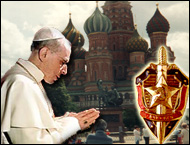 In fact, in his first Christmas message,
John XXIII called his
predecessor: "Supreme doctor, light of holy mother Church, lover of the
divine law."
Q: What do we have to learn from this
Pope?
Sister Marchione: Thousands of available
documents in the Vatican
Secret Archives record the humanitarian work of the Holy See. Pius XII
directed the greatest rescue program in the history of the Catholic
Church and served as a beacon of hope throughout his pontificate,
1939-1958.
In fact, in his first Christmas message,
John XXIII called his
predecessor: "Supreme doctor, light of holy mother Church, lover of the
divine law."
Q: What do we have to learn from this
Pope?
Sister Marchione: Thousands of available
documents in the Vatican
Secret Archives record the humanitarian work of the Holy See. Pius XII
directed the greatest rescue program in the history of the Catholic
Church and served as a beacon of hope throughout his pontificate,
1939-1958.
He knew that explicit condemnations would
have sabotaged rescue
operations and provoked more brutal reprisals. With "diplomacy" rather
than "confrontation" he saved hundreds of thousands of Jews and
Christians from death in the concentration camps.
He was a moral hero: a man solicitous on
behalf of Jews and Gentiles
alike who worked tirelessly for peace. Among his many prayers, he wrote
"Ten Commandments for Peace." His was a crusade of charity!
The documentation will show convincingly
that during the period leading
up to, during, and after the Second World War, the Vatican used its
moral prestige, limited funds, and extraordinary network of contacts to
work consistently for the protection of human life and human dignity.
The humanitarian work of the Vatican was
made known in the very words
of a Nazi leader, Adolf Eichmann, who was condemned at the Nuremberg
Trials. In his memoirs, he clearly states that the Vatican "vigorously
protested the arrest of Jews, requesting the interruption of such
action; to the contrary, the Pope would denounce it publicly."
Q: What is it about Pius XII that
inspires such interest on your part?
Sister Marchione: Undoubtedly my meeting
with Pius XII in 1957. I was
17 years old when he became Pope on March 2, 1939. I was a young nun
whose order had special connection with the papacy from 1707, when the
then Pope Clement XI called our sisters to open schools in Rome.
Like most Catholics of my generation, I
revered the new Pope whom
everyone described as the "Pope of Peace." My first trip to Italy was
in May 1957, as a Columbia University Garibaldi Scholar. Accompanied by
his niece, Elena Pacelli, I had the opportunity to meet Pius XII in the
Basilica of St. Peter.
His piercing eyes penetrated my soul as
we chatted informally. We spoke
about my research on the poet Clemente Rebora, about the sisters in the
USA, about my family.
I still see this tall, dignified, and
ascetic figure, along with his
brilliant glance, his loving smile, and animated gestures. He had a
magnetic personality full of intelligence and nobility of spirit. When
I think of Pius XII, I feel inspired.
Q: What are you doing now to promote the
truth about Pius XII?
Sister Marchione: As we approach the 50th
anniversary of the death of
Pius XII, October 9, 1958, I have asked Yad Vashem to posthumously
recognize and honor him as "Righteous among the nations."
He risked his own life to save Jews
during the Nazi occupation of Rome.
Jews firmly believe in justice and truth. I would also like Yad Vashem
to correct the statement below the portrait of Pope Pius XII which is
contrary to the truth and is unjust. It must be repudiated.
It says: "Pius XII's reaction toward the
killing of Jews during the
period of the Holocaust is controversial. In 1933, as the Vatican
secretary of state, in order to maintain the rights of the Church in
Germany, he signed a concordat with the Nazi regime even at the price
of recognizing the racist Nazi regime. When he was elected Pope in
1939, he put aside an encyclical against racism and anti-Semitism
prepared by his predecessor."
This statement is false. Pius XII wrote
his own encyclical, "Summi
Pontificatus," which did deal with racism.
The statement continues: "Although
reports about the assassination of
Jews reached the Vatican, the Pope did not protest either by speaking
out or in writing."
This is not true. Whenever Pius XII spoke
out, there was immediate
retaliation by the Nazis. There were more than 60 protests!
The text in Yad Vashem says: "In December
1942, he did not participate
in the condemnation by members of the allies regarding the killing of
Jews. Even when the Jews were being deported from Rome to Auschwitz,
the Pope did not intervene."
The Pope did indeed intervene. After that
first day, the SS were
ordered to stop the deportation of the Jews in Rome.
It adds: "He maintained a neutral
position except toward the end of the
war when he appealed on behalf of the government of Hungary and of
Slovakia. His silence and the absence of directives obliged the clergy
in Europe to decide independently how they should behave toward the
persecuted Jews."
This is not true. Members of the Church
were ordered to protect all
refugees and Jews.
If the statement is corrected and Pius
XII is declared a "Righteous
Gentile" by Yad Vashem in Israel, it would mean that finally the Jews
recognize the good that was done by Pius XII in saving hundreds of
thousands of Jews as the Jews themselves have testified.
In his introduction to the Eichmann
trial, Israeli Attorney General
Gideon Hausner stated on April 17, 1961, "that the Pope himself
intervened personally in support of the Jews arrested in Rome."
Some historians continue to ignore the
testimony of countless
contemporary witnesses. Can historians prove that the charges against
Pius XII are false? Truth and justice demand a re-evaluation of the
attacks against Pope Pius XII claiming "silence," "moral culpability,"
or "anti-Semitism." Did Hitler want to kidnap the Pope? The answer is,
"Yes."
However, Yad Vashem requires two
testimonials from people of Jewish
descent who can testify that they were saved, or that they knew Jews --
or heard about Jews -- who were saved by the Pope. Their testimony must
be notarized. Perhaps friends of ZENIT will be able to help locate
these testimonials.
--------------------------------------------------------------------------------------------
Pius
XI and
Eugenio Pacelli Revealed
Interview with Professor Matteo Luigi Napolitano
ROME, OCT. 2, 2006 (Zenit.org).- The opening of Vatican Secret
Archives
from the pontificate of Pope Pius XI may help historians to reevaluate
the years preceding World War II.
The archives, opened Sept. 18, include millions of letters
relating to
the years 1922-1939, covering events such as the Catholic Church's
persecution in Mexico and Spain, the advent of Fascism and Nazism, and
the spread of Communism in Europe.
In this interview with ZENIT, Matteo Luigi Napolitano, associate
professor at the University of Molise, comments on the first steps of
analyzing the documents found in the archives.
Napolitano is also a delegate of the Pontifical Commission of
Historical Sciences to the International Commission for the History of
World War II.
Q: From the historical point of view, of what importance is the
opening
of the Vatican Archives on the period of Pius XI's pontificate?
Napolitano: The opening of the archives, in the greatest possible
number, is in general the great desire of historians. In particular,
the Holy See's international relations can also be documented based on
different Vatican archives.
It is the case with Pius XI's pontificate: The valuable work
carried
out by experts of Italy's Foreign Ministry, in the '80s, under the
guidance of professor Pietro Pastorelli, has enabled us to have access
to an enormous quantity of material relative to the relationship
between the Holy See and Fascist Italy.
The work of similar commissions abroad and the publication of
diplomatic collections, has enhanced our knowledge of many other
aspects of Pius XI's diplomacy.
But the opening of the papers of the Vatican Secret Archive
represents
an enormous enrichment, not only because of its own importance, which
needs no explanation, but also because the internal dynamics of the
Holy See can be understood, especially in great moments of change in
the contemporary world in which the Vatican was involved.
Q: What do the documents say about Hitler's visit to Rome on May
2,
1938? How did the Holy See conduct itself?
Napolitano: From Father Giovanni Sale's research in the archives
opened
in 2003, one deduces that neither Pius XI nor Pius XII were "Hitler's
Popes." The papers now available enlarge the horizon on Pius XI's
pontificate and specify two aspects that were already known for a long
time.
Documented, in the first place, is the Vatican's criticism of a
passive
Mussolini, imitator of Hitler.
Recorded, in the second place, is the concern given the crushing
of
Italy because of German politics, not only in regard to the racial
issue, but more broadly in choosing an alignment fraught with dangerous
consequences.
In this connection, Hitler's visit on May 2, 1939 to which you
allude,
is symptomatic.
The Vatican did not approve of having the German chancellor in
Rome.
The Pope's departure for Castel Gandolfo and his allusion to the
other
cross that was rising over Rome, which was not Christ's, is only an
example of a larger theme of unfolding events, such as the controversy
over street decorations, over the route Hitler should follow, the
instructions to the Italian episcopate and religious not to participate
in manifestations of homage to Hitler, and the fear that the Axis would
become an alliance.
But also recorded was the Fascists' conviction that the Vatican's
anti-Nazi posture not only compromised the attempts to moderate Nazi
anger against the German Church, but ended ultimately by favoring the
"popular fronts," and, specifically, the "Bolsheviks" and French
"Masons" with whose position the Holy See seemed to be in agreement.
Q: What is your assessment of what the documents say about Pius
XII?
Napolitano: The proclivities to controversy might now be tempted
to
launch accusations, according to which the Vatican had a "Hitler's
Pope" and a "Mussolini's Pope" and, perhaps, also a "Franco's Pope."
But controversy and ignorance sometimes are related. This is
demonstrated in a Sept. 23 article by John Cornwell -- author of the
controversial book "Hitler's Pope" -- in the British review The Tablet,
in which he writes that the new opening of the Vatican Archives of the
period 1922-1939 "is an important event for all researchers interested
in the Holy See's relations with Nazi Germany."
Cornwell demonstrates consequently that he is unaware that the
Vatican
documents on the period 1922-1939 relating to German-Vatican relations
were opened in February of 2003. This is an example of a supposed
"expert" who is three years behind in regard to history!
To return to more serious matters, Pius XI's pontificate was
certainly
great, including the way he addressed international affairs, along with
his principal collaborator, Cardinal Eugenio Pacelli, the future Pius
XII.
There are already -- and others will come -- proofs of the
reservations
of Pius XI and Cardinal Pacelli vis-à-vis exasperated
nationalist
phenomena such as Hitlerism. I would not be surprised also to find
documentary proofs that deny the old theory that the Vatican was soft
toward Nazism and inflexible with Communism.
Thanks to some documents, one can now perceive, for example, the
Fascists' judgment on Pius XI: Mussolini always saw the Pope as too
aligned against Nazi Germany and too tolerant toward the Bolsheviks.
But a more detailed judgment will only be possible when the examination
of existing documentation is complete.
Q: What was the relationship like between Pius XI and his
secretary of
state, Cardinal Pacelli?
Napolitano: I would limit myself for now to verify what the other
archives say. In the archive of Italy's Foreign Ministry there is a
profile of possible "papables" -- papal candidates -- prepared by
Monsignor Enrico Pucci in anticipation of the conclave and given --
perhaps -- to the Italian ambassador in the Vatican, Pignatti Morano de
Custoza.
In the profile relating to the future Pius XII, the following is
read:
"Instead, it seems increasingly clear that the candidate preferred by
Pius XI for an eventual succession is Cardinal Pacelli. Pius XI,
especially recently, has never missed an occasion to manifest, even in
public addresses, the qualities of his immediate collaborator and of
showing him his predilection."
The document was published by professor Mario Casella in 2000. The
Vatican documents -- and I am thinking especially of the "Diary" of the
audiences written by Pacelli -- will undoubtedly confirm this
privileged relationship between the Pope and his closest collaborator.
Beyond personal differences, therefore, neither Pius XI nor his
successor were Hitler's or Mussolini's Popes.
------------------------------------------------------------------------------------------
The Myth of Hitler's Pope:
How Pope Pius XII Rescued Jews From
the Nazis
by David G.
Dalin
(Regnery, 209 pages, $27.95)
July/August 2006 issue of The American
Spectator.
AS A HISTORIAN OF THE HOLOCAUST, I
frequently receive requests from
Jewish educators, seeking support for grant applications for their
Holocaust programs. Almost all these applications include a sentence
about how the new program will inform students that the Pope, and the
Vatican, "did nothing" during the Holocaust to help Jews.
The most recent such portrayal reached me
while I was writing this
review. It is part of a proposal to a major Jewish philanthropic
organization, and contains the sentence: "Also discusses the role of
the Vatican and the rabidly anti-Semitic Pope Pius XII, who were privy
to information regarding the heinous crimes being committed against the
Jews, and their indifferent response."
That the Pope and the Vatican were either
silent bystanders, or even
active collaborators in Hitler's diabolical plan -- and "rabidly
anti-Semitic," as stated above -- has become something of a truism in
Jewish educational circles, and a powerful, emotional assertion made by
American-Jewish writers, lecturers, and educators.
David G. Dalin, professor of history and
political science at Ave Maria
University, Naples, Florida -- and an ordained rabbi -- demonstrates in
his recent book, The Myth of Hitler's Pope, that this is a false and
distorted portrayal. He also shows its long pedigree, starting more
than 40 years ago, in 1963, with Rolf Hochhuth's play The Deputy.
Although that play was fiction, it was widely regarded as based on fact
in its strident assertion of the moral cowardice and silence of Eugenio
Pacelli, who in 1939 became Pope as Pius XII.
Since Hochhuth's play, this theme has
become commonplace. John
Cornwell, a Roman Catholic, in his book Hitler's Pope (1999) blamed
Pius XII not only for silence, but for active collaboration with the
Nazi regime. Jewish writers have understandably been shocked by the
reiterated assertion of papal refusal to help Jews at their time of
greatest need. Daniel Goldhagen's book A Moral Reckoning: The Role of
the Catholic Church in the Holocaust and Its Unfulfilled Duty of Repair
(2002) portrays Pius XII as part of a wider Roman Catholic anti-Semitic
tradition that permeated the Church's teachings and was integral -- in
Goldhagen's words -- to the very "genesis of the Holocaust."
Dalin takes issue with these critics of
Pius XII. Building on earlier
documented defenses of Pius XII, including Ronald J. Rychlak's detailed
study Hitler, the War, and the Pope (2000), he builds a powerful case
for Pius XII, suggesting that the desire of Pope John Paul II to
canonize Pius need not have been offensive -- or insensitive -- to
Jews, as it was widely portrayed.
THE HISTORICAL RECORD is clear. There can
be no minimizing the horrors
of those manifestations of Christian anti-Semitism that were a curse in
the story of Nazi-dominated Europe. The Polish villagers who murdered
their neighbors in Jedwabne had been churchgoers all their lives. The
Roman Catholic priests who, on many documented occasions, turned their
flocks against the Jews throughout Eastern Europe were ordained in the
rites of Rome. The Slovak leader, Father Jozef Tiso, who asked the
Germans to deport his Jews to German-occupied Poland and to slave labor
-- and death -- was an ordained priest.
But, as I myself pointed out in my book
The Righteous: The Unsung
Heroes of the Holocaust (2003), there was another side to this coin. In
France, leaders of the Roman Catholic clergy were outspoken in their
condemnation of the deportations. In Italy, churchmen across the whole
spectrum of Roman Catholicism, including leading Jesuits, saved Jews
from deportation.
Many hundreds of Polish priests and nuns
are among more than 5,000
Catholic Poles who have been recognized by the state of Israel for
their courage in saving Jews.
Where does this leave Pope Pius XII, the
object of so much published
hostility, and the main figure in Dalin's short but powerful book? Can
Pius really merit the words of Israel's then Foreign Minister, Golda
Meir (later Prime Minister of Israel), when she telegraphed to the
Vatican on Pius's death in 1958: "When fearful martyrdom came to our
people in the decade of Nazi terror, the voice of the Pope was raised
for the victims. The life of our times was enriched by a voice speaking
out on the great moral truths above the tumult of daily conflict. We
mourn a great servant of peace."
Those who were in charge of that Nazi
terror during the war years held
this same view during the war itself. After Pius XII delivered his
Christmas message in December 1942, the Reich Security Main Office, the
German government department in Berlin responsible for the deportation
of the Jews, informed its representatives, who were in charge of
encouraging local leaders to permit their Jews to be deported: "In a
manner never known before, the Pope has repudiated the National
Socialist New European Order.... Here he is virtually accusing the
German people of injustice to the Jews, and makes himself the
mouthpiece of the Jewish war criminals."
This was stern condemnation by the Nazis
of a man who is now condemned
for the opposite failing. Yet nine months later, Pius XII was to upset
the Nazis even more. After the German occupation of Rome and the
northern part of Italy, when the SS determined to introduce the Final
Solution in all areas of Italy under German military control, Pius and
the Vatican took the lead in seeking to frustrate the deportation plan.
A MAIN OBJECT OF SS POLICY in Italy after
the German occupation in 1943
was the deportation to Auschwitz of all Jews living in Rome. Margherita
Marchione has told this story in Consensus and Controversy: Defending
Pope Pius XII (2002). The roundup began without warning at eleven in
the evening on October 15, 1943. Between then and one in the afternoon
on October 16, one thousand of Rome's 6,000 Jews were arrested and
taken to a deportation holding center, the Collegio Militare: their
destination (although unknown at the time) was Auschwitz.
News of the start of the round-ups was
brought personally to the Pope
early on the morning of October 16 by an Italian Catholic princess,
Enza Pignatelli Aragona Cortes, who had been alerted by a Jewish
friend. Having received the princess early that morning, the Pope
immediately instructed the Cardinal Secretary of State, Cardinal
Maglione, to protest to the German ambassador to the Vatican, Ernst von
Weizsacker (a former German Deputy Foreign Minister).
Maglione did so that morning, making it
clear to the ambassador that
the deportation of Jews was offensive to the Pope. In urging Weizsacker
"to try to save these innocent people," Maglione added: "It is sad for
the Holy Father, sad beyond imagination, that here in Rome, under the
very eyes of the Common Father, that so many people should suffer only
because they belong to a specific race."
Following Maglione's appeal, Weizsacker
gave orders for a halt to the
arrests. To protect those who were thus still in their homes from a
possible German reversal of the halt to the deportations, the Pope gave
instructions for the Vatican to be opened to Rome's Jews, and for the
convents and monasteries of Rome to provide hiding places, or provide
false identification papers.
As a result of this papal initiative, in
Rome a larger percentage of
the Jews were saved than in any other city then under German
occupation. Of the 5,715 Roman Jews listed by the Germans for
deportation, 4,715 were given shelter in more than 150 Catholic
institutions in the city; of these, 477 were given sanctuary within the
confines of the Vatican itself.
In reporting on the Maglione-Weizsacker
meeting to London two weeks
later, the British ambassador noted: "Vatican intervention thus seems
to have been effective in saving numbers of these unfortunate people."
Of the thousand deportees of October 16, only ten survived. The
remaining four-fifths of Rome's Jews were alive at liberation.
A footnote to these events: fifty-one
years after Weizsacker's decisive
intervention, his son Richard was the first President of the Federal
Republic of Germany to visit Israel, and there to express his shame at
what Germany had done to the Jews in the Nazi era.
AS THE GERMANS began deporting Jews from
other parts of northern Italy,
the Pope opened his summer estate at Castel Gandolfo to take in several
thousand (women had their babies in the Pope's apartment) and
authorized monasteries throughout the German-occupied areas of Italy to
do likewise. As a result, while the Germans managed to seize and deport
a further 7,000 Italian Jews to their deaths, 35,000 survived the war
-- one of the highest ratios of those rescued of any country.
There was to be a further decisive papal
rescue action after the German
occupation of Hungary in March 1944. Under the leadership of the Pope's
senior representative in Budapest, the Papal Nuncio Angelo Rotta, the
diplomats of eight neutral countries represented in the Hungarian
capital -- including the Swedish ambassador and his staff, prominent
among them Per Anger and Raoul Wallenberg -- organized a city-wide
rescue scheme.
Under Rotta's energetic lead, an
"International Ghetto" was established
in the northern section of the city, in which more than 40 safe houses
were established, marked by the Vatican emblem, and other national
emblems. Into these safe houses -- a series of tall, modern apartment
buildings -- 25,000 Jews found refuge, and survived. Elsewhere in
Budapest, Roman Catholic institutions hid several thousand more Jews in
their cellars and attics.
The influence and authority of Pius XII
was wide-ranging. In the port
of Fiume, the Italian police chief, Giovanni Palatucci -- the nephew of
an Italian bishop, Giuseppe Palatucci -- together with his uncle, saved
5,000 Jews from deportation during the German occupation of the port.
They did so by providing the Jews with false identity papers, enabling
them to gain safety in the bishop's diocese in southern Italy. For
helping the Jews of Fiume, Giovanni Palatucci was arrested by the SS
and sent to Dachau, where he was executed.
Pius XII took a direct part in sending
money to support the Jewish
refugees from Fiume. He also sent considerable sums of money to other
rescuers of Jews in Italy, and to the French Capuchin monk, Father
Pierre-Marie Benoit, from whose monastery in Marseille several thousand
French Jews were smuggled across the borders of neutral Spain and
Switzerland.
AMONG THE LEADING Roman Catholic
clergymen who helped save Jews was
Archbishop Giovanni Montini, the future Pope Paul VI. When the
government of Israel asked him, in 1955, to accept an award for his
rescue work during the Holocaust, Montini replied: "All I did was my
duty. And besides I only acted upon orders from the Holy Father."
When the deportation of 80,000 Jews from
Slovakia to Auschwitz began in
March 1942, Pius authorized formal written protests by both the Vatican
secretary of state and the papal representative in the Slovak capital,
Bratislava.
When a second round of deportations began
in Slovakia the following
spring, Pius wrote a letter of protest to the Slovak government. Dated
April 7, 1943, it was outspoken and unambiguous. "The Holy See has
always entertained the firm hope," Pius wrote, that the Slovak
government "would never proceed with the forcible removal of persons
belonging to the Jewish race. It is, therefore, with great pain that
the Holy See has learned of the continued transfers of such a nature
from the territory of the republic."
That pain was "aggravated further," the
Pope wrote in this same letter,
since it appeared "that the Slovak Government intends to proceed with
the total removal of the Jewish residents of Slovakia, not even sparing
women and children. The Holy See would fail in its Divine Mandate if it
did not deplore these measures, which gravely damage man in his natural
right, mainly for the reason that these people belong to a certain
race."
Six times the Pope appealed to the Slovak
leader -- the Catholic priest
Father Tiso -- to halt the deportations. After the sixth appeal, on
April 7, 1943, the remaining planned deportations were halted.
On April 8, 1943, the day after his final
protest to Father Tiso, Pius
XII instructed the Vatican's representative in the Bulgarian capital,
Sofia, to take "all necessary steps" to support those Bulgarian Jews
facing immediate deportation. From Istanbul, Cardinal Angelo Roncalli
(later Pope John XXIII), a former Papal Nuncio in Bulgaria, and
godfather to the king's sons, added his voice to that of Pius XII,
urging the King of Bulgaria not to deport the Jews of his kingdom.
Roncalli also signed transit visas for Palestine for several thousand
Slovak Jewish refugees.
On learning of the plight of Jews in
concentration camps in
Romanian-occupied Transnistria, Angelo Roncalli contacted Pius XII, who
interceded at once with the Romanian authorities, and authorized the
dispatch of money to those in the camps. When, in 1957, the Israeli
government sought to thank Cardinal Roncalli for his help, the Cardinal
replied: "In all those painful matters I referred to the Holy See and
afterwards I simply carried out the Pope's orders: first and foremost
to save human lives."
Such is the historical record. It
explains why Rabbi Dalin is so
disturbed by the continuing assertions that Pius XII did nothing to
help Jews, was an anti-Semite, and effectively acted as "Hitler's Pope."
AN IMPORTANT ASPECT OF THIS BOOK is the
carefully constructed
background to Pius XII's attitude to the Jews, going back to his early
days as a young Vatican official. Indeed, from his schooldays, Eugenio
Pacelli -- as he then was -- was friends with a Jewish student, Guido
Mendes, later a distinguished Roman physician. As a result of this
friendship, Pacelli was the first Pope to have shared a Sabbath dinner
in his youth at a Jewish home. In 1915, then aged 39, he helped draft
Pope Benedict XV's powerful papal denunciation of anti-Semitism in
Poland, which insisted that the Christian law to love one another "must
be observed and respected in the case of the children of Israel."
In 1919, as Papal Nuncio in Munich,
Pacelli defended the Church against
the ferocious onslaught of Communism, then -- as in Russia two years
earlier -- spearheaded by individual Jews who had long since abandoned
their religious faith. But anti-Communism did not make him pro-Nazi or
anti-Semitic, as his critics claim. In May 1922, Pacelli warned the
Jewish politician Walter Rathenau of an assassination plot by German
anti-Semites. A month later, Rathenau was murdered. In November 1923,
five days after Hitler's failed attempt to seize power in Munich,
Pacelli wrote critically to the Vatican about the Nazi movement, and
noted with approval the public defense of Munich's Jews by the city's
Catholic archbishop.
In 1933, while serving as Cardinal
Secretary of State -- the Vatican's
Foreign Minister -- Pacelli negotiated the "Reich Concordat" with
Hitler's Germany, determined to protect German Catholics from the
anti-religious policies of the new regime. Dalin makes a convincing
argument in favor of the Concordat as a protective measure, stressing
that it was not a moral endorsement of Nazism. Indeed, from the outset
of the anti-Jewish persecutions in Germany, Pacelli opposed them.
On April 4, 1933, three days after the
one-day boycott of Jewish shops,
Pacelli instructed the Papal Nuncio in Berlin to warn the regime
against the persecution of German Jews, asking the nuncio to become
actively involved on behalf of the Jews. Four months later he twice
expressed to the British ambassador to the Vatican his "disgust and
abhorrence" at the Nazi regime. The ambassador reported to the Foreign
Office in London -- on August 19, 1933 -- that Pacelli "deplored the
action of the German Government at home" including "their persecution
of Jews."
In 1936 Pacelli visited the United
States. One result of his mission,
Dalin notes, was that, at President Roosevelt's personal request, he
prevailed upon Father Charles Coughlin, the "radio priest," to end his
anti-New Deal -- and also anti-Semitic -- broadcasts. While willing to
meet Roosevelt, Pacelli never met Hitler. When, in a much-heralded
gesture of friendship, Hitler visited Mussolini in Rome in 1938,
Pacelli deliberately absented himself from the city, together with Pope
Pius XI.
While Secretary of State, Pacelli made an
astonishing 55 protests
against Nazi policies, including, repeatedly, the "ideology of race."
In 1938 Pacelli publicly endorsed and repeated the words of Pius XI,
that "it is impossible for a Christian to take part in anti-Semitism.
Anti-Semitism is inadmissible; spiritually we are all Semites."
So outspoken were Pacelli's criticisms
that Hitler's regime lobbied
against him, trying to prevent his becoming the successor to Pius XI.
When he did become Pope, as Pius XII, in March 1939, Nazi Germany was
the only government not to send a representative to his coronation.
IMMEDIATELY UPON BECOMING POPE, Pius XII
responded to Mussolini's
anti-Jewish legislation by appointing several Jewish scholars who had
been dismissed from the university to positions inside the Vatican.
Among them was the distinguished Jewish cartographer, Roberto Almagia,
a professor at the University of Rome since 1915. On the day after his
dismissal, Almagia was appointed director of the geography section of
the Vatican library. While working there he completed an exceptional
four-volume study of the Vatican's cartographic holdings.
Another dismissed Jewish scholar,
Professor Giorgio Levi della Vida, a
world authority on Islam, was also given a job in the Vatican library,
cataloguing the Arabic manuscripts.
In his first encyclical as Pope, Pius XII
specifically rejected Nazism
and expressly mentioned the Jews, noting that in the Catholic Church
there is "neither Gentile nor Jew, circumcision nor uncircumcision."
The head of the Gestapo, Heinrich Mueller, commented that the
encyclical was "directed exclusively against Germany." So outspoken was
it that the Royal Air Force and the French air force dropped 88,000
copies of it over Germany.
One strong piece of evidence that Dalin
produces against the concept of
"Hitler's Pope" is the audience granted by Pius XII in March 1940 to
the German Foreign Minister, Joachim von Ribbentrop, the only senior
Nazi official to visit the Vatican during his papacy. After Ribbentrop
rebuked the Pope for "siding" with the Allies, the Pope responded by
reading from a long list of German atrocities and religious persecution
against Christians and Jews, in Germany, and in Poland, which Germany
had occupied six months earlier.
The New York Times, under the headline
"JEWS' RIGHTS DEFENDED," wrote
on March 14, 1940: "The Pontiff, in the burning words he spoke to Herr
Ribbentrop about religious persecution, also came to the defense of the
Jews in Germany and Poland."
DALIN DRAWS ATTNETION in this book to the
man whom he regards as the
missing personality in the story: Hajj Amin al-Husseini, the Mufti of
Jerusalem, a position of influence in the Muslim world to which Hajj
Amin had been appointed by the British in 1922. This senior Muslim
prelate met Hitler several times during the war, called openly for the
destruction of European Jewry, and intervened with Hitler to prevent
rescue efforts.
Having been given an office in wartime
Berlin, Hajj Amin mobilized
political and military support for the Nazi regime. Traveling to
German-occupied Yugoslavia, he helped raise a Muslim Waffen SS company,
which turned its savage attentions against both Jews and Serbian
Christians. In one of his many broadcasts from Germany to the Middle
East, Hajj Amin said of the Jews: "They cannot mix with other nations
but live, as parasites among the nations, suck out their blood,
embezzle their property, corrupt their morals...." Hitler found the
Mufti a useful tool.
In answer to Daniel Goldhagen's charge
that the Roman Catholic Church
remains a danger to the Jews today, Dalin writes: "It is radical Islam
-- Hitler's overt ally in World War II -- not the Catholic Church, that
threatens Jews today."
In his book Hitler's Pope, John Cornwell
calls Pius XII the "most
dangerous" cleric in modern history. Dalin feels that the Mufti is the
one who deserves this title. As Dalin writes: "Hitler's mufti is truth.
Hitler's pope is myth."
Professor Dalin's book is an essential
contribution to our
understanding of the reality of Pope Pius XII's support for Jews at
their time of greatest danger. Hopefully, his account will replace the
divisively harmful version of papal neglect, and even collaboration,
that has held the field for far too long.
Sir Martin Gilbert is Winston
Churchill''s official biographer and the
author of ten books on the Holocaust. His new book, Kristallnacht:
Prelude to Destruction, was published in June by HarperCollins. This
review appears in the July/August 2006 issue of The American Spectator.
---------------------------------------------------------------------------------------------
The Myth of Hitler’s
Pope
By Rabbi David G
Dalin
256pp | Regnery Publishing | ISBN 0895260344 |
US$27.95 | 2005
History in the short term can be fickle with the
reputations of good
men. Until 1963, Pope Pius XII was always regarded as a defender, even
a champion, of the Jews during the Fascist period. Then, in 1963, Rolf
Hochhuth, a German playwright, wrote “Der Stellvertreter” (“The
Deputy”), a play attacking Pius for his alleged “silence” when the
Jewish Holocaust was taking place. Other writers have followed suit,
not least John Cornwell to whose recent, much-publicised book,
Hitler’’s Pope, the title of this volume alludes.
The author, an ordained rabbi, is a professor of
history and political
science at Ave Maria University, Florida. His book, which is robust,
polemical and argumentative, deploys much documentation to show that
the notion of the Holy Father being a Nazi sympathiser and anti-Semite
is at best grotesque, at worst deliberately false and mendacious. Given
the wealth of evidence he assembles to the contrary, it seems strange
that such a fantastic notion should ever have been taken seriously.
Rabbi Dalin argues persuasively that it has been used by Western
liberals to further their own hidden agenda: an attack on
Judaeo-Christian civilisation itself and in particular the bastion of
this civilisation, the Catholic Church.
Professor Eamon Duffy, medieval Church historian
at Cambridge, has
referred to the “repellently illiberal” stance of “angry liberals”. In
their attacks on the reputation of Pius XII the ugliness and illiberal
nature of this stance is revealed in all its twisted rhetoric and
selective evidence. For example, the notorious jacket cover to
Cornwell’s book seems to show Pius XII grandly sweeping out of Hitler’s
chancellery and being saluted by Nazi guards; in fact the photo was
taken in 1927, during the Weimar Republic, when the Pope was papal
nuncio; it was deliberately selected by Cornwell for its malign
subliminal “message” and the caption given the wrong date of 1939.
Dalin begins by giving an historical survey of
the Papacy’s attitude
towards the Jews. Compared with the often lamentable record of other
Christians, the Popes through the ages appear to have been
philo-Semites. Beginning with Gregory the Great in the seventh century,
successive Popes promoted enlightened attitudes towards Jews, so that
Cecil Roth, the Jewish historian, was to write: “Only Rome…… is free
from having been a place of Jewish tragedy.” Indeed, Alexander Borgia,
better known for his moral laxity, created the first chair of Hebrew at
the University of Rome and during his tenure of office the Jewish
population of Rome almost doubled. It was also the Popes who
consistently defended the Jews from the scurrilous accusations of
ritual murder. In more modern times, Pope Pius X observed: “As far as
charity is concerned, the best Christians are the Jews”. In 1916 Pope
Benedict XV published a condemnation of anti-Semitism, which was
drafted by Archbishop Eugenio Pacelli, later to become Pius XII. Pius
XI, who succeeded Benedict, studied Hebrew with a local rabbi. It was
he who made the famous remark: “Spiritually we are all Semites”. John
XXIII (1958-63) blessed Jews leaving a Rome synagogue; John Paul II
visited Rome’’s chief synagogue -–– the first Pope ever to do so -- and
made a moving pilgrimage to the Western Wall in Jerusalem in 2000. On
his first foreign visit as Pope, in August, Benedict XVI visited a
synagogue in Cologne. On inauguration he greeted his “brothers and
sisters of the Jewish people.”
Nazi
fear of Pius XII
These, then, are the gestures and attitudes of
Pius XII’s papal
forbears and successors. What of the life and pontificate of this
deeply controversial figure of the modern liberal establishment? He,
too, studied Hebrew and had many Jewish friends, notably the conductor
Bruno Walter, whom he met in 1917 when he was Papal Nuncio to Bavaria.
Of 44 speeches he made as Papal Nuncio between 1917 and 1929, forty
denounced some aspect of the emerging Nazi ideology. Indeed, the Nazis
viewed Pacelli as a “Jew-loving” cardinal. Heydrich, the Nazi SS
commander, wrote that “in the long run the Pope in Rome is a greater
enemy of National Socialism than Churchill or Roosevelt”. There is
evidence of a Nazi plot to kidnap the pontiff, only frustrated by
Wolff, the German commander in Rome.
When Pacelli was elected Pope in 1939, Dalin
cites a huge amount of
evidence for his implacable opposition to Hitler, National Socialism
and the anti-Semitic attitude of the Nazi party. The Nazis, the Pope
said, were “diabolical” and of Hitler he commented, “This man is
capable of trampling on corpses”. When Mussolini’’s Fascist laws
forbade Jews to teach in Italian schools or universities, Pius XII
promptly appointed several Jewish scholars to posts in the Vatican
library. The Times newspaper of London commented on the Pope on 1
October 1942: “He condemns…… the persecution of the Jewish race” and
the New York Times described the Pope’s Christmas address of 1941 “a
lonely voice in the silence and darkness enveloping Europe”.
Notwithstanding this, the overwhelming
historical record of the Pope’s
concern for the Jews comes from Jews themselves. It is perverse how who
those who perpetuate the ““myth”” ignore the overwhelming documentation
in Pius XII’’s favour by the very people he is supposed to have
despised.
Setting
the record straight
Rabbi Dalin puts the record straight. His
best-known source is Three
Popes and the Jews by the Jewish diplomat and historian, Pinchas
Lapide, which was published in 1967. Weighing all the evidence at his
disposal, Lapide calculated that “Pius saved at least 700,000 but
possibly 860,000 Jews from death” -–– more than all the other relief
agencies put together. This enormous effort was achieved largely
through the Church’s own religious houses in Italy and through the
Papal nunciatures in other European countries such as Hungary and
Bulgaria.
Both Archbishop Roncalli, later to become Pope
John XXIII, and
Archbishop Montini, later to become Pope Paul VI, were charged by Pius
to do what they could to save Jewish lives. The theologian Henri de
Lubac SJ, was similarly directed, as were countless other priests and
senior members of the Church’s hierarchy. Convents, monasteries and
presbyteries all over Europe opened their doors to Jewish fugitives;
more than 1,000 found asylum at the papal summer residence at Castel
Gandolfo and hundreds were hidden in the Vatican itself. It is
estimated that more than 80 per cent of Rome’’s Jews were saved by the
intervention of the Pope.
Albert Einstein paid tribute to Pius XII as
early as 1940, saying that
in Germany “only the Catholic Church stood squarely across the path of
Hitler’s campaign for suppressing the truth”. When Pius died in 1958 he
was deeply mourned by the Jews. Golda Meir, then Israel’s foreign
minister, wrote to the Vatican: “When fearful martyrdom came to our
people in the decade of Nazi terror, the voice of the Pope was raised
for the victims.” One telling detail is omitted from this
well-researched book: after the war the Chief Rabbi of Rome, Israel
Zolli, converted to Catholicism; in a personal tribute to the Holy
Father, he took “Eugenio” as his baptismal name.
So how could the slur of Pius’s “silence” ever
gain the slightest
credibility? Although the Pope was not silent in his actions, in his
directives to Church personnel and in his communications with Allied
diplomats, he deliberately refrained from making public statements
attacking Hitler during the war. Was this silence culpable? His reason,
heavily influenced by Jewish and diplomatic advice, was that not only
would a public protest not help the Jews but that it would actually
increase their persecution.
The former chief rabbi of Denmark, Marcus
Melchior, a Holocaust
survivor, argued that “it is an error to think that Pius XII could have
had any influence whatsoever. If the Pope had spoken out, Hitler would
have massacred more than six million Jews.” When the Dutch bishops did
courageously protest against the rounding up of Dutch Jews, the Nazis
instantly retaliated by harsher measures. To have excommunicated Hitler
-–– a former Catholic -–– would, as historical examples demonstrate,
have had a similar effect. Such an imposed silence must have caused the
Holy Father great inner agony.
His critics have further attacked the Holy See’s
1933 concordat with
Nazi Germany, not accepting, as the author indicates, that is was “a
morally defensible diplomatic measure to protect German Catholics……
against a dangerous regime”. It was in no way an endorsement of
National Socialism. During the negotiations preceding the concordat,
Hitler arrested 92 priests and closed down nine Catholic publications.
As the British ambassador to the Vatican, Ivone Kirkpatrick, commented,
“A pistol…… had been pointed to his [Cardinal Pacelli’s] head.”
Reporting to the Foreign Office on 19 August 1933, Kirkpatrick reported
that the Cardinal “deplored the action of the German government at
home, their persecution of the Jews……”
Nazi
links with Muslim
extremists
Dalin has done an excellent job in defending the
wartime record of Pius
XII. But perhaps the most interesting and significant section of his
book is the evidence he produces for a quite different and sinister
scenario: the close relationship between Hajj Amin al-Husseini, the
grand mufti of Jerusalem from 1922, and Hitler’s Nazi party. He
suggests that Pius’’s critics have deliberately deflected blame from
pro-Nazi Islamic fundamentalists onto Pius XII. Certainly this thread
of the argument was news to me and, I suspect, to many others, but
Dalin produces disturbing evidence to support his case. Hajj Amin
al-Husseini was known to have met Hitler privately on a number of
occasions. He was a friend of Adolf Eichmann and visited Auschwitz. An
implacable enemy of the Jews, he supported the destruction of European
Jewry and did all he could to prevent the establishment of a Jewish
state. He made frequent broadcasts on German radio, displaying virulent
anti-Semitism with statements such as that the Jews “live as parasites
among the nations, suck out their blood, embezzle their property……”
Most telling of all in this disturbing and little-known aspect of
history: in Egypt in 1946 Hajj Amin al-Husseini met the young Yasser
Arafat, who became his protéégé and who later went
on to lead Palestinian terrorists in the PLO for 40 years.
The cause for Pius XII’s canonisation is under
way. It has been held up
by unsubstantiated and malicious accusations over his wartime record.
According to Rabbi Dalin, the Pope should be honoured as a “righteous
Gentile”, the term given to Christians who risked their own lives to
save Jews from the Holocaust. Because of the author’s scholarly
research it is to be hoped that history in the long term will be kinder
to the reputation of a great and good -– and much-maligned -- man.
Francis
Phillips, who
is married with eight children, lives in Bucks, in the UK.
Her reviews often appear in British Catholic
publications.
-------------------------------------------------------------------------------------------
Foundation Hails
Myth-Debunking Book on
Pius XII
Says Rabbi
Reveals "Other Side
of the Coin"
BUENOS AIRES, AUG. 29, 2006 (Zenit.org).-
The founder of the Raoul
Wallenberg Foundation said a new book written by an American Rabbi on
Pope Pius XII reveals another side of the debate surrounding the
Pontiff.
Baruj Tenembaum, speaking at an
interconfessional meeting in Buenos
Aires, said that David Dalin's "The Myth of Hitler's Pope: How Pius XII
Rescued Jews from the Nazis" demonstrates that how the Holy Father
rescued many Jews from the Holocaust.
The Argentine-born Jew who established
the Wallenberg Foundation and
the Angelo Roncalli Committee, said that this book reveals "the other
side of the coin" of the Pope's relationship with Jews at the height of
World War II.
Dalin, professor at Ave Maria University
in Florida, analyzes and
documents in his book the deportation of Rome's Jews to Auschwitz in
1943.
He includes in his book the Pope's
protest made to Ernst von
Weizsacker, the German ambassador to the Vatican, through his secretary
of state, Cardinal Luigi Maglione.
The cardinal asked the ambassador that
they "try to rescue the innocent
who suffer for belonging to a specific race."
In response to the cardinal's request,
the German ambassador gave
orders for the deportation to be halted; and the Pope instructed that
the Vatican be opened to hide Rome's Jews, who installed themselves in
convents and monasteries of the Vatican, according Dalin's sources.
Of Rome's 5,715 Jews registered by
Germany for deportation, 4,715 were
sheltered in 150 Catholic institutions, and of the total, 477 were in
Vatican sanctuaries. The British ambassador to the Vatican confirmed
this fact.
Servant
of peace
Dalin also mentions in his book the
message sent by Golda Meir,
Israel's minister of foreign affairs, on the occasion of the death of
Pius XII: "We mourn. We have lost a servant of peace. The Pope's voice
during Nazism was clear and in defense of the victims."
Tenembaum clarified that he assumes no
role whatsoever in this
discussion, but "calls everyone to seek and proclaim the truth, with no
prejudices: Only the truth, not sticking to preconceptions or spreading
slander! Let us follow the path of reconciliation with open minds!"
He added: "The rhetorical reiteration
does not certify conjectures or
guarantee truths; we Jews wish to recall and defend the truth, the
whole truth and nothing but the truth."
---------------------------------------------------------------------------------------------------------------------------
Pius XII hid Jews during war
Philip
Crispin
The Roman convent of Santi Quattro
Coronati sheltered political
fugitives and Jews during the Second World War on the direct orders of
Pope Pius XII, according to the diary of one of the Augustinian
convent's sisters.
According to the Italian daily La Stampa,
which has seen the
60-year-old-plus diary, the Pope, who has often been criticised for
keeping his counsel during the Holocaust, instructed the mother
superior to open, exceptionally, the enclosure of the contemplative
order's convent in order to shelter those fleeing the Germans.
The anonymous author of the journal
provides detailed names and dates
of more than 10 Jews and non-Jews who were sheltered in the convent
from September 1942 to June 1944. One of these was Amalia Viterbo, the
Jewish niece of Palmiro Togliatti, one of the creators of the Italian
Communist Party and secretary of the Comintern before the Second World
War.
The Augustinian sister writes that the
Pope wished to save "his
children as well as Jews" and ordered that monasteries and enclosures
should be opened up to those persecuted.
Later, when the convent superior
perceived that the SS were flouting
the sanctuary of convent enclosures, she had false identity papers
drawn up for her guests.
The diary should interest historians who
have been at loggerheads for
60 years over the attitude of Pope Pius XII concerning concentration
camps and the Holocaust. Many have accused him of complicity through
his silence.
---------------------------------------------------------------------------------------------------------------------
Pius XII beatification on track, says Kasper
Cardinal
Walter Kasper has
defended the role of Pope Pius XII during World War II but a Jewish
expert has called for further argument and debate before any eventual
beatification.
The Holy See has stepped up its campaign
to rehabilitate the memory of
war time pontiff Pope Pius XII - before he is moved further down the
track to sainthood and is beatified by the Church, according to a
report in The Universe.
Pius XII, who denounced extermination
without citing the Jews or Nazis,
had to "strike a balance in such a dramatic situation" according to
Cardinal Walter Kasper, head of the Vatican Office for Religious
Dialogue with Jews, who spoke at a conference about him at the
pontifical Lateran University.
"I think that means he thought stronger
words would have had very
negative consequences," the Cardinal said.
The controversial Pontiff "silently
helped countless victims of
persecution," Cardinal Kasper said, revealing that Pius's path to
beatification - a halfway house on the way to sainthood - was
"proceeding according to the rules and in a very well-pondered way."
Cardinal Kasper said Pius XII did what
was "humanly possible" during
the difficult years around World War II.
"Right here in Rome, for instance, many
Catholics, Jews and even
atheists found refuge in convents and other church buildings," he added.
"It is unthinkable that it all happened
without the Pope's knowledge.
It is unfair to judge Pius by today's standards."
There is concern however that the memory
of Pius XII has only been
rehabilitated in some limited scholarly circles.
"In the last 10 years we have become more
knowledgeable about Pius XII
and a great deal of positive and heartening information has emerged,"
said Rev Jonathan Gorsky, of the Council of Christians and Jews.
"The problem is that this is still not
widely known in the Jewish
community and by the general public.
"People do not know the stories of rescue
of Jews, especially those
that took place in Rome, and must have occurred with the knowledge of
the Pope. "
Rev Gorsky called for further argument
and debate before any eventual
beatification.
"I think that at the moment, many Jews
would construe a beatification
in a way that the Vatican and the Catholic Church certainly do not
intend," he added.
It would be very important to encourage
Catholics to communicate with
Jewish leaders about this before, rather than after, it takes place to
make known the reasoning and the understanding behind it. A
beatification of Pius XII without this elaborate explanation would
result in the same controversy that took place a few years ago."
--------------------------------------------------------------------------------------------------------------------------
Rabbi Says Pius XII Deserves "Righteous" Title
David Dalin
Makes Case in
"Myth of Hitler's Pope"
ROME, JAN. 17, 2006 (Zenit.org).- A U.S.
rabbi says that the title
"Righteous among the Nations" should be conferred on Pope Pius XII for
his efforts to defend the Jews during World War II.
Rabbi David Dalin, a professor of history
and political science at Ave
Maria University in Florida, makes his case in his book "The Myth of
Hitler's Pope," published by Regnery.
The work shows that, in the course of
history, many popes defended and
protected the Jews from accusations and persecutions. It also recounts
many incidents which show how Pius XII saved Jews from Nazi persecution.
Rabbi Dalin quotes authoritative studies
by Jewish authors, such as
Pinchas Lapide's "Rome and the Jews" and "Pius XII and the Jews,"
written in 1963 by Joseph Lichten, a member of the Anti-Defamation
League.
The rabbi also quotes Hungarian historian
Jeno Levai who, in the face
of accusations of silence against Pius XII, wrote "Hungarian Jewry and
the Papacy: Pope Pius XII Did Not Remain Silent. Reports, Documents and
Records from Church and State Archives," published in English in 1968.
Robert M.W. Kempner, the deputy U.S. counsel during the Nuremberg
trials, wrote the introduction to that book.
Martin Gilbert's view
Among recent books, the American rabbi
stresses specifically the works
of Martin Gilbert, one of the most authoritative living Jewish
historians. Gilbert is the official biographer of Winston Churchill and
author of more than 70 books on World War II and the Shoah.
Gilbert recounts all that the Catholic
Church did in defense of the
Jews, opposing racism and Nazism, and affirms that "Pius XII should be
praised and not censured."
Rabbi Dalin proposes that Pius XII, for
his actions in favor of Jews,
be conferred the highest Jewish recognition for a gentile, the title
"Righteous among the Nations." Last Nov. 3, the Internet edition of the
Jerusalem Post published a positive review of the book.
Pius
XII as a "Righteous Gentile"
---------------------------------------------------------------------------------------------------------------------
Scholar Ronald
Rychlak Defends
Wartime Pope
JACKSON, Mississippi, JAN. 11, 2006
(Zenit.org).- Despite what some
modern critics say, Pope Pius XII launched a multifaceted response to
the Nazi campaign against the Jews.
So says, Ronald Rychlak, an adviser to
the Holy See's delegation to the
United Nations, University of Mississippi law professor and author of
"Righteous Gentiles: How Pope Pius XII and the Catholic Church Saved
Half a Million Jews from the Nazis".
Rychlak shared with ZENIT some of the
information he has amassed in
defense of Pius XII and the Church, and how Catholics can respond to
detractors.
Q: How is this book different from those
that have previously defended
Pope Pius XII? What new information does it reveal?
Rychlak: In "Righteous Gentiles" I
directly respond to arguments made
by the critics of Pope Pius XII and the Catholic Church during the Nazi
era. I generally tried to avoid doing that in my last book -- "Hitler,
the War, and the Pope" -- because I wanted to lay out the facts
chronologically and just as they happened.
Philosopher Michael Novak, author of the
foreword to "Righteous
Gentiles," pointed out that over the past five years there have been so
many books and articles that set forth arguments against the Church
that a book responding to them had become necessary.
That's what I have tried to do with this
book: address each and every
argument that has been lodged against Pope Pius XII and the Catholic
Church during the Holocaust.
As for new information, the first chapter
of "Righteous Gentiles" sets
forth 18 new pieces of evidence that have come to light in recent
years. Each one casts a positive light on Pius XII and the Catholic
Church.
The book also discusses Pope Pius XII,
the Germany clergy and other
rescuers from nations throughout Europe. Those topics have not, for the
most part, been discussed in other recent pro-Pius XII books.
Q: How did Pius XII and the Catholic
Church respond to Nazi aggression?
Rychlak: Pius XII's response was
multifaceted. He opened buildings
throughout Rome, providing food, shelter and clothing to all those in
need. He also made many statements in opposition to the Nazis and in
support of the Jews.
His first encyclical, "Summi
Pontificatus" -- released just weeks after
the outbreak of war -- expressly mentioned Jews and urged solidarity
with all who profess a belief in God. Allied forces later dropped
thousands of copies behind enemy lines for propaganda purposes.
In his 1942 Christmas statement, Pius
spoke on behalf of "the hundreds
of thousands who, through no fault of their own, and solely because of
their nation or race, have been condemned to death or progressive
extinction."
His 1943 encyclical "Mystici Corporis
Christi" explained: "Our paternal
love embraces all peoples, whatever their nationality or race." He went
on to say that Christ, by his blood, made Jews and Christians one
"breaking down the middle wall of partition ... in his flesh by which
the two peoples were divided."
Pius XII also used his representatives
throughout Europe to intervene
on behalf of Jewish victims. He sent open telegrams complaining to
collaborating governments and commiserating with the persecuted.
He established the Pontifical Relief
Commission which distributed food,
medicine and clothing in 40 countries during the war, and he created
the Vatican Information Office which supplied information about missing
persons and helped reunite families -- all without any discrimination
on the basis of race, religion or nationality.
Many Catholic rescuers were inspired by
the repeated appeals in support
of Jews that were broadcast on Vatican Radio. Some rescuers even
testified to direct papal orders that they received to help victimized
Jews.
The Pope's position, like his means of
inspiring the resistance, was
well understood during the war. The New York Times reported that
because of him, "hiding someone 'on the run' became the thing to do."
The Congregation for the Causes of
Saints, following a 39-year
investigation into Pius XII's life, concluded that the only way to save
the Jews was with "secret but efficient ways to shelter them, provide
them food and clothing, and move them to neutral countries. Pius XII
did this in a manner unequaled by any state or organization."
Q: What did you find in your research of
Church archives, especially
the confidential Vatican report on Pius XII?
Rychlak: I was able to draw upon
documents that I saw for the first
time in March 2003, when I traveled to Rome to examine materials from
newly opened Vatican archives. I returned to Rome in April 2004, at
which time I was given extraordinary access to the still-confidential
internal Vatican report -- the "positio" -- prepared by historians for
the Congregation for the Causes of Saints.
This eight-volume work includes sworn
testimony from about 100
witnesses who knew Pius XII. It also reviews all the scholarship in the
area -- critical and supportive -- and looks to the victims, the
rescuers and the Nazi villains.
Relying on this evidence, and applying
reasonable standards to evaluate
his leadership -- as opposed to the ever-shifting and unfair procedures
adopted by so many critics -- it sets forth a compelling case that he
lived a life of heroic virtue.
Q: Why do so many scholars and critics
want to find Pius XII culpable
in Nazi atrocities?
Rychlak: The "positio" concludes that
there is a campaign to denigrate
the personality and work of Pius XII. This should not, I think, be
taken as an orchestrated campaign of critics working in conjunction.
Rather, many of the critics share a view
of the world that runs counter
to the Catholic Church, and they have tried to advance their view and
discredit the Church by denigrating Pope Pius XII.
Read through to the end of most of these
books and you will find that
the authors are critical not only of Pope Pius XII, but also the late
Pope John Paul II, the positions expressed by Cardinal Ratzinger/Pope
Benedict XVI, traditional Catholic doctrines of papal supremacy, the
all-male priesthood and especially Catholic sexual teachings.
In fact, because the Catholic Church
stands as the pre-eminent voice
advancing the very concept of ultimate truth, it is their main target
-- not Pius or any other individual.
Q: What factual evidence can Catholics
cite in response to criticism of
Pius XII and the Church during World War II?
Rychlak: Much of the evidence, including
sheltering, feeding and
clothing the Jews of Rome, is well known. The same goes for his public
statements and the offer of gold to pay a ransom so that the Nazis
would not deport Roman Jews. The diplomatic protests and radio
broadcasts are not as well known, but are just as important.
Some of the newly discovered evidence
that is set forth in "Righteous
Gentiles" includes letters from Pius XII containing money to be used to
help interned Jews.
There is also a 1933 letter from
Secretary of State Eugenio Pacelli --
the future Pius XII -- instructing the papal representative in Germany
to intervene with the Nazi government regarding "anti-Semitic excesses
in Germany."
In 1923, Pacelli -- who was then the
papal representative in Germany --
wrote to Rome reporting that "right-wing radicals" and "followers of
Hitler" were persecuting Catholics and Jews.
He praised the "learned and zealous"
archbishop of Munich who had been
attacked by the Nazis because he "had denounced the persecutions
against the Jews."
Q: Why is Pius XII's exoneration crucial
to future Catholic-Jewish
relations?
Rychlak: As Jews and Catholics have come
together in recent years, this
issue has remained a stumbling block. It's unfortunate, because we
share so many interests and outlooks. We need to get to the truth,
which will permit us to focus on joint efforts and shared heritage.
That, not revision of Catholic doctrine
or social teaching, is the
important result that should come from honest research into the
Catholic Church during the Nazi era.
Q: Why do you think the Jewish people
should award Pius XII the title
of "Righteous Gentile"?
Rychlak: Since 1963, a commission headed
by an Israeli Supreme Court
justice has been charged with awarding the title "Righteous among the
Nations."
In general, when a non-Jewish person
risked his or her life, freedom
and safety in order to rescue one or more Jews from the threat of death
or deportation, without exacting monetary compensation, the rescuer
qualifies for consideration as a "Righteous Gentile."
As Rabbi David Dalin has long asserted,
based on the record that we
already have, Pope Pius XII fully deserves that designation. I also
think that this designation would once-and-for-all resolve the
controversy and heal the divisions.
The Holocaust was a horrible era in the
history of mankind. The best
way to assure that it is not repeated is to deal honestly with the
facts.
The victims of that era thanked Pius XII,
the rescuers identified him
as their inspiration and the Nazis detested him. Those who want to
revise history have ignored this evidence.
I hope that "Righteous Gentiles" can, in
some small way, help restore
the truth.
---------------------------------------------------------------------------------------------
Radio Moscow Linked to
Rumors Against
Pius XII
Revelations of Italian Review La Civiltà
Cattolica
VATICAN CITY, JUNE 13,
2005 (Zenit.org).- Newly
published
research reveals that the "black legend" against Pope Pius XII was
launched
by Radio Moscow at the end of World War II.
Pius XII, who on his
death received tribute from
numerous
heads of democratic states and from key Jewish representatives, has
been
described by some publications as an ally of totalitarian regimes. In
particular,
he has been accused of being "silent" in the face of Nazism.
Now, an article in the
latest issue of the Italian
review
La Civiltà Cattolica, signed by Father Giovanni Sale, analyzes
the
Communist radio's role in defaming Pius XII, specifically its reaction
to the Pope's address of June 2, 1945, the feast of St. Eugene.
On June 7, 1945, Radio
Moscow broadcasted a program
which
"assumed … a paradigmatic value, as it summarized very well the point
of
view of the radical left about the Holy See's activity during the time
of the war," affirms the historical research.
"Those who heard the
Pope's address on the occasion
of
the feast of St. Eugene, have been extremely surprised to learn that
the
Vatican, during the past years of Hitler's dominance in Europe, acted
with
courage and audacity against the criminal Nazis. What the Vatican
really
did states the contrary," claimed Radio Moscow.
"Spread distrust"
"In fact, if the
Vatican acted in this way, it did
so
to maintain the vigilant policy of protection of Hitler and Mussolini,"
added the Communist radio.
"No atrocity carried
out by the Hitlerites stirred
the
contempt and indignation of the Vatican," Radio Moscow claimed. "The
latter
was silent when the German death machines were active, when the
chimneys
of the crematorium ovens spewed smoke, when grenades and projectiles
were
thrown against the peaceful population of London, when the Hitlerite
doctrine
of elimination and extermination of nations and peoples was being
transformed
into a harsh reality."
Radio Moscow lamented
that Pius XII was filling his
address
with allusions against the Soviet Union and international Communism to
"provoke differences and spread distrust among the Allies."
The author of the La
Civiltà Cattolica
article
states that "the international Communist press, and not only the
latter,
was totally aligned to Moscow's directives on this matter."
The article adds: "So
began the 'Black Legend' --
which
in the main has come down to our days -- of a Pius XII friend and ally
of the Nazis; the Pope who supported, for reasons of political
interest,
the Fascist totalitarian regimes and declared enemies of popular
democracy."
------------------------------------------------------------------------------------------------------------------------
Pius XII's Aid to
Jews Was So Great That It
Stirred
Protests
New Revelations of
Vatican Archives, Analyzed by
Historian
ROME, JULY 4, 2004
(Zenit.org).- Documentation from
the
Vatican Secret Archives has revealed that Pope Pius XII's wartime
assistance
to Jews was so great that it stirred protests in some Catholic circles.
This is confirmed in
letters published together with
the
registers of the Vatican Information Office on Prisoners of War,
established
by Pius XII, with the title "Inter Arma Caritas."
Press agencies
published one of the letters
reproduced
in Volume 2, pages 950-951, sent to the Vatican secretary of state,
Cardinal
Luigi Maglione, on July 21, 1943, by Archbishop Andrea Cassulo,
apostolic
nuncio in Romania, in which he referred to "some protests."
Bishop Agostino Pacha
of Timisoara, Romania, wrote
that
in his community there were protests, "as the greater part of messages
transmitted to this nunciature are for persons of the Jewish race," to
the point that he spoke of the Holy See's "preference" for Jews.
Archbishop Cassulo
presented a copy of a letter in
Latin,
written by a Monsignor Tacha, in which he spoke about the protests of
his
faithful -- 78% of whom were of German origin -- who accused the Church
"openly and publicly" of supporting and having good relations with the
Jews, "enemies of the Germanic people."
In the letter, the
apostolic nuncio explained that
he
sent a circular to the Romanian bishops in which he clarified the
reasons
for the Holy See's assistance "not taking into account any political
consideration
or any nationality or race." In the missive, the nuncio asked the
secretary
of state to advise him what he should do.
In order to understand
better these new discoveries
of
the Vatican archives, ZENIT interviewed Father Peter Gumpel, a
historian
and expert on the matter.
Q: What do the recently
published Vatican archives
say
about the Holy See's relation with Jews and about the protests of some
Catholic circles?
Father Gumpel: First of
all, it must be recognized
that
the Catholic Church carried out an enormous work of assistance to Jews.
A. Safran, the rabbi of
Romania, expressed on
various
occasions his gratitude to the apostolic nuncio, Archbishop Andrea
Cassulo.
On April 7, 1944, he
wrote him this message: "In
these
hard times, our thoughts go more than ever to what the Supreme Pontiff
has done in favor of Jews in general and to Your Excellency in favor of
Romania and Transylvania. These deeds will never be forgotten." [See
Civiltà
Cattolica, 1961, Volume 3, p. 462]
Moreover, in Volume 10,
pages 428-429, of the
"Minutes
and Documents of the Holy See Relating to the Second World War," in a
message
sent by Archbishop Cassulo to Monsignor Domenico Tardini [a future
secretary
of state], the full article appears which was published by the Romanian
newspaper Mantuirea, in which Rabbi Safran recounts how, thanks to the
interventions of the nuncio and "with the help of God, he succeeded in
having no more deportations take place."
Q: What can you say
about the protests of Catholics
because
of the Holy See's help to Jews?
Father Gumpel: The work
of assistance to the victims
of
war and to Jews, ordered in particular by Pius XII, was so extensive
and
intense that it caused surprise even among some ecclesiastics.
When Angelo Giuseppe
Roncalli himself [the future
Pope
John XXIII], who did so much for the Jews, was apostolic delegate in
Turkey,
after the umpteenth recommendation by the Holy See to help and foster
the
Jewish emigration to Palestine, he wrote these words to Maglione on
September
4, 1943: "I confess that this sending by the Holy See of Jews to
Palestine,
which seems a reconstruction of the Jewish Kingdom, beginning by making
them leave Italy, causes me some uncertainty in spirit."
Q: Do the testimonies
contained in "Inter Arma
Caritas"
contribute something new?
Father Gumpel: These
new historical tendencies deny
definitively
many articles on the alleged silence and insensibility of Pope Pius XII
in regard to the Jews. As can be seen, there were people who criticized
the Pontiff for doing too much for the Jews.
Also denied are theses,
such as Susan Zuccotti's,
according
to which the work of assistance to Jews was the result of individual
actions,
of which Pius XII knew nothing.
From all the
correspondence of the nuncios, it is
obvious
that the work of assistance was determined, directed and organized
directly
by Pope Pius XII.
---------------------------------------------------------------------------------------------------------------------------------------------------------
On
Pius XII's Help to
Slovakian Jews
Interview With
Monsignor Walter Brandmuller
VATICAN CITY, SEPT. 7,
2004 (Zenit.org).- A new book
attests
to the Holy See's intervention to prevent the persecution of Jews in
Slovakia
during World War II.
"The Holocaust in
Slovakia and the Catholic Church"
("L'Olocausto
nella Slovacchia e la Chiesa Cattolica"), written by Monsignor Walter
Brandmuller,
president of the Pontifical Committee for Historical Sciences, was
published
last July in an Italian translation by the Vatican Publishing House.
Through meticulous
historical research, including
the
use of previously unpublished documents, the book analyzes the position
of the Church and the Holy See in the face of the wartime persecution
of
Jews.
Q: Your book recounts
the history of Slovakia in a
historical
period that goes from 1939 to 1945, analyzing how the Church intervened
to rescue Jews persecuted by the Nazis. Can you explain the conclusions
you reached in your research?
Monsignor Brandmuller:
In my book I attempt, above
all,
with the necessary brevity, to describe the political, social and
religious
situation of Slovakia between 1939 and 1945, and to study at the same
time
the famous persecution measures against Jews.
When speaking later of
the reaction of the Catholic
Church,
I make a distinction between the Church in Slovakia and the Pope, that
is, the Holy See.
In regard to the
reaction of the Slovakian bishops,
clergy
and faithful, it is interesting to note that, on one hand, there was
inflamed
bad humor toward the influence -- perceived as excessive -- of the
Jewish
section of the population on the economic life of Slovakia. And, on the
other, there was a change in this atmosphere in favor of the Jews as
soon
as the persecution measures were introduced.
Evidently, a
distinction must be made here between
the
large Catholic population and the numerically reduced realm of the
nationalists-National
Socialists. The latter were on the side of the German National
Socialists.
Q: What are the
novelties in the historical field
contained
in your book?
Monsignor Brandmuller:
Again in this book there is
the
fact, for example, that for the first time the texts of communications
of the Slovakian bishops are presented, in the form of translations and
original documents.
Moreover, it has been
possible to analyze documents
collected
in the Archives of the Congregation for Extraordinary Ecclesial
Questions
which are still not available for publication. Also the "Actes et
Documents
du Saint-Siège relatifs à la Seconde Guerre Mondiale,"
already
published in 1970-1981, have been used for the first time.
From these sources
stems, among other points, a very
differentiated
assessment of the role that the president of the Slovakian republic,
Josef
Tiso, a Catholic priest, played in this context.
Q: What was the policy
that Pius XII and the Holy
See
adopted in face of the persecuted, and in what way did they intervene
to
save the Jews?
Monsignor Brandmuller:
The Holy See's policy -- or
rather
Pope Pius XII's -- consisted in influencing the Slovakian government,
through
diplomatic channels, in order to impede the persecution of Jews and, in
particular, to impede deportations to Polish extermination camps.
In this respect,
Vatican diplomacy carried out,
under
Secretary of State Cardinal [Luigi] Maglione and -- after his death
which
occurred in 1944 -- under Monsignor Tadini, an excellent role.
Q: What objectives do
you hope to achieve with the
publication
and diffusion of this book?
Monsignor Brandmuller:
A careful and impartial
reading
of the book makes one understand how the appropriate interpretation of
the sources lets the contribution of Pius XII and Vatican diplomacy be
seen in the just light of rescue of the Jews, against all the
accusations
and suspicions that have existed.
The gratitude and
acknowledgment of the help given
to
Jews expressed to Pius XII by Jews, both when he was alive as well as
after
his death, were, therefore, well motivated. Only Rolf Hochhuth's
"Vicar"
has poured against him what had until then been the positive opinion of
the people. One should ask: Why?
---------------------------------------------------------------------------------------------------------------------------